

How much revenue did your practice lose this morning? If you're waiting on payer approvals, the answer is likely thousands. Credentialing isn't just a pile of paperwork. It's the primary valve controlling your cash flow. Relying on outdated credentialing services for nurse practitioners often leads to confusing CAQH rejections and stalled starts. It's frustrating to have the clinical expertise but no legal way to bill for it.
We agree that administrative friction shouldn't stand between you and your patients. This 2026 guide is designed to help you stop losing revenue to delays and streamline your enrollment process immediately. You'll learn how to secure faster in-network status and eliminate application errors. We're providing a clear timeline so you know exactly when you can start seeing patients and getting paid. Let's fix the bottleneck.
Key Takeaways
- Understand why credentialing is the only gatekeeper that's standing between your clinical expertise and your revenue.
- See how credentialing services for nurse practitioners eliminate the common errors that trigger CAQH rejections.
- Discover why in-house enrollment efforts often take 50 percent longer than professional services.
- Get a clear roadmap to secure your NPI and start billing insurance without administrative delays.
What Are Credentialing Services for Nurse Practitioners?
Credentialing is the formal validation of your education, professional training, and clinical experience. Insurance payers use this process to verify you are qualified to provide care. It functions as the ultimate gatekeeper to your "in-network" status. Without it, you cannot bill insurance or receive reimbursement for your services. Professional credentialing services for nurse practitioners manage the exhaustive data entry and the relentless follow-up that typically drains your productivity. Our team handles the administrative heavy lifting so you can focus on patient care. We ensure your applications are accurate and compliant from day one.
Why NPs Face Unique Enrollment Hurdles
National payers often struggle with the patchwork of state regulations. While some states grant Full Practice Authority, others require restrictive collaborative agreements. NP credentialing is more complex than standard physician enrollment due to scope-of-practice nuances. Payers frequently issue rejections simply because they don't understand local requirements or they apply physician-centric rules to your file.
You also have to decide between individual credentialing and group enrollment. Joining an established practice requires linking your NPI to their tax ID, while solo providers must build a profile from scratch. Professional credentialing services for nurse practitioners ensure these distinctions don't lead to administrative delays. Choosing Provider Enrollment through a specialist helps you navigate these hurdles daily:
- State Compliance: Aligning your application with local practice authority rules to prevent automatic denials.
- Entity Linking: Correctly associating your credentials with the right practice group or facility tax ID.
- Payer Nuances: Managing the specific, often contradictory, requirements of each insurance carrier to ensure your file stays at the top of the pile.
The NP Credentialing Roadmap: 2026 Requirements
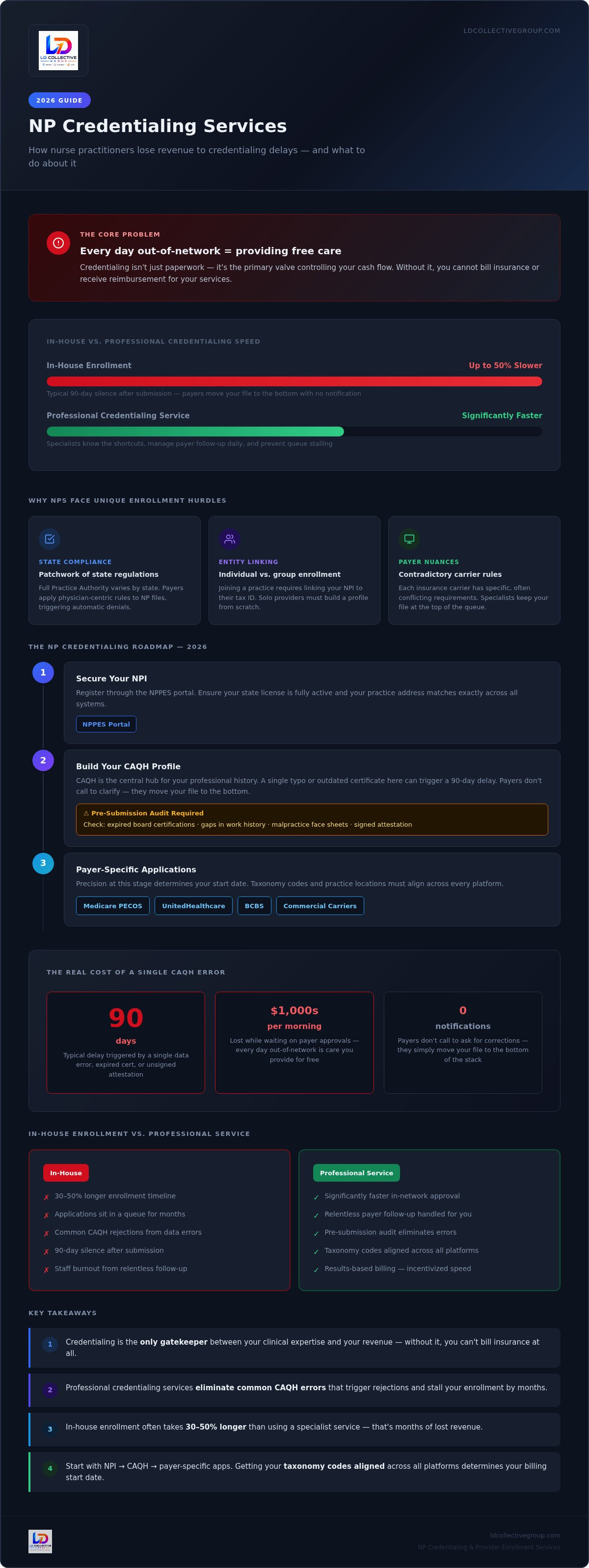
Your path to reimbursement begins with three non-negotiable steps. First, secure your National Provider Identifier (NPI) through the NPPES portal. Ensure your state license is fully active and matches your current practice address. Second, build your CAQH profile. This serves as the central hub for your professional history. Finally, move to payer-specific applications. Whether it's Medicare's PECOS system or commercial portals for UnitedHealthcare and BCBS, precision at this stage determines your start date. Professional credentialing services for nurse practitioners ensure that your taxonomy codes and practice locations align across every single platform.
CAQH Management and Document Audits
Your CAQH profile is the engine of your enrollment. A single typo or an outdated certificate can trigger a 90-day delay. Payers don't call to ask for clarification; they simply move your file to the bottom of the stack. We recommend a rigorous pre-submission audit to catch expired board certifications or gaps in work history before they become liabilities. This includes verifying that your malpractice face sheets are current and your attestation is signed. For a deeper look at the process, read our Provider Enrollment and Credentialing Services: The 2026 Strategic Guide.
Managing these technical registrations alone is a recipe for burnout. Experienced credentialing services for nurse practitioners eliminate the guesswork by handling the uploads and attestations on your behalf. If you want to move fast, consider our Provider Enrollment packages to keep your practice on schedule.
Protecting Your Revenue: The Cost of Credentialing Delays
Every day you spend out-of-network is a day you provide free care or turn patients away. It's a massive revenue leak that many practices simply accept as a cost of doing business. It shouldn't be. In-house credentialing often takes 30 to 50 percent longer than professional healthcare provider credentialing services. Choosing specialized credentialing services for nurse practitioners ensures that your applications don't sit in a queue for months. Specialists already know the shortcuts. Outsourcing these tasks allows you to focus on increasing patient volume while we navigate the payer bureaucracy for you.
How LD Collective Group Speeds Up Your Enrollment
We don't just fill out forms. We move fast. Our team handles the relentless follow-up with insurance representatives that typically stalls internal efforts. Because we operate on a per-engagement model, we're incentivized to get you in-network quickly. We don't bill you for hours of administrative stalling; we bill for results. This approach ensures your practice starts generating revenue as soon as possible. We treat your enrollment with the urgency it deserves. By managing the back-and-forth with payers, we prevent the typical 90-day silence that follows a submission.
Once you're finally on the panel, the work isn't over. You need to ensure your claims actually turn into cash. Utilizing integrated medical billing and credentialing ensures you get paid correctly from the first patient visit. Our credentialing services for nurse practitioners bridge the gap between getting credentialed and getting reimbursed. Don't let administrative friction hold your practice back. If you're ready to stop the revenue leak, check out our Provider Enrollment packages to find a solution that fits your scale. We get you paid faster.
Take Control of Your Practice Revenue
Credentialing is the primary valve controlling your practice's cash flow. By mastering your CAQH profile and avoiding common application errors, you eliminate the administrative friction that leads to revenue leaks. Professional oversight cuts through the bureaucracy that typically stalls in-house efforts. Choosing the right credentialing services for nurse practitioners is the fastest way to turn your clinical expertise into actual income. Our results-driven approach provides fast, reliable national enrollment with expert CAQH management. We handle the relentless follow-up so you can stay focused on patient volume.
You've done the hard work of becoming a provider. Now it's time to ensure you get paid for it. Don't let another day of out-of-network status drain your practice's potential.
Frequently Asked Questions
How long does insurance credentialing take for nurse practitioners in 2026?
Standard turnaround times range from 90 to 120 days. Commercial payers typically move faster than government entities. However, simple errors in your CAQH profile can easily push this window to six months. Professional credentialing services for nurse practitioners keep you on the shorter end of that timeline by submitting clean files the first time. We don't let applications sit idle in a reviewer's queue.
Can I see patients while my credentialing application is still pending?
Yes, but you usually can't bill for them as an in-network provider. Seeing patients while pending means you're either seeing them out-of-network or holding claims until your effective date. Some payers allow for retroactive billing, but it's a high-risk gamble. Most practices wait for the formal approval letter to avoid the risk of non-payment. Don't provide free care by mistake.
Do I need to be credentialed with every single insurance company?
No. You should prioritize the top five to seven payers that dominate your local market. Medicare and Medicaid are usually essential for most NP practices. Focus on the commercial giants that offer the best reimbursement rates for your specific specialty. Spreading yourself too thin across dozens of small payers often creates more administrative overhead than the revenue justifies. Strategy beats volume every time.
What is the difference between NP credentialing and provider enrollment?
Credentialing verifies your background. Enrollment gets you the actual contract and billing number. You cannot have the latter without the former. Professional credentialing services for nurse practitioners manage both phases to ensure you aren't just verified, but actually capable of collecting revenue. Credentialing is the background check; enrollment is the green light to bill. Verification is the start; enrollment is the finish.

Disclaimer
The information provided in this article is for general educational and informational purposes only and reflects the author’s professional experience, research, and interpretation of provider credentialing, payer enrollment, and healthcare operations practices.
Credentialing and enrollment requirements vary by payer, health plan, government program, provider type, state, contract, and organizational structure and are subject to change. Nothing in this article should be interpreted as legal, regulatory, compliance, tax, or other professional advice, nor as an official interpretation or guidance from CMS, a state Medicaid agency, Medicare Administrative Contractor (MAC), commercial payer, accrediting organization, or other regulatory entity.
Organizations and providers should independently verify current requirements with the applicable payer, government agency, regulatory authority, accreditation organization, contract, provider manual, or other authoritative source before making credentialing, enrollment, contracting, billing, or compliance decisions.
Any opinions expressed are those of the author and do not necessarily represent the views, policies, or positions of any current or former employer, client, payer, or affiliated organization.


