

Why would you spend years building a medical practice only to let a few sheets of paper keep you from getting paid? You've secured the office space and hired the staff, but new physician practice credentialing is the silent gatekeeper standing between you and your first check. It's a brutal reality when commercial payers take up to 150 days to process an application while your overhead keeps climbing. You aren't alone if you feel like the paperwork is winning.
We've seen how these delays happen, and they're usually fueled by bad advice. This article will stop the revenue leaks before you open your doors by debunking the most dangerous credentialing myths in healthcare today. We're breaking down the five common misconceptions that cause delayed reimbursements and keep your practice in the red. It's time to clear the path for clean claims and a predictable revenue cycle. Let's get your practice moving.
Key Takeaways
- Master new physician practice credentialing to ensure your office stays profitable from day one.
- Identify the hidden enrollment roadblocks like CAQH errors that stall your applications for months.
- Learn why it's a mistake to treat payer enrollment as a clerical task instead of a revenue strategy.
- Connect your billing with your credentialing process to build a faster, more predictable revenue cycle.
The Reality of New Physician Practice Credentialing
You can't treat patients and expect a paycheck just because you have a medical degree. Credentialing is the gatekeeper between your expertise and your bank account. For a new practice, this process involves a deep dive into your identity, education, and clinical history. Payers want proof of your competence before they let you into their network. New physician practice credentialing is the strategic alignment of provider qualifications with insurance network requirements. Understanding The Reality of New Physician Practice Credentialing means recognizing it as the foundation of your revenue cycle. Without it, you're essentially running a pro bono clinic.
Think of it as the first domino. If it doesn't fall, nothing else moves. You can't submit claims. You can't collect co-pays. You can't grow. It's a binary situation. You're either in-network and earning, or you're out and losing money every single day your doors are open. This isn't just about administrative compliance. It's about business survival.
Myth vs. Fact: Why "It Can Wait" is a Lie
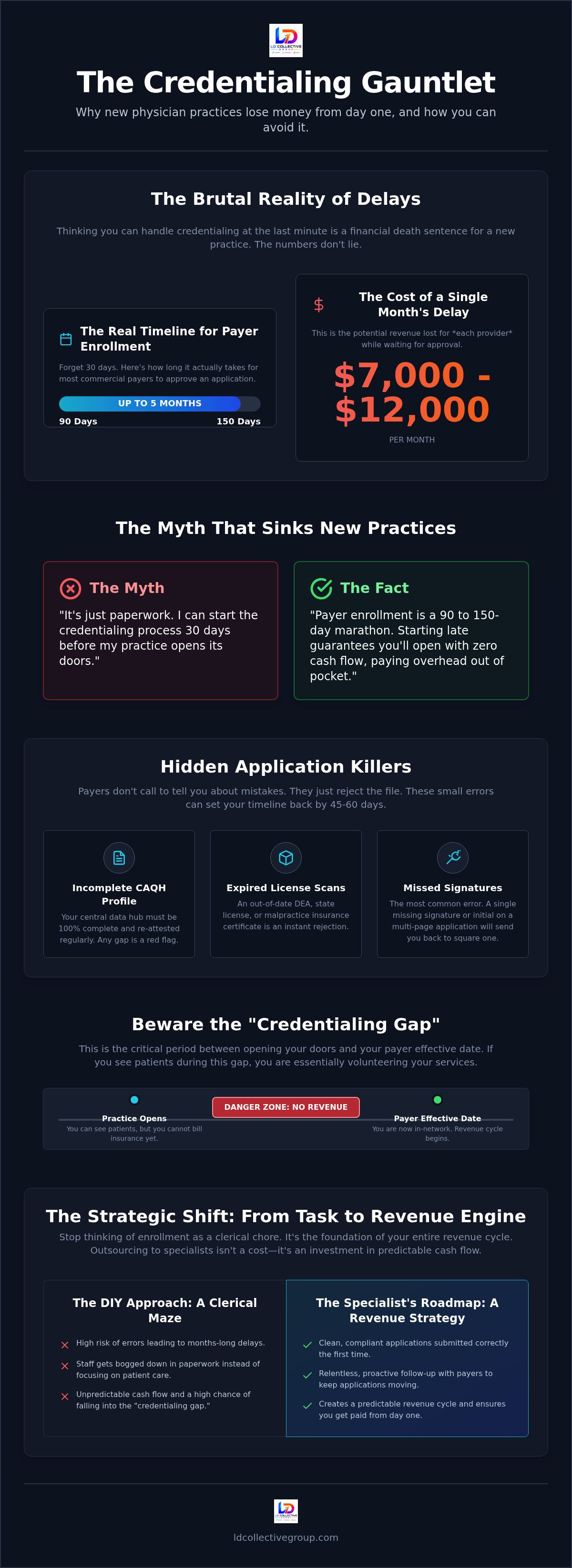
The most dangerous myth is that you can start this process 30 days before your launch. That's a financial death sentence. The fact is that new physician practice credentialing can take 90 to 120 days, and often up to 150 days for commercial payers. If you wait until the last minute, you're looking at months of zero cash flow while your overhead stays the same. Data from 2026 shows that practices can lose between $7,000 and $12,000 per provider every month during these delays. Delaying this step is the fastest way to ensure your practice opens with zero cash flow. You're effectively paying for the privilege of seeing patients.
Navigating the Payer Enrollment Maze Without the Headache
Payer enrollment isn't a task you finish and walk away from. It's a marathon of relentless follow-up. If you aren't calling payers every week to check status, your application is likely gathering dust at the bottom of a digital pile. Most delays in new physician practice credentialing happen because of small, avoidable errors that trigger an automatic rejection. An incomplete CAQH profile, an expired license scan, or a single missed signature page can set your timeline back by 45 to 60 days. You don't have that kind of time when your opening date is looming. Leveraging professional provider enrollment and credentialing services ensures your applications are clean, compliant, and moving through the system. Payers won't call you to fix a mistake; they'll just move on to the next file.
The Strategic Role of Physician Practice Specialists
Specialists win because they know the unwritten rules of each major payer. One insurance carrier might require a specific format for your 10-year work history, while another rejects any application missing a specific state-level attestation. Managing new physician practice credentialing through a dedicated specialist prevents the common errors that lead to payment delays. Physician practice specialists act as the essential bridge between your new office and the insurance giants. When you outsource this work to healthcare provider credentialing experts, you eliminate the constant re-work that destroys your revenue cycle. This approach removes the heavy administrative burden from your clinical staff, allowing them to focus on patient care rather than insurance paperwork. If you want to identify potential leaks in your process early, a professional practice assessment from LD Collective Group is the smartest first step you can take to protect your startup investment.
Accelerating Your Practice Launch and Revenue Cycle
Your clinical expertise doesn't pay the bills. In-network status does. The biggest mistake in new physician practice credentialing is assuming that submitting an application is the same as being ready to bill. It isn't. You must avoid the "credentialing gap" at all costs. This is that dangerous period where you're seeing patients but cannot yet submit clean claims. If you treat patients before your official effective date, you're essentially volunteering. That's a fast way to drain your startup capital before you've even started.
Operational efficiency requires total alignment between your back office and your payers. Leveraging integrated medical billing and credentialing ensures your data flows correctly from the first enrollment form to the final payment. In 2026, payers are more aggressive about cross-checking data across multiple systems. You need a proactive strategy. Follow a proven roadmap on how to become in-network with insurance to bypass bureaucratic stalling and secure your revenue stream from day one.
Moving from Credentialing to Consistent Cash Flow
Organization is your best defense against revenue leaks. Standardize your documentation early by keeping NPI, DEA, and board certifications in a single digital vault. It's not enough to know you're approved; you need to know exactly when that approval goes live. Monitor your effective dates with surgical precision to avoid providing services that won't be reimbursed. Before you sign a lease or commit to a launch date, contact LD Collective Group to audit your status and eliminate friction points before they become disasters. We've seen too many practices stall because they missed a single effective date window.
Secure Your Revenue Stream Today
Your clinical expertise is ready, but your bank account depends on how you handle the insurance giants. New physician practice credentialing is more than just a hurdle; it's the strategic engine that powers your cash flow. We've shown you why waiting is a financial risk and how professional oversight prevents common application rejections. By securing your in-network status before your doors open, you protect your investment and ensure your staff can focus on patients instead of paperwork. Don't let administrative friction dictate your success.
Take the guesswork out of your launch. Our national expertise and results-driven approach eliminate the bottlenecks that stall new practices. You've done the hard work of building your clinic; let us ensure you get paid for it from day one. Your success is within reach.
Frequently Asked Questions
How long does new physician practice credentialing actually take in 2026?
Expect the process to take between 60 and 120 days on average. Commercial insurance payers often require more time, frequently stretching the timeline to 150 days. Medicare credentialing usually settles between 60 and 90 days once your PECOS submission is verified. You should start the application process at least five months before your scheduled opening date to ensure you're ready to bill.
Can I see patients while my credentialing application is still pending?
You can see patients, but you can't bill their insurance for those visits. Most payers won't provide retroactive reimbursement for services rendered before your official effective date. Seeing patients during this "credentialing gap" essentially means you're providing free care. It's a risky financial move that often leads to a stack of denied claims and zero revenue for those clinical hours.
What is the difference between credentialing and provider enrollment?
Credentialing is the deep dive into your qualifications, education, and clinical history to verify you're fit to practice. Provider enrollment is the administrative process of getting a contract and a provider number so you can actually bill a specific payer. Both steps are essential components of new physician practice credentialing. One proves you're a competent doctor; the other makes you an authorized business partner.
Why do insurance companies reject credentialing applications most often?
Simple clerical errors and missing documentation cause the majority of rejections. Payers frequently stall applications due to incomplete CAQH profiles, expired license scans, or unexplained gaps in work history. In 2026, insurance companies are more aggressive about cross-checking data across multiple systems. A single missing signature or an inconsistent address can reset your entire timeline by 60 days or more.

Disclaimer
The information provided in this article is for general educational and informational purposes only and reflects the author’s professional experience, research, and interpretation of provider credentialing, payer enrollment, and healthcare operations practices.
Credentialing and enrollment requirements vary by payer, health plan, government program, provider type, state, contract, and organizational structure and are subject to change. Nothing in this article should be interpreted as legal, regulatory, compliance, tax, or other professional advice, nor as an official interpretation or guidance from CMS, a state Medicaid agency, Medicare Administrative Contractor (MAC), commercial payer, accrediting organization, or other regulatory entity.
Organizations and providers should independently verify current requirements with the applicable payer, government agency, regulatory authority, accreditation organization, contract, provider manual, or other authoritative source before making credentialing, enrollment, contracting, billing, or compliance decisions.
Any opinions expressed are those of the author and do not necessarily represent the views, policies, or positions of any current or former employer, client, payer, or affiliated organization.


