

Every month your credentialing sits in a queue, your practice loses between $7,000 and $12,000 in revenue per provider. It's a heavy price for administrative friction. You've likely felt the sting of confusing portals and the blurred lines between credentialing and enrollment. It's frustrating to watch patient volume grow while your claims are denied because of "enrollment pending" status. Payer portals shouldn't feel like black holes where applications go to die.
Mastering how to become in-network with insurance is a revenue strategy, not just a paperwork task. We've built a clear, no-nonsense roadmap to help you transition from out-of-network to fully credentialed without the typical delays. You'll learn how to navigate the 2026 payer landscape, streamline your internal process, and secure contracts faster. This guide covers the exact steps to eliminate revenue leaks and turn your enrollment into a repeatable, high-speed logistics project.
Key Takeaways
- Stop confusing credentialing with enrollment. One verifies your background, while the other is the contract that lets you bill.
- Master the specific steps of how to become in-network with insurance. A structured roadmap is the only way to avoid 90-day delays.
- Get your NPI numbers and CAQH profile right the first time. Inaccurate data is the fastest way to get your application rejected.
- Identify the hidden costs of DIY enrollment. Every day your status is "pending" is another day of lost revenue for your practice.
Understanding the Credentialing vs. Enrollment Divide
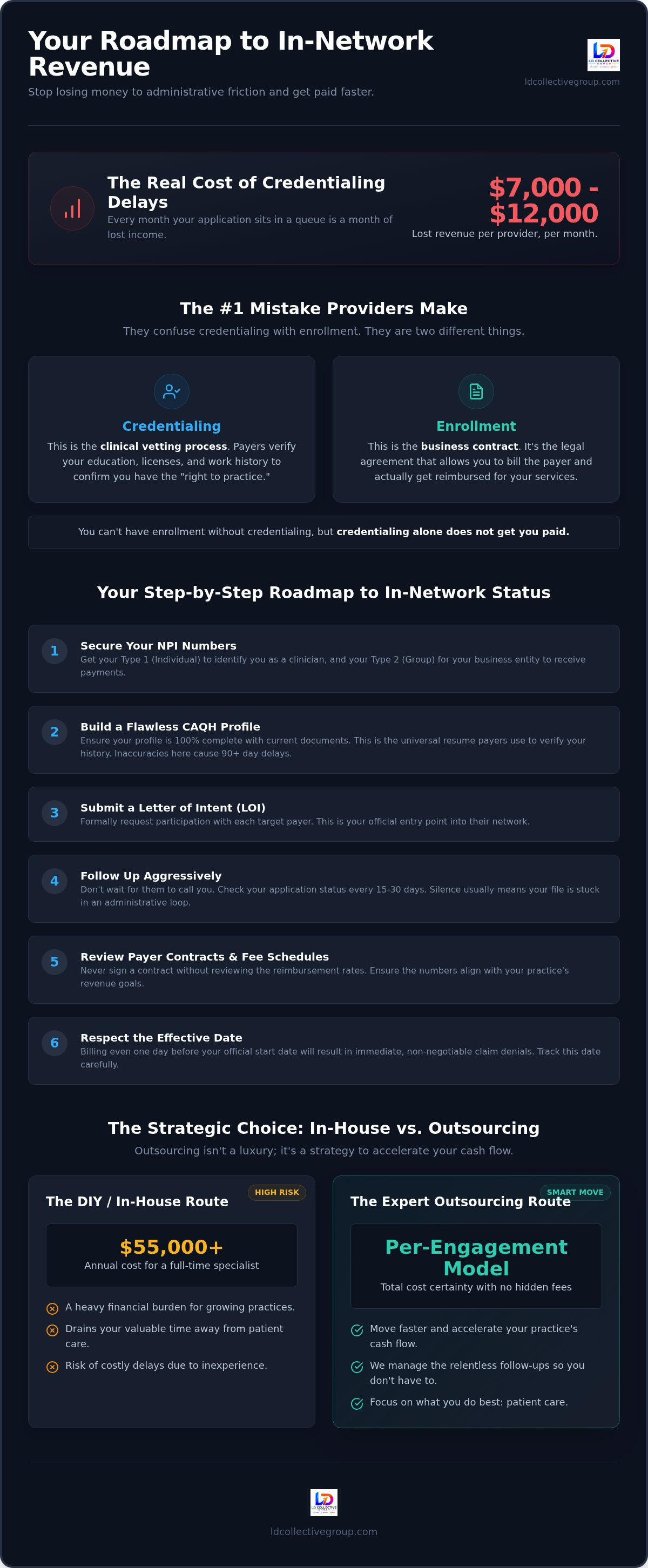
Many providers use the terms credentialing and enrollment interchangeably. They shouldn't. Confusing these two distinct phases is the primary reason applications stall. Credentialing is the clinical vetting process. It's the exhaustive verification of your education, licenses, and work history to prove you have the "right to practice." Enrollment is the business contract. It's the legal agreement that allows you to actually bill the payer and receive reimbursement for your services.
You cannot have enrollment without credentialing, but credentialing alone does not get you paid. Many practices celebrate when their clinical background is approved, only to realize months later they still can't submit a claim. This distinction is the bedrock of your revenue cycle; treating them as separate, sequential projects is the only way to ensure your cash flow remains predictable.
The Role of CAQH in Your Application
CAQH ProView acts as your universal resume in the healthcare world. Payers use this database to pull your primary source documents, making it a critical hub for how to become in-network with insurance. If your profile isn't current, your application hits a wall immediately. You must proactively designate specific payers in your CAQH profile to grant them access to your data. Without this manual step, payers can't see your credentials, and your file sits untouched. Common profile errors like expired malpractice insurance or mismatched practice addresses often stall the process for 90 days or more.
A Step-by-Step Roadmap to In-Network Status
Achieving in-network status requires a linear, aggressive approach. Most providers fail because they treat these steps as suggestions rather than hard requirements. First, secure your Type 1 (Individual) and Type 2 (Group) NPI numbers. The individual NPI identifies you as a clinician, while the group NPI is essential for your business entity to receive payments. Next, ensure your CAQH profile is 100% complete with current primary source documents. This is the data source payers will use to verify your identity and history before they even look at a contract.
The third step involves submitting a Letter of Intent (LOI) or Request for Participation to each target payer. This is your formal entry into the 2026 payer landscape. Once submitted, the real work begins: aggressive follow-up. You must check the status of your file every 15 to 30 days. Payer portals are notorious for losing files; silence usually means your application is stuck in an administrative loop. If managing this logistics project feels like a drain on your clinical time, consider a per-engagement provider enrollment service to keep the process moving while you focus on patients.
Navigating Payer Contracts and Fee Schedules
Understanding how to become in-network with insurance also means understanding the financial trade-off. By joining a network, you agree to the payer's set reimbursement rates. Never sign a contract without reviewing the fee schedule first. You must verify that the numbers align with your practice's overhead and revenue goals. Finally, respect the effective date. Billing even one day before your official start date results in immediate, non-negotiable claim denials. These are unrecoverable losses that can easily be avoided with a disciplined tracking system.
Eliminating the Roadblocks to Faster Revenue
The "Black Hole" effect is where applications stall without warning. Payers rarely call to report a missing document or a minor data mismatch. Instead, your file sits untouched while your revenue stagnates. This is the most difficult stage of learning how to become in-network with insurance. Every day of administrative silence represents a direct hit to your bottom line. While you wait for a response that might never come, your practice absorbs the cost of provider salaries without the ability to bill for their work.
Data integrity is your only defense against these delays. Accurate entry on the initial application prevents 90% of future claim denials caused by credentialing errors. If you're building a new clinic, our Opening a Medical Practice Checklist provides a high-level view of these requirements. Getting the details right on day one stops the cycle of rejections before it starts.
Why Outsourcing Your Enrollment Wins
Outsourcing isn't a luxury; it's a strategic move to accelerate cash flow. Hiring a full-time specialist costs upwards of $55,000 annually, which is a heavy burden for most growing practices. LD Collective Group offers a per-engagement model that provides total cost certainty. We move fast, managing the relentless follow-ups and payer communications so you don't have to. This approach simplifies how to become in-network with insurance while keeping your overhead lean. You focus on patient care; we focus on clearing the path to reimbursement.
Secure Your Revenue Stream
Mastering how to become in-network with insurance is the difference between a thriving practice and one bogged down by administrative debt. You've seen the roadmap: distinguishing credentialing from enrollment, maintaining a pristine CAQH profile, and executing relentless follow-ups. In the 2026 landscape, passive waiting is no longer an option. Every day spent in a payer's "black hole" is unrecoverable revenue that your practice can't afford to lose.
We offer a faster, more reliable alternative to the DIY struggle. LD Collective Group specializes in nationwide enrollment and expert payer communication to ensure your effective dates are secured without the typical 90-day delays. Our per-engagement model provides the cost certainty you need to scale without the overhead of in-house staff. We handle the friction so you can focus on patient care.
Stop managing paperwork and start managing your practice. We're ready to move when you are.
Frequently Asked Questions
How long does it typically take to become in-network with insurance?
The average timeline is 60 to 120 days per payer. Medicare electronic submissions are faster, often processing in 15 days, but commercial networks like Blue Cross Blue Shield can take up to 180 days. These windows are non-negotiable. If you want to know how to become in-network with insurance without losing months of income, you must submit applications at least four months before your launch.
Can I see patients while my insurance credentialing is still pending?
You can see patients, but you cannot bill them at in-network rates. Any claims submitted before your official effective date will be denied immediately. Some providers see patients on an out-of-network basis during this gap. Others wait for the contract to finalize, though retroactive billing is never guaranteed. It's a financial risk that requires a clear policy for your front office staff.
What is the difference between a Type 1 and Type 2 NPI number?
A Type 1 NPI identifies you as an individual healthcare provider. It's yours for life. A Type 2 NPI is for your organization or group practice. Most payers require both to process claims correctly. This structure ensures that while you provide the care, the business entity receives the reimbursement. Correct NPI usage is a foundational step in learning how to become in-network with insurance.
Do I need to re-credential if I move my practice to a new state?
Yes. Insurance contracts are generally state-specific and tied to your local medical license. Even with national payers, you must apply to the specific state network and update your CAQH profile with the new location. You'll also need to secure a new state license and malpractice coverage first. Moving states essentially restarts the enrollment clock, so plan for a standard 90 to 120-day wait.

Disclaimer
The information provided in this article is for general educational and informational purposes only and reflects the author’s professional experience, research, and interpretation of provider credentialing, payer enrollment, and healthcare operations practices.
Credentialing and enrollment requirements vary by payer, health plan, government program, provider type, state, contract, and organizational structure and are subject to change. Nothing in this article should be interpreted as legal, regulatory, compliance, tax, or other professional advice, nor as an official interpretation or guidance from CMS, a state Medicaid agency, Medicare Administrative Contractor (MAC), commercial payer, accrediting organization, or other regulatory entity.
Organizations and providers should independently verify current requirements with the applicable payer, government agency, regulatory authority, accreditation organization, contract, provider manual, or other authoritative source before making credentialing, enrollment, contracting, billing, or compliance decisions.
Any opinions expressed are those of the author and do not necessarily represent the views, policies, or positions of any current or former employer, client, payer, or affiliated organization.


