

Your new medical practice is just an expensive hobby until you're credentialed and enrolled with payers. It's a harsh reality. The paperwork often takes longer than the office build-out. You didn't go to medical school to become a full-time administrator, but those forms stand between you and your first reimbursement check. Finding a reliable opening a medical practice checklist is the difference between a successful launch and months of lost revenue. We understand the fear of compliance errors and the frustration of waiting on payers.
This guide is your no-nonsense roadmap to getting in-network fast. We'll show you how to bypass the typical delays that plague most new clinics. We'll cover how to streamline your enrollment, secure your credentials, and build a profitable, compliant practice from day one. It's time to stop the administrative bleeding and start seeing patients on your own terms.
Key Takeaways
- Secure your legal entity and EIN immediately. It's the foundation you need before you can even think about billing.
- Start payer enrollment at least four to six months out. Use our opening a medical practice checklist to avoid the typical revenue-killing delays.
- Prioritize your top 10 local insurance payers. Focus your energy where the volume is to ensure you're in-network on day one.
- Align your EHR and billing systems early. A clean revenue cycle captures every dollar from your first patient encounter.
Laying the Legal and Financial Groundwork
Before you see your first patient, you need a legal shell. Don't overthink it, but don't ignore it. Choosing between an LLC, PLLC, or S-Corp is your first move. This decision dictates your personal liability and tax efficiency. Consult a professional, pick your structure, and file the paperwork. You can't build a practice on a shaky foundation.
Once your entity exists, go to the IRS website and secure your Federal Tax ID (EIN). You cannot move forward without it. It's the primary identifier for your business bank account and payer enrollment. Speaking of accounts, open a dedicated business bank account immediately. Keep your personal and professional finances strictly separated. Mixing funds is a compliance nightmare you want to avoid. It also makes your practice assessment much cleaner later on.
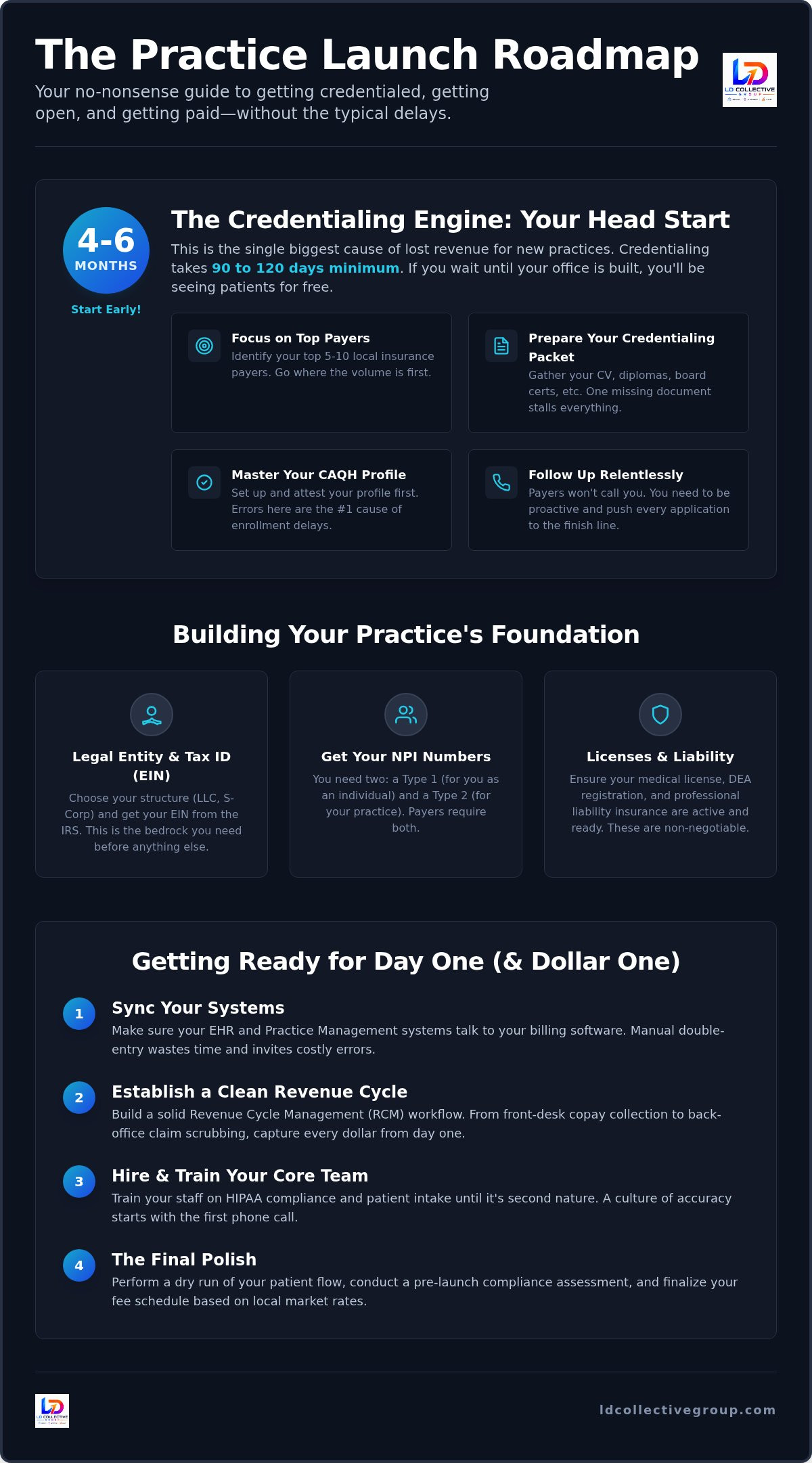
Your NPI numbers are the next vital step on any opening a medical practice checklist. You need two. A Type 1 NPI identifies you as an individual provider. A Type 2 NPI identifies your group or organization. Payers require both for the credentialing process to function correctly. Without these, your revenue cycle stalls before it even begins.
Core Identifications and Licensing
Verify your state medical license is active and updated with your new practice address. If you're moving across state lines, start this months in advance. Next, obtain your DEA registration and any state-specific controlled substance certificates. These are non-negotiable for most specialties. Finally, get professional liability insurance quotes ready to bind. Most payers won't finalize your enrollment without proof of active malpractice coverage. We recommend starting this as part of your opening a medical practice checklist to avoid last-minute delays.
The Credentialing and Payer Enrollment Engine
Most consultants list credentialing as step five or six. That is a mistake. Credentialing takes 90 to 120 days minimum. If you wait until your office is built, you'll be seeing patients for free. Start the enrollment process at least 4 to 6 months before your target opening date. This is the most critical item on your opening a medical practice checklist. Focus on your top 5 to 10 insurance payers based on your local market demographics. Don't waste time on niche payers initially. Go where the volume is.
Get your paperwork organized now. You need a "credentialing packet" ready to go. This includes your current CV, diplomas, board certifications, and peer references. Any missing document stalls the machine. If this sounds like a headache, LD Collective Group handles the enrollment paperwork so you don't have to. We eliminate the friction and keep your timeline on track.
Mastering the CAQH and Payer Strategy
Set up and attest your CAQH profile first. Errors here are the top cause of enrollment delays. One wrong date can trigger a rejection. Submit your applications for Medicare and Medicaid early. Government processing backlogs are real and they don't care about your launch date. Finally, maintain a no-nonsense follow-up schedule. Don't wait for them to call you. They won't. You need to push every application through the finish line. Using a solid opening a medical practice checklist ensures no payer falls through the cracks during the process.
Operational Readiness and Revenue Cycle Setup
Software isn't a strategy. You need an EHR and Practice Management system that actually talks to your billing software. If they don't sync, you're manually entering data twice. That's a waste of time and an invitation for errors. Establish a clean Revenue Cycle Management (RCM) workflow to capture every dollar from day one. You want your front desk collecting copays and your back office scrubbing claims immediately. This phase of your opening a medical practice checklist is where the money starts to feel real.
Hire your core team early. Train them on HIPAA compliance and patient intake procedures until it's second nature. A bad intake process kills your billing cycle before it starts. It's about building a culture of accuracy from the first phone call. To see how this fits into the bigger picture, read more about integrated medical billing and credentialing to maximize your launch revenue.
Practice Assessments and Final Audits
Perform a dry run of your patient flow. Walk through the front door as a patient. See where the friction points are. Schedule a professional practice assessment to find hidden compliance gaps before you open. It's better to find a hole in your process now than during an audit. Finally, finalize your fee schedule. Base it on local market rates and payer contract allowed amounts. Don't leave money on the table because you guessed at your prices. This final polish on your opening a medical practice checklist ensures a smooth, profitable opening day.
Build Your Practice on a Profitable Foundation
You've secured your legal entity and EIN. You've launched the credentialing engine four to six months early. You've synced your EHR with your billing workflow. These steps transform a vision into a viable business. Following this opening a medical practice checklist is the only way to avoid revenue-killing delays and ensure your clinic's long-term health. It's about more than just checking boxes; it's about protecting your future revenue and patient experience from day one.
You don't have to navigate the bureaucracy alone. LD Collective Group provides fast and reliable enrollment services, comprehensive practice assessments, and accurate medical billing solutions to ensure your launch is a success. Your expertise belongs in the exam room, not buried under payer forms. Get ready to open your doors with absolute confidence.
Frequently Asked Questions
How long does the medical practice credentialing process actually take?
Expect the process to take 90 to 120 days on average. Some commercial payers move faster, but government entities like Medicare often hit the upper limit of that window. This timeline is exactly why your opening a medical practice checklist should prioritize enrollment months before you sign a lease. If you wait, you're just delaying your first paycheck.
Can I see patients before my insurance credentialing is fully completed?
You can see patients, but you won't be able to bill their insurance until you're fully in-network. Any claims submitted before your official effective date will be denied immediately. You can operate as a cash-pay practice in the interim, but most providers find this unsustainable. It's better to align your launch with your payer effective dates to ensure steady revenue.
What is the difference between provider enrollment and medical credentialing?
Credentialing is the verification of your qualifications, including your education, training, and work history. Enrollment is the administrative process of contracting with a payer so you can submit claims and receive payment. You need both to function. Credentialing proves you're a safe, competent provider; enrollment gives you the legal right to get paid for your work.
Do I need a separate NPI for my new medical practice entity?
Yes, you definitely need a Type 2 NPI for your practice. Your personal NPI is a Type 1, which identifies you as an individual clinician. The Type 2 NPI identifies your group or business entity. Payers use both numbers to link your clinical work to your business's tax ID. Failing to secure both is a major error on any opening a medical practice checklist.

Disclaimer
The information provided in this article is for general educational and informational purposes only and reflects the author’s professional experience, research, and interpretation of provider credentialing, payer enrollment, and healthcare operations practices.
Credentialing and enrollment requirements vary by payer, health plan, government program, provider type, state, contract, and organizational structure and are subject to change. Nothing in this article should be interpreted as legal, regulatory, compliance, tax, or other professional advice, nor as an official interpretation or guidance from CMS, a state Medicaid agency, Medicare Administrative Contractor (MAC), commercial payer, accrediting organization, or other regulatory entity.
Organizations and providers should independently verify current requirements with the applicable payer, government agency, regulatory authority, accreditation organization, contract, provider manual, or other authoritative source before making credentialing, enrollment, contracting, billing, or compliance decisions.
Any opinions expressed are those of the author and do not necessarily represent the views, policies, or positions of any current or former employer, client, payer, or affiliated organization.


