

National claim denial rates are climbing past 10%, leaving many practices to treat lost revenue as an unavoidable cost of doing business. It isn't. If you're tired of waiting 50 days to see the money you've already earned, the problem isn't your patients. It's your back end revenue cycle management. You shouldn't have to guess why a claim stalled in adjudication or accept slow reimbursement as the status quo.
We know the frustration of watching clean claim rates dip while operating costs rise. You've done the work. You should be paid for it. This guide shows you how to master the final stages of the billing cycle to stop revenue leaks and secure every dollar. We're breaking down the 2026 strategies you need to slash days in A/R and build a denial management workflow that actually delivers results.
Key Takeaways
- Understand that back end revenue cycle management covers every critical step from the moment a patient leaves to the second the final payment is posted.
- Stop the cycle of endless resubmissions by identifying the specific root causes of claim denials to fix your cash flow at the source.
- Eliminate technical errors in your claims submission workflow to speed up the adjudication process and significantly reduce your days in A/R.
- Learn why a professional practice assessment is the fastest way to find revenue leaks and stop guessing about your practice's financial health.
What is Back End Revenue Cycle Management? The Engine of Your Practice
Back end revenue cycle management is where the real work begins. It covers every action that takes place after the patient leaves your office. Think of it as the recovery phase. This is the stage where you turn clinical effort into actual cash. If the front end is about gathering data, the back end is about securing results. Accuracy here isn't just a preference. It's the only way to maintain a healthy cash flow.
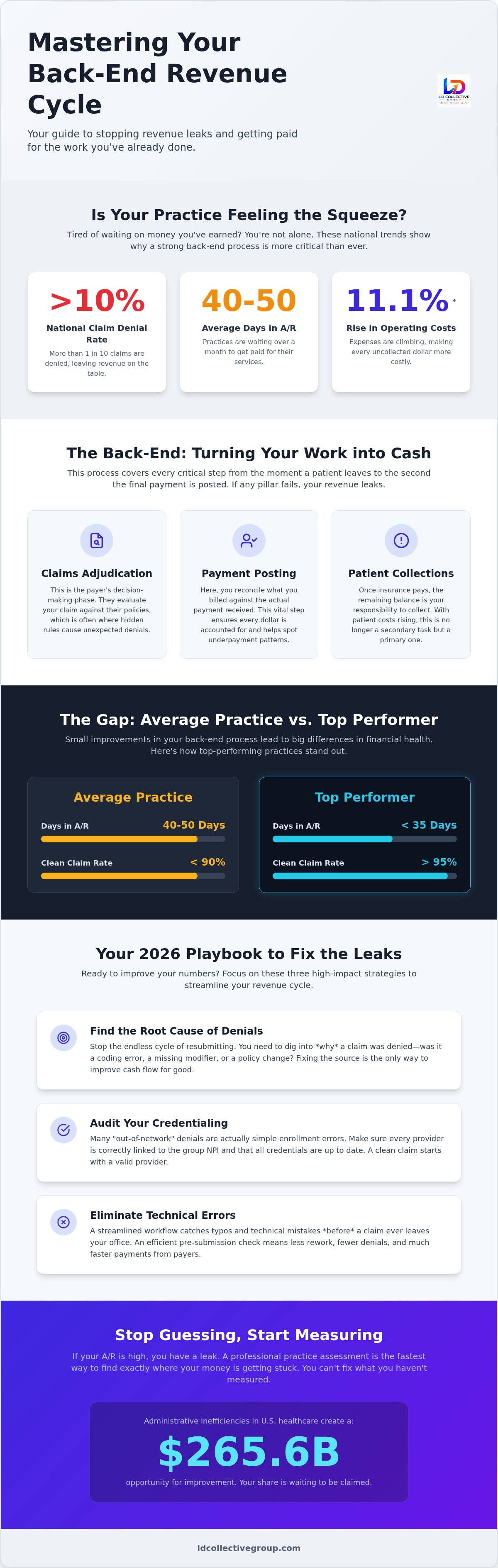
The process includes everything from claims submission and adjudication to final payment posting. It's a high-stakes environment. According to industry benchmarks, the average days in A/R sit between 40 and 50 days. Top-performing practices push that number below 35. Achieving that requires a relentless focus on the details that payers use to delay your checks.
The Core Components of the Back-End Process
The back end consists of three critical pillars. If any of these fail, your revenue leaks.
- Claims Adjudication: This is the payer's decision-making phase. They evaluate your claim against their policies to determine exactly what they owe. It's often where hidden rules cause unexpected denials.
- Payment Posting: You must reconcile what you billed against the actual payment received. This step ensures every dollar is accounted for and helps identify patterns in underpayment.
- Patient Collections: Once insurance pays, the remaining balance is your responsibility to collect. With patient financial responsibility increasing, this is no longer a secondary task.
Success in these areas requires more than just software. It requires a proven billing strategy that anticipates payer behavior. Effective back end revenue cycle management moves fast to resolve friction points before they become permanent losses.
Optimizing the Back End: How to Fix Denials and Speed Up Payments
Stop resubmitting claims blindly. It's a waste of time. To master back end revenue cycle management, you must identify the root cause of every denial. Is it a coding error, or did the payer change their policy? A structured denial management plan lets you recover lost revenue fast. You can find specific tactics in our guide on how to reduce claim denials medical billing.
Efficiency matters. National denial rates are climbing above 10%, which means your team is working twice as hard for the same dollar. Streamline your workflow to catch technical errors before they leave the building. If you don't have a clear process, your cash stays in the payer's pocket. High-performing practices aim for a clean claim rate above 95%, and you should too.
The Credentialing Connection: Why You Aren’t Getting Paid
Many "out-of-network" denials are actually enrollment errors. If your provider isn't correctly linked to the group NPI, the back end fails immediately. Expired credentials will halt your back end revenue cycle management instantly. You can't bill for a provider who doesn't exist in the payer's eyes. This is a common friction point that generalist billers often miss.
Credentialing is the foundation of every clean claim. If this step is broken, your billing team is fighting a losing battle. Explore our healthcare provider credentialing guide to fix the root of the problem. If you're seeing a spike in denials you can't explain, our medical billing services are designed to pinpoint these friction points and clear the path for payment.
Stopping the Leak: When to Audit Your Revenue Cycle
Stop guessing why your A/R is high. If your collection cycle is dragging, you have a leak. A professional practice assessment identifies exactly where your money is getting stuck. You can't fix what you haven't measured. In 2025, operating costs for medical practices rose by 11.1% year over year. You can't afford to let cash sit in limbo while your expenses climb.
Operational efficiency is the only way to scale. You shouldn't need to add more billing staff just because your patient volume grew. If your back end revenue cycle management is structured correctly, it absorbs growth without increasing your overhead. Most practices don't need more people; they need better data. Transitioning to an integrated medical billing and credentialing strategy ensures every claim has a clear path to payment from the start.
Why Practice Assessments Are the First Step to Recovery
Audits reveal compliance gaps before they become financial liabilities. A fresh set of expert eyes finds the errors your internal team misses because they're too close to the daily process. We don't just look at the numbers. We look at the friction. The Healthcare Financial Management Association reports that administrative inefficiencies create a $265.6 billion opportunity for savings. We help you claim your share of that.
Move from reactive billing to proactive revenue management. Instead of chasing old claims, you should be preventing them. A comprehensive audit turns your back end revenue cycle management into a predictable engine. It's about control. When you know where the leaks are, you can plug them and keep your cash flow steady.
Take Control of Your Revenue Today
Mastering back end revenue cycle management isn't about working harder; it's about working smarter. You've seen that resubmitting claims without addressing root causes is a losing game. By aligning your credentialing with your billing and using data-driven audits to find hidden leaks, you stop the guesswork and start securing your cash flow. You've done the clinical work. Now, it's time to ensure you're paid for it.
LD Collective Group offers fast, reliable enrollment and accurate medical billing audits for practices nationwide. We move quickly to eliminate the friction that causes revenue loss so you can focus on patient care. Our specialized team knows exactly where the money gets stuck and how to get it moving again.
Your practice deserves a streamlined workflow that rewards your expertise. Let's build a more profitable 2026 together.
Frequently Asked Questions
What is the difference between front-end and back-end RCM?
Front-end RCM handles the data entry and eligibility checks before a provider sees the patient. Back end revenue cycle management covers the aftermath, including claims submission, payment posting, and denial management. Think of the front end as the intake and the back end as the collection. Both must be accurate, but the back end is where your practice's financial health is ultimately decided.
How does back-end RCM impact patient satisfaction?
Efficient back end revenue cycle management prevents the billing errors that frustrate patients and damage your reputation. When claims are processed accurately, patients receive timely, itemized statements that match their expectations. With high-deductible health plans on the rise, patients are more sensitive to costs. Providing clear billing communication ensures a professional experience that keeps your patients coming back and your reviews positive.
What are the most common reasons for back-end claim denials?
Claim denials often happen because of technical errors, coding inaccuracies, or expired provider credentials. Industry reports show that over 60% of denials start with front-end failures like missing authorizations or incorrect patient data. On the back end, failing to meet specific payer deadlines or ignoring the root cause of a previous denial will stall your cash flow. Proactive denial management solves these issues before they repeat.
Should I outsource my back-end revenue cycle management?
You should consider outsourcing if your internal team is struggling to keep days in A/R below 40. Managing back end revenue cycle management requires specialized knowledge of payer rules that change constantly. Outsourcing to a specialist often reduces the cost to collect to the industry benchmark of 3 to 5%. It allows your staff to focus on patients while experts handle the complex adjudication and follow-up.

Disclaimer
The information provided in this article is for general educational and informational purposes only and reflects the author’s professional experience, research, and interpretation of provider credentialing, payer enrollment, and healthcare operations practices.
Credentialing and enrollment requirements vary by payer, health plan, government program, provider type, state, contract, and organizational structure and are subject to change. Nothing in this article should be interpreted as legal, regulatory, compliance, tax, or other professional advice, nor as an official interpretation or guidance from CMS, a state Medicaid agency, Medicare Administrative Contractor (MAC), commercial payer, accrediting organization, or other regulatory entity.
Organizations and providers should independently verify current requirements with the applicable payer, government agency, regulatory authority, accreditation organization, contract, provider manual, or other authoritative source before making credentialing, enrollment, contracting, billing, or compliance decisions.
Any opinions expressed are those of the author and do not necessarily represent the views, policies, or positions of any current or former employer, client, payer, or affiliated organization.


