

Every time a billing staffer quits, your practice loses up to $50,000 in revenue slippage. With turnover rates hitting 40 percent, many providers are looking to outsource medical billing to stop the bleeding. You're likely tired of the endless cycle of hiring and training, only to see your overhead climb while denied claims pile up. It's a frustrating, expensive treadmill that stalls your growth.
This guide breaks down the 2026 landscape so you can stop guessing and start collecting. We'll compare the true cost of in-house teams against outsourced performance, looking specifically at the 2026 CMS updates, and reveal the transition pitfalls that most providers miss. It's time to trade staff headaches for faster reimbursement cycles and compliant reporting. Here's how to make the right move for your practice revenue.
Key Takeaways
- Compare the hidden costs of in-house staffing against the efficiency of a per-engagement model. Stop paying for benefits and training for employees who might leave tomorrow.
- Learn how to outsource medical billing without interrupting your revenue cycle. High clean claim rates start with the right transition plan.
- See why billing fails when you ignore credentialing. We show you how to align provider enrollment with your billing strategy to stop automatic denials.
- Get a clear roadmap for moving your data and managing "run-out" claims. You can switch providers without losing track of your old accounts receivable.
In-House Staffing vs. Outsource Medical Billing: A 2026 Comparison
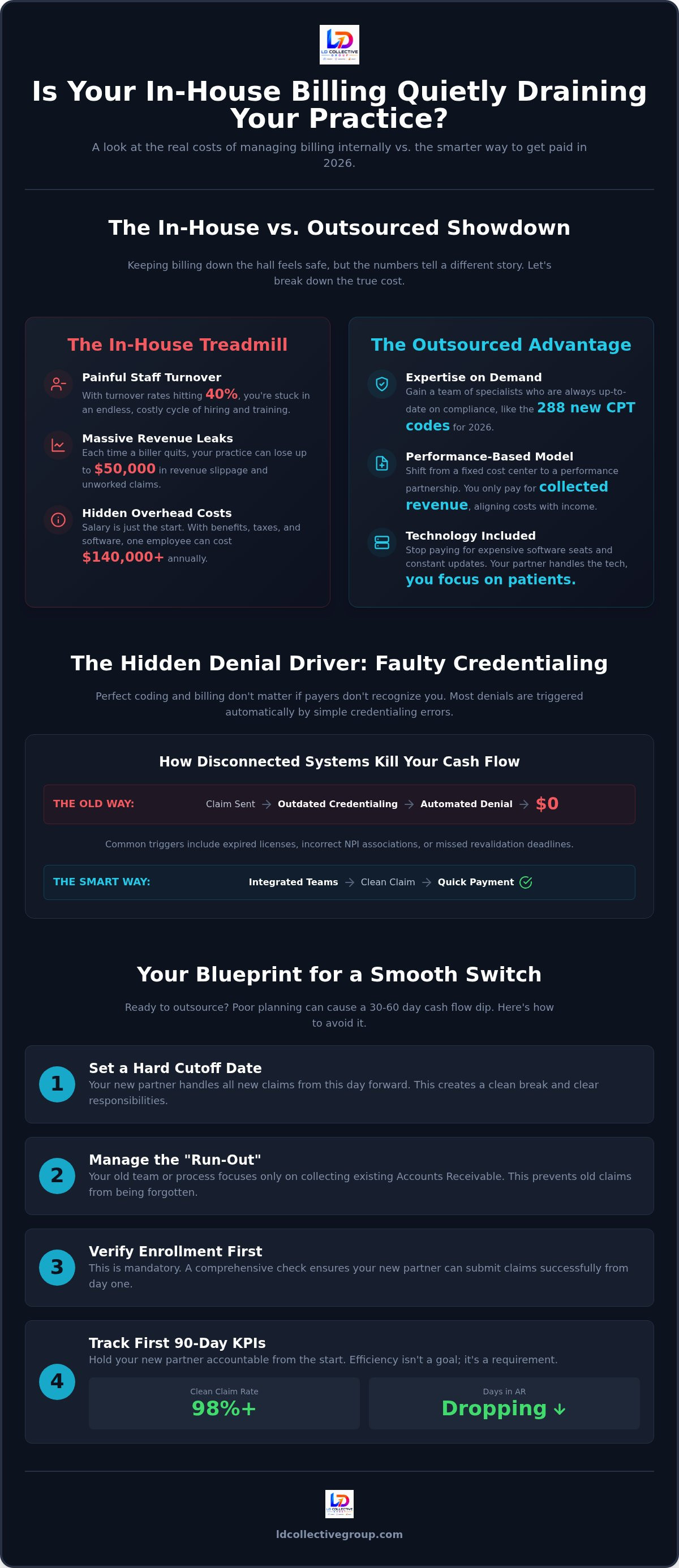
Keeping billing in-house feels safe until you look at the numbers. Many providers think they have more control when the biller is just down the hall. They're wrong. Modern reporting provides more transparency than a desk you can see from your office. When you outsource medical billing, you trade fixed salaries for results. You stop paying for idle time and start paying for collected revenue. It's a shift from a cost center to a performance model. Whether you choose per-engagement fees or a percentage of collections, your costs finally align with your actual income.
Staff turnover is a massive revenue leak. Research shows each resignation can lead to $35,000 to $50,000 in accounts receivable slippage. In-house billing costs can reach $140,000 per employee annually when you factor in salary and software. Then comes the cost of training a replacement on the complex Medical billing process and the 288 new CPT codes for 2026. Outsourcing shifts the technology burden too. You no longer pay for expensive software seats or constant system updates. Your partner handles the tools. You focus on the patients.
The Real Cost of Managing Billing Internally
Salaries are just the beginning. You must factor in payroll taxes, health insurance, and 401(k) matches. Then look at the claims sitting unworked because your biller is busy with the front desk or out sick. These unworked claims are the silent killers of your cash flow. Effective billing cost is the sum of direct labor, employee benefits, and the lost revenue of every dollar that remains uncollected due to human error or lack of time. A practice assessment is the first step to seeing if your current in-house model is actually sustainable.
The Integrated Strategy: Why Billing Fails Without Proper Credentialing
Perfect coding doesn't matter if the payer doesn't know who you are. Most providers think a denial is always a coding error. Often, it's a credentialing failure. Even if you outsource medical billing to the best coders, you'll still see zeros if your enrollment isn't current. Payers use outdated credentialing as an immediate excuse to stop payment. Common errors like expired licenses, incorrect NPI associations, or missed revalidation deadlines trigger automated denials before a human ever looks at your claim.
Integrated services are the only way to protect your revenue. You need a system where the billers talk to the credentialing specialists every day. This alignment ensures that every claim sent is backed by an active, compliant provider contract. Experts suggest that professional vendors can boost private practice efficiency by handling these administrative hurdles. A Practice Assessment is the best way to uncover these hidden leaks before they drain your bank account.
Bridging the Gap Between Enrollment and Revenue
Success requires synchronizing your CAQH profile with your billing cycle. Don't wait for a denial to check your status. Proactive practice audits identify compliance gaps months before they become financial disasters. When billing and enrollment work together, your clean claim rate stays high and your stress stays low. Read more about this approach in our guide on Integrated Medical Billing and Credentialing: The 2026 Revenue Strategy. If you want to see exactly where your practice stands, start with a comprehensive Practice Assessment today.
How to Outsource Medical Billing Without Losing Cash
Don't let a transition tank your revenue. Poor planning often causes a 30 to 60 day cash flow dip that catches providers off guard. To avoid this, you need a hard cutoff date for new claims. While your new partner starts fresh, your old team (or you) should manage the "run-out" of existing accounts receivable. This prevents old claims from falling through the cracks during the handoff. Before you move a single byte of data, a comprehensive Provider Enrollment check is mandatory. If your enrollment isn't verified, your new partner will be fighting a losing battle from day one.
Set firm KPIs for the first 90 days to hold your partner accountable. Demand a clean claim rate of 98 percent or higher. Track your "Days in AR" to ensure they're dropping, not climbing. When you outsource medical billing, you aren't just offloading work; you're hiring for performance. If they can't meet these benchmarks within the first quarter, you've chosen the wrong partner. Efficiency isn't a goal; it's a requirement.
Evaluating Your Potential Billing Partner
Ask direct questions about HIPAA compliance and data security. A reliable partner should follow the OIG Compliance Program Guidance to the letter. Look for per-engagement or transparent fee structures. These models often beat percentage-only contracts because they keep costs predictable and incentives aligned. For more on staying compliant while maximizing income, check out our Healthcare Provider Credentialing: The 2026 Guide to Compliance and Revenue.
Maximize Your Revenue and Minimize Administrative Friction
Choosing to outsource medical billing isn't just about cutting overhead costs; it's about building a resilient revenue cycle for the long term. You've seen how high in-house turnover drains your cash flow and why perfect coding fails without current enrollment. Success in 2026 requires an integrated strategy that connects credentialing directly to your billing desk. By focusing on performance-based KPIs and a clean migration plan, you can finally eliminate the headaches that stall your practice growth. We offer accurate, timely, and compliant billing services with a national reach and a no-nonsense results focus. It's time to stop chasing payers and start collecting what you've earned.
Take the first step toward a streamlined revenue cycle today. Your practice deserves a billing partner that moves as fast as you do.
Frequently Asked Questions
Is it cheaper to outsource medical billing or keep it in-house?
Outsourcing is typically more cost-effective because it converts fixed labor expenses into variable performance-based costs. You stop paying for employee benefits, payroll taxes, and the high cost of billing staff turnover. By choosing to outsource medical billing, you only pay for results. This model ensures your overhead shrinks when patient volume drops, protecting your profit margins during slower months.
What is the average cost to outsource medical billing in 2026?
Average costs vary based on specialty complexity and monthly volume. Most vendors use either a percentage-of-collections model or a flat-fee-per-claim structure. Complex specialties often require different rate structures than primary care. You should look for transparent, per-engagement pricing that aligns with your specific goals. Avoid generic industry quotes that don't account for your unique practice needs and volume requirements.
Will I lose control over my practice data if I outsource?
You actually gain more control through enhanced transparency and real-time reporting. Modern billing partners use cloud-based systems that let you view your practice data, claim status, and financial KPIs 24/7. You aren't relying on a single employee's manual spreadsheets anymore. This digital shift ensures your data is secure, compliant, and accessible from any device, providing better oversight than an in-house desk.
How long does it take to transition to an outsourced billing company?
A standard migration to outsource medical billing takes 30 to 60 days to complete without interrupting your cash flow. This timeline includes data migration, software integration, and a vital check of your current provider enrollment status. Starting with a practice assessment ensures all credentialing hurdles are cleared before the handoff. A structured approach prevents the common revenue dips that happen during a transition.

Disclaimer
The information provided in this article is for general educational and informational purposes only and reflects the author’s professional experience, research, and interpretation of provider credentialing, payer enrollment, and healthcare operations practices.
Credentialing and enrollment requirements vary by payer, health plan, government program, provider type, state, contract, and organizational structure and are subject to change. Nothing in this article should be interpreted as legal, regulatory, compliance, tax, or other professional advice, nor as an official interpretation or guidance from CMS, a state Medicaid agency, Medicare Administrative Contractor (MAC), commercial payer, accrediting organization, or other regulatory entity.
Organizations and providers should independently verify current requirements with the applicable payer, government agency, regulatory authority, accreditation organization, contract, provider manual, or other authoritative source before making credentialing, enrollment, contracting, billing, or compliance decisions.
Any opinions expressed are those of the author and do not necessarily represent the views, policies, or positions of any current or former employer, client, payer, or affiliated organization.


