

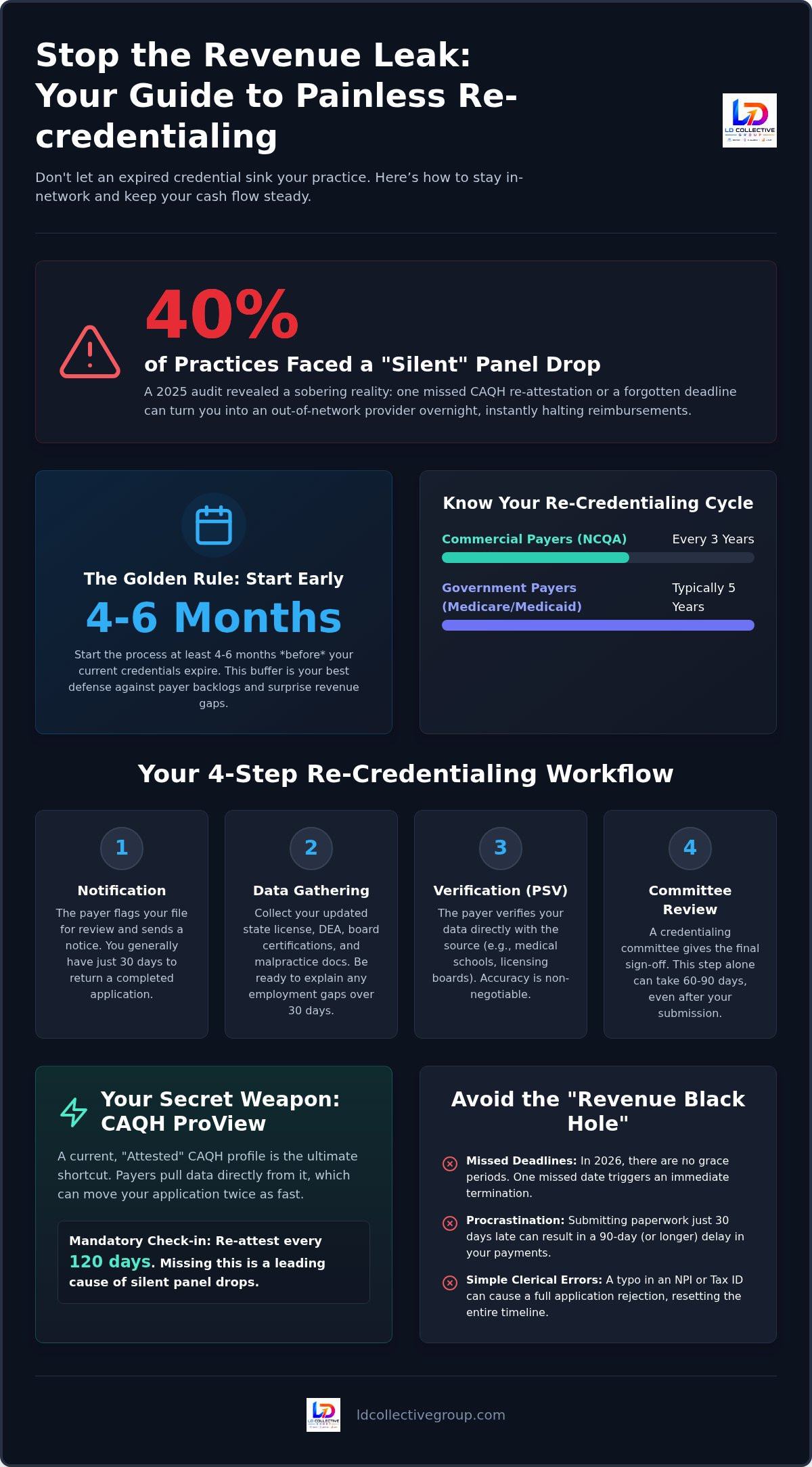
Did you know that a 2025 audit found 40% of practices had experienced at least one "silent" panel drop? It's a sobering reality. One missed CAQH re-attestation can turn an in-network provider into an out-of-network stranger overnight. Mastering the re-credentialing process with insurance companies isn't just paperwork; it's a financial survival skill. You're likely exhausted by manual data entry and the constant fear that a claim will bounce because of an expired credential. It's frustrating when unpredictable payer timelines dictate your office cash flow.
We're here to stop the revenue leak. This guide simplifies the cycle so you can maintain steady reimbursements without the guesswork. We'll walk through the 2026 requirements, the critical role of CAQH, and a step-by-step workflow to keep your practice compliant. Let's get your credentials back on track.
Key Takeaways
- Understand that payers view re-credentialing as a periodic audit of your network standards. Stay ahead of the cycle so you don't lose your in-network status without warning.
- Start the re-credentialing process with insurance companies at least 4-6 months before your current credentials expire. This buffer accounts for payer backlogs and prevents the revenue black hole caused by terminated contracts.
- Keep your CAQH profile updated and have your licensure, DEA, and malpractice insurance documents ready for submission. Accurate data gathering's the only way to avoid the weeks of delays caused by simple clerical errors.
- Treat this cycle as a high-stakes audit of your practice’s financial health. A proactive workflow ensures you'll never face a day of denied claims due to expired credentials.
Understanding the Re-credentialing Cycle: Why Payers Audit You
Re-credentialing isn't a suggestion. It's a mandate. The re-credentialing process with insurance companies involves a full-scale re-verification of your qualifications every few years. They aren't just checking boxes. They're auditing your practice to ensure you still meet their rigid network standards. Think of it as a quality control measure for their provider panels. If you don't prove your compliance, you don't stay in the network. Period.
Missing a deadline carries heavy consequences. There is no grace period in 2026. A single missed date doesn't just result in a warning; it triggers an immediate shift to out-of-network status. This "silent" termination stops your reimbursements instantly. To understand the foundational requirements you must maintain between cycles, refer to our Healthcare Provider Credentialing Pillar. Keeping these standards sharp is the only way to survive the audit.
The re-credentialing process with insurance companies is designed to be rigorous. Payers examine your state license, DEA certificate, and malpractice history with fresh eyes. They want to see a clean record. Any discrepancy, like an unexplained 30-day employment gap, now triggers additional scrutiny. Mastering this cycle ensures your revenue stays protected while you focus on patient care.
The 2-to-3 Year Rule and NCQA Standards
Most commercial payers align with NCQA guidelines. These standards require re-verification at least every 36 months to maintain accreditation. While commercial plans stick to this three-year window, government payers operate differently. Medicare and Medicaid cycles often extend to five years, though this varies by provider specialty and state regulations. The NCQA serves as the national authority, setting the 2026 benchmarks that ensure every provider in a network remains qualified, compliant, and safe for patients.
The Step-by-Step Re-credentialing Process with Insurance Companies
Speed is your only defense against a revenue lapse. The re-credentialing process with insurance companies officially starts when the payer sends a notification, typically 4 to 6 months before your expiration date. If you haven't seen a notice by the 120-day mark, call the provider relations department immediately. Waiting for them to find you is a gamble you'll likely lose.
- Step 1: Notification. Payers flag your file for review. They expect a completed application and updated documents within 30 days of this notice.
- Step 2: Data Gathering. Collect your updated state license, DEA certificate, and board certifications. As of 2026, payers require written explanations for any employment gap longer than 30 days.
- Step 3: Primary Source Verification (PSV). The payer verifies your data directly with the source. They contact medical schools and licensing boards to confirm your history rather than using aggregator databases.
- Step 4: Committee Review. A credentialing committee gives the final sign-off based on the PSV report. This process can take 60 to 90 days after submission.
A proactive Practice Assessment can help you identify missing documents before the payer asks for them. Preparation prevents the panic of a sudden termination notice.
The CAQH ProView Shortcut
Modern payers pull data directly from CAQH ProView. If your profile is "Attested" and current, the entire cycle moves twice as fast. A common mistake is forgetting to upload the newest malpractice face sheet or a renewed state license. If CAQH is out of sync, your re-credentialing stops. Follow our CAQH Credentialing Help Guide to ensure your portal is optimized. Attesting every 120 days is mandatory; missing this window can lead to a "silent" panel drop where claims are denied without warning.
Avoiding Revenue Gaps: Common Re-credentialing Pitfalls
The "Revenue Black Hole" is where profitable practices go to die. It starts when you miss a single deadline in the re-credentialing process with insurance companies. Your contract gets terminated. Suddenly, every claim you submit for that payer is rejected. You aren't just late; you're out. Recovering from a termination can take months of back and forth negotiations to get back into the network. It's a self-inflicted wound that's entirely preventable.
Procrastination carries a heavy price tag. Payer backlogs are at an all time high in 2026. If you submit your paperwork just 30 days late, expect at least a 90 day delay in your payments. Payers don't rush because you're in a cash flow crunch. They move at their own pace. Even small errors, like a typo in an NPI or Tax ID, can trigger a full application rejection. This resets your timeline to zero. Check your current status with our Speed Up Credentialing Checklist to see where you're vulnerable.
Outsourcing vs. In-House Efficiency
In-house staff often treat the re-credentialing process with insurance companies as a side task. They're busy with patient intake and daily billing. Notifications get buried in overstuffed inboxes. A dedicated engagement ensures a specialist is tracking every payer deadline and following up relentlessly. LD Collective Group moves fast because we know the friction points before they happen. We don't wait for the payer to call us. Contact us to secure your revenue and eliminate the guesswork from your maintenance cycle.
Secure Your Practice’s Financial Future
The 2026 cycle is unforgiving. A single missed deadline in the re-credentialing process with insurance companies triggers an immediate shift to out-of-network status, stopping your cash flow instantly. Keeping your CAQH ProView profile attested every 120 days is the only way to avoid silent panel drops. This cycle is a high-stakes audit of your practice’s health, not a routine chore. Gathering data early and verifying your status four months out protects your reimbursements from the "revenue black hole."
LD Collective Group provides fast, reliable support with national expertise to ensure your results are always accurate and compliant. Our per-engagement model pays for itself by preventing costly claim denials.
Don't let paperwork derail your success. Secure your maintenance cycle today and keep your practice thriving.
Frequently Asked Questions
How often do I need to go through the re-credentialing process?
Most commercial payers require you to complete this cycle every two to three years. They follow NCQA standards, which mandate re-verification at least every 36 months. As of 2026, CMS has also reduced the revalidation cycle to three years for specific provider specialties. Don't wait for a notice. Mark your calendar based on your initial approval date to stay ahead.
What happens if I miss my insurance re-credentialing deadline?
Missing your deadline results in immediate contract termination. Payers don't offer grace periods; they simply designate you as out-of-network. This triggers a "silent" panel drop where your claims are denied without prior warning. You'll then have to navigate a full re-enrollment process, which can take 90 to 180 days, leaving a massive gap in your practice's reimbursement.
Is re-credentialing the same as initial provider enrollment?
No, but it's just as rigorous. Initial enrollment gets you into the network, while the re-credentialing process with insurance companies keeps you there. Think of it as a mandatory audit of your current standing. While the paperwork feels familiar, payers now use stricter primary source verification, contacting medical schools and boards directly to ensure your credentials haven't lapsed or changed.
Which documents are required for the re-credentialing process?
You'll need your current state license, DEA certificate, and malpractice insurance face sheet. Payers also require updated board certifications and a comprehensive work history. In 2026, be prepared to provide written explanations for any employment gaps exceeding 30 days. Having these digital files ready in your CAQH profile is the only way to prevent unnecessary and costly processing delays.
Can an insurance company deny my re-credentialing application?
Yes, and they do. Denials often stem from lapsed licenses, undisclosed sanctions, or a significant history of malpractice claims. Even simple data discrepancies, like a mismatched tax ID, can lead to a rejection. Insurance companies use this process to trim their panels of high-risk or non-compliant providers. Accuracy during the re-credentialing process with insurance companies is your only safeguard.

Disclaimer
The information provided in this article is for general educational and informational purposes only and reflects the author’s professional experience, research, and interpretation of provider credentialing, payer enrollment, and healthcare operations practices.
Credentialing and enrollment requirements vary by payer, health plan, government program, provider type, state, contract, and organizational structure and are subject to change. Nothing in this article should be interpreted as legal, regulatory, compliance, tax, or other professional advice, nor as an official interpretation or guidance from CMS, a state Medicaid agency, Medicare Administrative Contractor (MAC), commercial payer, accrediting organization, or other regulatory entity.
Organizations and providers should independently verify current requirements with the applicable payer, government agency, regulatory authority, accreditation organization, contract, provider manual, or other authoritative source before making credentialing, enrollment, contracting, billing, or compliance decisions.
Any opinions expressed are those of the author and do not necessarily represent the views, policies, or positions of any current or former employer, client, payer, or affiliated organization.


