

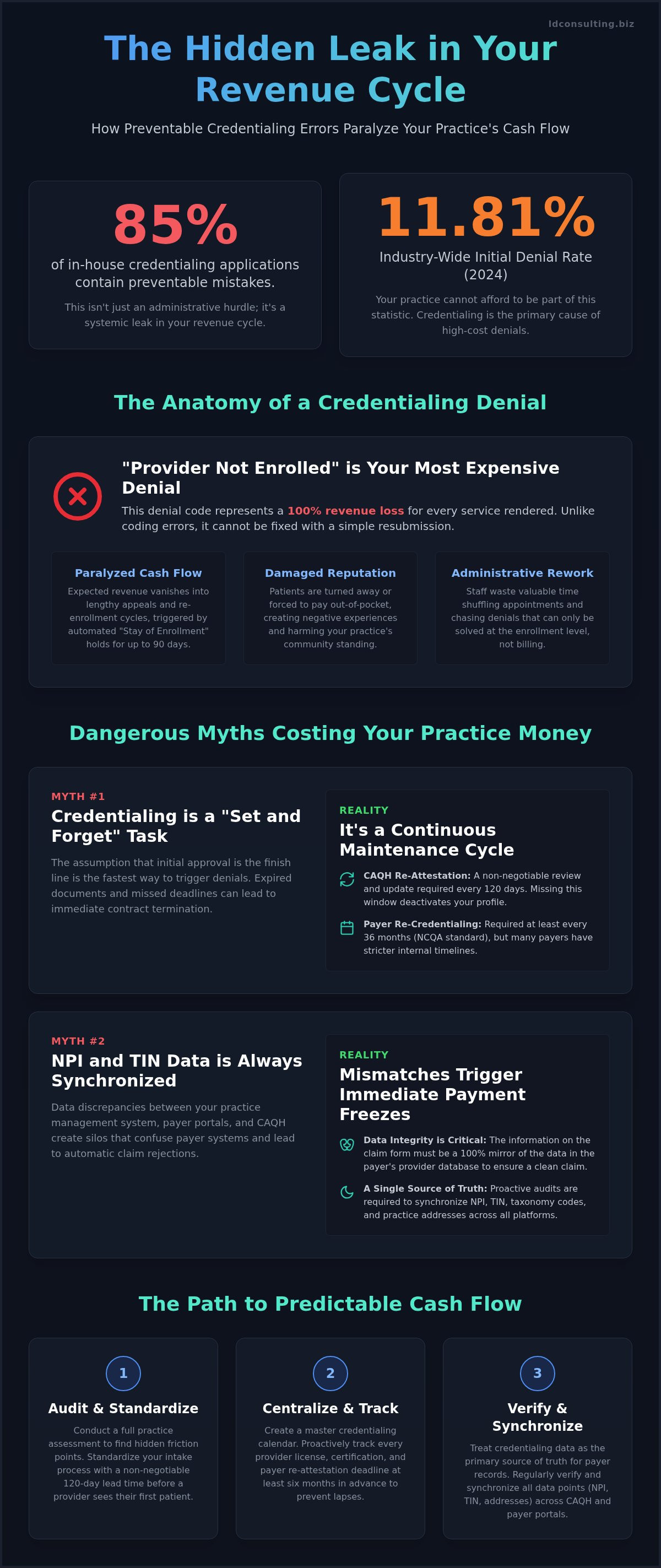
An estimated 85% of in-house credentialing applications contain preventable mistakes. That's not just an administrative hurdle. It's a systemic leak in your revenue cycle. When credentialing errors and denials become your baseline, you're essentially asking your providers to see patients for free. Industry-wide initial denial rates hit 11.81% in 2024. Your practice can't afford to be part of that statistic.
You likely believe your enrollment process is under control because your team is busy. Busy isn't the same as compliant. With the full implementation of PECOS 2.0 and stricter reporting deadlines, the margin for error has vanished. A single lapse can now trigger an automated "Stay of Enrollment," freezing your payments for up to 90 days. You deserve predictable cash flow, not administrative rework.
We're here to stop the friction. This article uncovers five dangerous myths currently costing your practice money. You'll learn how to move toward lower denial rates, faster in-network status, and streamlined enrollment workflows. It's time to treat credentialing as the foundation of your revenue, not an afterthought.
Key Takeaways
- Stop treating credentialing as administrative overhead. It is the gatekeeper of your reimbursement cycle and the primary cause of high-cost denials.
- Avoid the "set and forget" trap. Learn why persistent credentialing errors and denials are often linked to missed CAQH re-attestation deadlines.
- Identify NPI and TIN mismatches. These data discrepancies confuse payer systems and lead to immediate, automated payment freezes.
- Standardize your intake process. A 120-day lead time ensures providers are fully enrolled before they see their first patient.
- Streamline your revenue cycle. Use a practice assessment to find hidden friction points and move providers to in-network status faster.
The Hidden Link: How Credentialing Errors Trigger Claim Denials
Credentialing is the gatekeeper of your reimbursement cycle. It isn't a side task. It's the foundation. If your provider data is wrong, your claims won't pay. It's that simple. Payers use the medical credentialing process to verify every detail before releasing a single dollar. When this foundation cracks, the result is a surge in credentialing errors and denials that can paralyze your cash flow.
The "Provider Not Enrolled" denial code is the most expensive line item in your practice. It represents 100% revenue loss for every service rendered by that clinician. Unlike a simple coding mistake, you can't just fix this with a new modifier. You have to fix the enrollment. This creates a destructive ripple effect across your entire operation:
- Patient Access: Patients are turned away or forced to pay out-of-pocket, damaging your reputation.
- Scheduling: Front-desk staff must constantly shuffle appointments to match "safe" providers.
- Cash Flow: Large chunks of expected revenue vanish into lengthy appeals and re-enrollment cycles.
Accurate data is the only path to a clean claim. If the information on the claim form doesn't mirror the information in the payer's provider database, the system triggers an automatic rejection.
The Anatomy of a Credentialing-Related Denial
Billing teams often misdiagnose these issues. They see a denial and assume it's a coding error. They check the CPT codes and the diagnosis. They resubmit. The payer denies it again. This cycle of administrative rework is a silent profit killer. You're paying your staff to touch the same claim multiple times for a problem they can't solve at the billing level. Identifying denial codes specifically linked to enrollment status is critical. Look for codes like N265 or N290. These point directly to the provider's status in the payer's system, not the clinical service provided.
Gatekeeping vs. Administration
Stop viewing credentialing as a clerical burden. It's a high-stakes financial strategy. Outdated provider data creates a "black hole" for your revenue. If your Tax ID or NPI doesn't match the payer's file, the money stops moving. This isn't just about paperwork; it's about maintaining your status as a legitimate billing entity. Credentialing is the primary source of truth for payer records. Managing credentialing errors and denials requires a proactive audit of every data point before the provider ever sees a patient.
Myth #1: Credentialing is a One-Time "Set and Forget" Task
Initial approval is not a finish line. It's the beginning of a maintenance cycle that never ends. Many practices fall into the "initial approval" trap, assuming that once a provider is in-network, the work is over. This mindset is the fastest way to trigger credentialing errors and denials. Credentialing is a living process. It requires constant updates, re-attestations, and document renewals to keep the revenue flowing.
Expired documents are the silent killers of in-network status. A single lapsed DEA license or board certification can result in an immediate termination of your payer contract. Payers don't always send reminders. They simply stop paying. Every insurer operates on a different clock. While the NCQA requires recredentialing at least every 36 months, your commercial payers may have stricter internal windows. If you aren't tracking these dates centrally, you're managing by crisis rather than by strategy.
The CAQH Profile Trap
The Council for Affordable Quality Healthcare (CAQH) requires providers to review and re-attest their information every 120 days. This is a non-negotiable quarterly event. If you miss this window, your profile goes inactive, and payers lose access to your data. Accuracy is binary. A taxonomy code that's "close enough" is an automatic rejection. You must ensure 100% accuracy in addresses, phone numbers, and specialty designations. Discrepancies between CAQH and individual payer portals create data silos that lead to claim rejections. Synchronizing this data is the only way to maintain a clean record.
Monitoring Beyond the Expiration Date
Waiting for an expiration notice is a failing strategy. By the time a notice arrives, the payer has likely already flagged your account for non-compliance. You need a master credentialing calendar that tracks every provider and every document at least six months in advance. Primary Source Verification (PSV) is also time-sensitive. For NCQA-accredited organizations, PSV must be completed within 120 days before a credentialing decision is made. If your internal team is overwhelmed by these rolling deadlines, a practice assessment can pinpoint exactly where your monitoring process is breaking down. Consistency is the only defense against administrative friction.
Myth #2: Your NPI and TIN Data is Always Synchronized
NPI and TIN data are not inherently linked. This is a fundamental misunderstanding that halts payments. Your Tax ID (TIN) identifies your business entity. Your National Provider Identifier (NPI) identifies the provider or the group. When these numbers don't align in the payer’s database, you face immediate credentialing errors and denials. Payer systems are literal. They don't guess your intent. If the data points don't mirror each other exactly, the claim is rejected.
Type 1 NPIs are for individuals. Type 2 NPIs are for organizations. Confusing the two is a common error. Specifically, using a Type 1 NPI in a billing field that requires a Type 2 will trigger a rejection. Practice name discrepancies add another layer of friction. If your W-9 says "Smith Medical LLC" but your NPI registry says "John Smith MD," the mismatch triggers a manual review. In the worst cases, it results in an automatic denial. You must verify that your billing and rendering IDs match the payer's internal records before submitting a single claim.
The Billing Provider vs. Rendering Provider Conflict
Claims often fail because the provider is credentialed but the group is not. You cannot bill for a clinician under a group TIN if that group hasn't completed its own enrollment. Payer files must mirror your W-9 exactly. Any deviation in the legal business name or address results in a "Provider Not Found" error. Pay close attention to Box 33 on the CMS-1500 form. This is where billing provider information lives. If the NPI entered here doesn't match the TIN associated with the practice's contract, the revenue stops. It's a binary system: match or fail.
Updating the NPPES Registry
The National Plan and Provider Enumeration System (NPPES) is the primary source of truth for payers. With the transition to PECOS 2.0, real-time data validation against NPPES and IRS records is now standard. If your practice moves and you don't update NPPES, your claims will fail. Payers use this registry to verify your data before processing payments. An outdated address is an invitation for a denial.
Audit your alignment with this checklist:
- Verify that the legal name on the IRS SS-4 matches the NPPES registry.
- Ensure the Type 2 NPI is linked to the correct TIN in every payer portal.
- Confirm that rendering providers (Type 1) are correctly associated with the group NPI (Type 2).
- Check that the physical service location matches the address on file with the payer.
The Solution: Auditing Your Credentialing Workflow
Passive waiting is a revenue killer. Most practices treat enrollment as a "someday" task until the first batch of claims comes back rejected. By then, you're already 60 days behind. Managing credentialing errors and denials requires a shift from administrative reaction to strategic auditing. You need a rigid framework that prevents errors before they reach the payer's system.
Standardize your intake immediately. Do not allow a provider to see a single patient until their credentialing file is 100% complete. This includes every license, DEA certificate, and peer reference. Implementation of a 120-day lead time for all new enrollments is non-negotiable. This window accounts for payer backlogs and the inevitable request for additional information. If you're starting the process 30 days before a start date, you're planning for failure. You are essentially providing free labor while you wait for an "in-network" status that could have been secured months ago.
Conducting a Credentialing Internal Audit
A formal audit exposes the gaps your in-house team might be stepping over. You can't fix what you don't measure. Follow these three steps to secure your revenue foundation:
- Step 1: Cross-reference rosters. Compare your active provider list against your active payer contracts. Ensure every provider is linked to the correct group TIN and that no one is billing under a legacy ID.
- Step 2: Check CAQH status. Verify re-attestation dates for every clinician. An inactive CAQH profile is an immediate trigger for a payment freeze.
- Step 3: Analyze denials. Review the last 90 days of denials specifically for "Provider Not Enrolled" codes. This data tells you exactly which payers are missing your information or where your data synchronization has failed.
Optimizing Payer Communication
Stop waiting for the mail. Payer portals and electronic communication are the only ways to move at the speed of business. Document every interaction with payer representatives. Record the date, the name of the person you spoke with, and a specific reference number for the call. Establish a dedicated point of contact for enrollment follow-ups. When one person owns the relationship, details don't slip through the cracks. Aggressive follow-up is the only way to shorten the enrollment window. A Practice Assessment is the most efficient way to identify these revenue leaks without taxing your current staff. We find the friction points you've learned to ignore.
Eliminate Errors with Expert Provider Enrollment
In-house administrative staff are often generalists. They manage scheduling, patient issues, and billing disputes simultaneously. Credentialing becomes a "when I have time" task. This divided focus is exactly how credentialing errors and denials slip through the cracks. LD Consulting moves faster because we are specialists. We don't manage your front desk. We manage your revenue foundation.
We handle the payers so you can handle patients. Our team navigates the specific requirements of CAQH, PECOS 2.0, and commercial insurance portals with precision. We eliminate the administrative friction that keeps your providers from being fully reimbursed. Accurate. Compliant. Comprehensive. These aren't just goals. They're our standard operating procedure.
Our per-engagement model offers a clear advantage over traditional staffing. You don't pay for overhead or downtime. You pay for results. Whether you're onboarding a single specialist or auditing an entire practice roster, our fee structure remains transparent and predictable. We find the errors that in-house teams miss because we know exactly where to look.
LD Consulting: Your Partner in Revenue Protection
We manage the full enrollment lifecycle. From initial application to final approval, we track every document and follow up with every payer representative. This significantly reduces the administrative burden on your clinical staff. They should be focused on patient outcomes, not tracking down a missing W-9 or waiting on a payer’s hold line. We move the process forward while your team focuses on care.
Our Practice Assessment is the first step in this process. We don't just look at current applications. We audit your existing records to find the money you're leaving behind. Many practices discover they've been seeing patients for months without valid in-network status. We stop that leak. We identify the specific credentialing errors and denials that are stalling your cash flow and provide a clear path to resolution.
Next Steps for Your Practice
Stop guessing why your claims are being denied. If your initial denial rate is climbing toward the industry average of 11.81%, the problem is likely systemic. You need a specialist to diagnose the friction points in your enrollment workflow. Don't wait for a payment freeze to realize your data is out of sync.
Schedule a consultation to evaluate your current credentialing status. We'll review your provider roster, your payer contracts, and your recent denial history. Don't let preventable administrative errors dictate your cash flow. Get a Practice Assessment from LD Consulting today and secure your reimbursement cycle.
Secure Your Revenue Foundation Today
Credentialing is the primary gatekeeper of your practice's financial health. It isn't a passive administrative task. It's a critical financial strategy that requires quarterly re-attestation and absolute synchronization between your NPI and TIN records. Ignoring these maintenance cycles leads to predictable revenue loss. You've uncovered the myths. Now you have the framework to dismantle them and protect your cash flow.
LD Consulting provides national expertise in payer enrollment with a focus on speed and surgical accuracy. Our per-engagement model ensures you get results without the bloated overhead of additional in-house staff. We specialize in identifying the specific credentialing errors and denials that stall your growth. Through comprehensive practice revenue assessments, we find the leaks your team might be missing. We move fast so your providers can focus on care rather than paperwork.
Stop letting administrative friction dictate your reimbursement schedule. Streamline your provider enrollment with LD Consulting. Your practice deserves a clean claim on the first submission every single time. Let's get your revenue cycle back on track.
Frequently Asked Questions
What are the most common credentialing errors that lead to denials?
The most common errors include expired state licenses, Tax ID mismatches, and incorrect taxonomy codes. These simple data discrepancies trigger immediate rejections. Many practices also fail to update their physical service locations in the payer portal. When the address on the claim doesn't match the address on the provider's file, the system assumes the provider is out of network. Accuracy is the only way to avoid these preventable revenue leaks.
How long does it typically take to fix a credentialing-related claim denial?
Fixing a credentialing-related denial typically takes 30 to 90 days. This timeline depends on the payer's internal processing speed and the severity of the error. You must first correct the underlying enrollment issue before you can even resubmit the claim. There's no shortcut. This delay creates a significant gap in your cash flow that most practices find difficult to recover without specialized intervention. Proactive management is your only defense.
Can a provider see patients while their credentialing application is pending?
A provider can technically see patients, but you can't bill them as in-network until the application is fully approved. Billing under another provider’s NPI is fraudulent and will lead to audits. If you see patients while pending, you risk providing services for free or forcing patients to pay out-of-network rates. This damages your practice's reputation. It's better to wait for a confirmed effective date before scheduling appointments for a new clinician.
Why do insurance companies deny claims for "Provider Not Enrolled"?
Insurance companies use this code when the rendering provider's NPI isn't correctly linked to the billing group's Tax ID in their system. It's a signal that the payer has no record of the provider as an authorized clinician for your practice. These credentialing errors and denials are often caused by a failure to complete the group addition process or a lapse in the provider’s mandatory quarterly CAQH re-attestation.
What is the difference between provider enrollment and healthcare credentialing?
Healthcare credentialing is the process of verifying a provider's education, training, and experience through primary source verification. Provider enrollment is the administrative step of linking that verified provider to a specific insurance plan and Tax ID. You must be credentialed before you can be enrolled. Credentialing proves you're a qualified professional; enrollment ensures you're a recognized billing entity within the payer’s specific network. Both are required for reimbursement.
How often should a medical practice audit its credentialing records?
You should audit your records at least every 90 days. A quarterly cycle aligns with CAQH re-attestation requirements and helps you catch expiring documents before they trigger a payment freeze. Waiting for an annual review is too late. By then, a single expired license has likely already caused months of lost revenue. Continuous monitoring is the industry standard for practices that prioritize a predictable and healthy revenue cycle.
What documents are most frequently missing from credentialing applications?
Malpractice insurance face sheets, current DEA certificates, and state-specific licenses are the most frequently missing items. Applications also stall when providers fail to include their full work history or current hospital privileges. Payers require a complete, gap-free record before they move an application to the next phase. If a single document is missing or expired, the entire process resets, extending your enrollment timeline by weeks or even months.
How does an incomplete CAQH profile affect my medical billing?
An incomplete CAQH profile acts as a stop-gap for your medical billing. Most commercial payers pull data directly from CAQH to verify your providers. If the profile is incomplete or hasn't been re-attested, the payer will flag the provider as non-compliant. This leads to immediate credentialing errors and denials across your entire patient roster. Keeping this profile 100% accurate is the most effective way to maintain your in-network status.


