

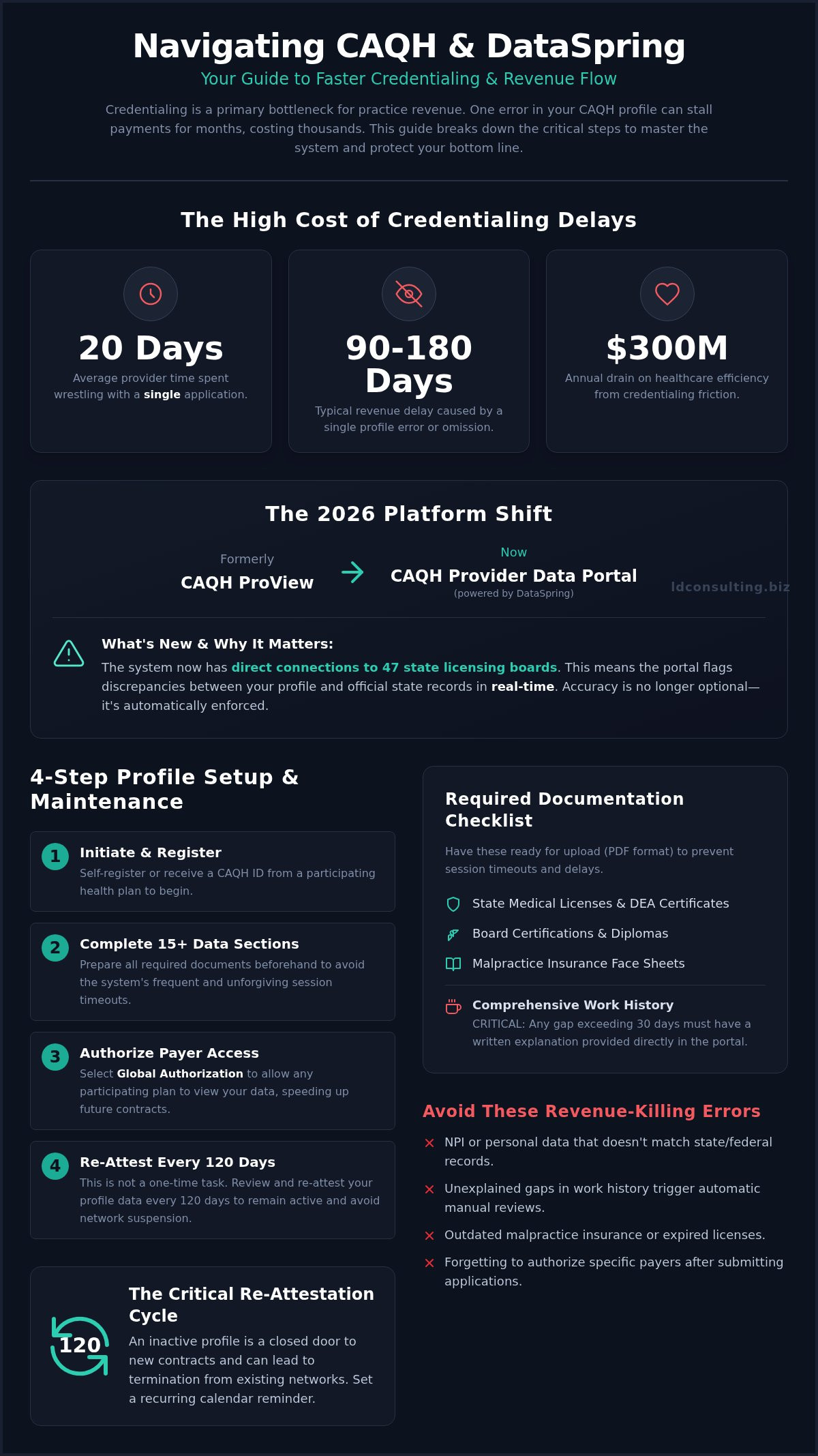
The average provider spends 20 days wrestling with a single credentialing application. This is more than an administrative hurdle. It is part of a $300 million drain on healthcare efficiency that starts with your front office. You understand the stakes: one missed field in the CAQH Provider Data Portal can stall your enrollment for months. If you need professional CAQH credentialing help, you are likely tired of vague error messages and the constant 120-day re-attestation cycle that feels like a full-time job.
You can't afford to let administrative friction dictate your revenue. This guide provides a results-driven roadmap to mastering the 2026 platform updates, including the new direct connections to state licensing boards. We'll show you how to eliminate profile errors, maintain a fully attested status, and fast-track your insurance contracts. Efficiency is the only way forward. Let's get your data moving.
Key Takeaways
- Understand the 2026 transition to DataSpring and why your profile remains the primary source of truth for major health plans.
- Master the registration sequence with expert CAQH credentialing help to ensure your documentation is compliant before the system times out.
- Spot the specific NPI and work history errors that cause manual review triggers and months of unnecessary revenue delays.
- Establish a strict 120-day re-attestation protocol to keep your status active and avoid sudden network suspensions.
- Learn when to leverage a per-engagement specialist to solve complex enrollment hurdles and protect your practice's bottom line.
The Gateway to Revenue: Understanding CAQH and DataSpring
CAQH is the universal hub for provider data. It is the first stop for nearly every major health plan in the country. If you aren't in the portal, you aren't in the network. The organization formerly known as the Council for Affordable Quality Healthcare (CAQH) rebranded to DataSpring in June 2026. This isn't just a cosmetic name change. It reflects a shift toward a more automated, for-profit model owned by the industry's largest payers, including UnitedHealth Group and Aetna. Access remains free for providers, but the administrative burden of maintaining accuracy has increased. Data is now the primary currency of enrollment.
Most providers treat this as a one-time setup task. That's a mistake. The portal is a living document that requires constant management. Payers use this data to verify your education, licenses, and malpractice history. If the information here doesn't match your state board records or your enrollment application, the process stops. You cannot bypass this gate. Professional CAQH credentialing help is often the difference between a 90-day turnaround and a six-month nightmare of unbillable claims. Errors here cascade. They don't just delay one contract; they stall every payer application simultaneously.
DataSpring Rebranding: What Changed?
The transition to DataSpring, powered by CAQH, has caused unnecessary friction for practice managers. The core product, formerly CAQH ProView, is now officially the CAQH Provider Data Portal. Despite the new branding, the portal functionality remains largely consistent. Your login credentials and existing profile data transitioned automatically during the June 2026 rollout. You don't need to create a new account, but you must verify that your information migrated correctly. The rebranding also introduced direct connections to state licensing boards in 47 states. This means the system now flags discrepancies in real-time. Accuracy is no longer optional. It's enforced by the platform's new architecture.
Why Your Revenue Cycle Depends on CAQH
Credentialing is the primary bottleneck of your practice revenue. Payers use the portal for primary source verification. They will not initiate an enrollment contract until they see a fully attested, error-free profile. An incomplete profile results in an immediate application rejection. These rejections aren't always communicated clearly. Your application might simply sit in a queue for weeks while you wait for a status update that never comes. Credentialing delays typically last between 90 and 180 days. During this period, you are providing care that you cannot bill to the insurance company. For a high-volume specialist, this administrative lag can cost thousands of dollars in lost revenue every week. You aren't just filling out forms. You are unlocking your practice's ability to get paid. Treat your profile with that level of urgency.
Step-by-Step: Setting Up Your CAQH ProView Profile
Setting up your profile is a precision task. Efficiency is the priority. Your journey begins at DataSpring, powered by CAQH, where you'll either self-register or receive an ID through a participating health plan. Once you have this ID, you must navigate over 15 distinct sections of professional data. This isn't a task for a spare ten minutes. Session timeouts are frequent and unforgiving. If you find the data entry overwhelming, seeking expert CAQH credentialing help can prevent the common input errors that trigger manual reviews. Accuracy at this stage is the only way to avoid the archive status that kills your revenue.
Required Documentation for a Clean Submission
Preparation prevents delays. You can't complete your profile without specific, current documentation. Most session timeouts occur because a provider is searching for a document while the portal clock is ticking. Securing CAQH credentialing help early in this process ensures your documents are audited before they reach the payer's desk. You need the following files ready for upload:
- State medical licenses and DEA certificates.
- Board certifications and diplomas.
- Current malpractice insurance face sheets with policy numbers and coverage limits.
- A comprehensive work history with zero gaps exceeding 30 days.
All documents must be in PDF format for upload. If a gap exists in your history, you must provide a written explanation within the portal to avoid an immediate "incomplete" status. Incomplete statuses lead to rejections that the payer might not communicate for weeks.
The Authorization Step: Who Can See Your Data?
Data entry is only half the battle. You must authorize payers to access your profile. You have two choices: global authorization or specific payer authorization. We recommend global authorization. This setting allows any participating health plan to view your data as soon as you initiate a contract. It eliminates the administrative step of manually adding each new payer, which directly speeds up your enrollment timeline. You can monitor the "Payer Activity" section to see which companies have successfully pulled your information. If a payer claims they can't see your data, check your authorization settings first.
The final step is attestation. This is your legal signature confirming the data is accurate. Without a current attestation, your profile is effectively invisible to payers. Check every box. Review every entry. One typo in your NPI or tax ID will stall your enrollment for months. We move fast because your practice depends on it; don't let a simple clerical error stop your cash flow.
Troubleshooting Common CAQH Errors That Stall Enrollment
Errors in the CAQH Provider Data Portal are more than clerical mistakes. They are financial leaks. According to insights often discussed by the Healthcare Financial Management Association, administrative waste accounts for an estimated $300 million in lost healthcare value. Much of this waste stems from redundant data entry and avoidable errors. When you seek professional CAQH credentialing help, the goal is to identify these friction points before a payer rejects your application. Most delays are predictable. They occur when your portal data contradicts other primary sources like the NPPES database. Payers don't call you to fix these. They simply move your file to the bottom of the stack.
In 2026, the industry has shifted toward continuous monitoring. This means your data is verified against primary sources in real-time. If a state license expires in the portal, your "Attested" status drops immediately. Practice location details are another common failure point. Inaccuracies here contribute to the fact that 40% of patients encounter errors in provider directories. Check your suite numbers and zip codes. If you are part of a group enrollment, ensure every location is linked to the correct Type 2 NPI. A single mismatched address can stall a contract for months.
The Work History Audit
Account for every month since you graduated from professional school. Gaps are red flags for credentialing committees. If you took more than 30 days off between residency and your first practice, you must document it. Use terms like "Sabbatical" or "Relocation" to fill these windows. Your CV and your portal must be identical. If the dates differ by even a week, the system flags the entry for manual review. Manual reviews add 30 to 60 days to your timeline. Accuracy is the only way to keep the process moving.
NPI and Tax ID Alignment
Your individual Type 1 NPI must link correctly to your group's Type 2 NPI. This is the most common point of failure for new hires. Verify that your Tax ID matches the exact legal name on your IRS SS-4 form. Mismatched Tax IDs are the leading cause of enrollment rejection. LD Consulting has seen hundreds of applications stalled because a provider used a "Doing Business As" (DBA) name instead of the legal entity name. Get the paperwork right the first time. If you need CAQH credentialing help to audit these identifiers, do it before you submit your next application.
Beyond Setup: Maintaining Compliance and Re-attestation
Completing your initial profile is only the first step. The real risk to your revenue lies in administrative neglect. Many providers treat the portal as a one-time task, but the system is designed for continuous maintenance. In 2026, payers have moved toward stricter verification models that penalize stale data. If you need CAQH credentialing help to manage these recurring requirements, you aren't alone. Neglecting your profile leads to immediate network suspension. It's a simple equation: no attestation means no payment. Efficiency requires a proactive approach to the 120-day cycle.
The 120-Day Re-attestation Rule
You must verify the accuracy of your data at least every 120 days. Some payers now require more frequent confirmations to ensure their directories remain accurate. If you miss this window, your status changes to "Archive." This isn't just a label; it's a financial stop-work order. Payers will view your profile as inactive and may stall your claims immediately. To stay ahead of this, follow these steps:
- Set calendar reminders for 10 days before your current attestation expires.
- Log in even if your information hasn't changed to "confirm" the existing data.
- Verify that your contact email in the portal is an address you check daily.
Missing a notification is not an excuse health plans accept. If your staff is struggling to manage these rolling deadlines, it's time to outsource your healthcare credentialing to specialists who monitor these cycles for you. We ensure you never hit "Archive" status.
Managing Document Renewals
The 2026 platform enhancements include direct connections to state licensing boards in 47 states. The system often flags an expired license before your office even receives the renewal notice. You must be faster than the automated flags. Upload new DEA certificates, state licenses, and malpractice face sheets the day you receive them. Don't wait for a payer to request the documents. Proactive updates prevent "out of compliance" flags that can remove you from online provider directories and disrupt patient access. Accuracy is your best defense against network termination.
Finally, audit your authorized payers list quarterly. Review which plans have access to your data and remove any you no longer participate with. This protects your professional data security and ensures only active partners can pull your sensitive history. Maintenance isn't just a chore; it's the gatekeeper of your practice's financial health.
Fast-Track Your Enrollment: When to Hire CAQH Specialists
In-house staff are often overwhelmed. They treat credentialing as a secondary task between patient check-ins and billing inquiries. This approach is a recipe for revenue stagnation. Mastering the CAQH Provider Data Portal requires more than just filling out forms; it requires a deep understanding of payer-specific requirements and the technical nuances of the DataSpring platform. When a profile is flagged for a minor discrepancy, an administrator without specialized training might spend weeks trying to decipher a vague error message. Professional CAQH credentialing help eliminates this trial-and-error phase. We don't just enter data. We navigate the friction points that stall your cash flow.
Outsourcing to LD Consulting provides a faster, per-engagement solution. We handle the persistent payer follow-ups that drain your team's time. This allows your clinical staff to focus on patient care instead of fighting with portals. A specialist knows exactly who to call when an application sits idle. We move with the urgency your practice deserves. Efficiency is the only way to protect your bottom line.
The ROI of Professional Credentialing Services
The cost of a specialist is a fraction of the revenue lost during a month of unbillable services. If an enrollment delay keeps a high-volume provider out-of-network for an extra 30 days, the financial impact is immediate and severe. Expert verification reduces the risk of claim denials by ensuring your data is compliant before it ever reaches the payer. We offer predictable, per-engagement fee structures. This means you have a fixed investment with a high return, rather than the hidden costs of ongoing administrative errors. You aren't just paying for data entry. You're buying back your timeline.
How LD Consulting Streamlines Your Setup
Our process is structured and purposeful. We start with a comprehensive audit of your existing CAQH data to identify the red flags mentioned earlier, such as work history gaps or NPI mismatches. We don't wait for the system to flag an error. We resolve it first. Our team maintains direct communication with insurance payers to push through stalls and ensure your profile is being utilized. Continuous monitoring is part of the package. We ensure you stay in-network, compliant, and ready to bill. If you're ready to stop the administrative drain, get CAQH credentialing help from LD Consulting today. We clear the path so you can get back to work.
Secure Your Practice Revenue Today
CAQH is the foundation of your practice's financial health. Treating it as a secondary administrative task is a financial risk you don't need to take. You've learned that DataSpring accuracy is mandatory for payer enrollment and that the 120-day re-attestation cycle is non-negotiable. One clerical error or missed deadline can stall your cash flow for months. If you are ready to eliminate these friction points, professional CAQH credentialing help ensures your data is compliant and your status remains active.
LD Consulting offers national provider enrollment expertise with a predictable per-engagement pricing model. We specialize in rapid turnaround for new practices, handling the technical nuances so you can focus on patient care. Efficiency is the only way forward. Stop wasting time on paperwork. Get expert CAQH help now. Your revenue shouldn't wait for a portal login. We have the expertise to get your practice fully enrolled and compliant today. Let's get your data moving.
Frequently Asked Questions
Is there a fee for providers to use CAQH ProView?
Access to the CAQH Provider Data Portal remains free for individual healthcare providers as of August 2026. While the organization transitioned to a for-profit model under DataSpring, the provider-facing portal is still funded by participating health plans. Your costs are exclusively administrative. You pay in the time required for setup and maintenance or by hiring a specialist to ensure the data is accurate and compliant.
How long does CAQH credentialing take to complete?
The typical timeline for the full credentialing process falls between 90 and 180 days. This period starts once your profile is fully attested and authorized for your target payers. Delays often occur during the primary source verification phase, where payers confirm your medical school, residency, and board certifications. Incomplete profiles or mismatched NPI data can easily push this timeline beyond the six-month mark.
What is the difference between CAQH and PECOS?
CAQH is a centralized database used primarily by commercial insurance payers for credentialing and directory accuracy. PECOS is the Provider Enrollment, Chain, and Ownership System used exclusively by the Centers for Medicare & Medicaid Services (CMS). You must manage both separately to be fully in-network. While CAQH is the standard for private plans, PECOS is mandatory for billing government-funded programs.
Can I be credentialed with insurance without a CAQH profile?
Most major U.S. payers require a CAQH profile for primary source verification. While some small, local plans or specialized niche payers might use paper applications, they are the exception. Without a fully attested profile, you cannot initiate contracts with national carriers like Aetna, Cigna, or UnitedHealth Group. Treating the portal as optional will effectively lock you out of the commercial insurance market.
What happens if I miss my CAQH re-attestation deadline?
Missing the deadline triggers an immediate shift to Archive status. This makes your data invisible to health plans. Payers will view you as non-compliant and may suspend your network participation or stall claim payments. If you require CAQH credentialing help to manage these deadlines, it is a high-ROI investment. Re-attestation is the only way to prove your data is current and valid for billing.
Do I need a separate CAQH ID for every state I practice in?
No. You maintain a single CAQH ID for your entire professional career, regardless of how many states you practice in. You simply add each state license and practice location to your existing profile. The system is designed to be a centralized hub. Attempting to create multiple IDs will cause significant data conflicts and likely result in your applications being rejected for duplicate records.
How do I fix a discrepancy error on my CAQH profile?
Discrepancy errors occur when your input doesn't match primary source data. Start by auditing your NPI record in the NPPES database and your current state board profile. Ensure every date, address, and license number is identical across all platforms. If the error persists, you must upload the specific document that proves your data is correct. The system's direct connections to 47 state boards make these matches mandatory.
Can a consultant manage my CAQH login for me?
Yes. Professional consultants frequently manage CAQH profiles to ensure accuracy and meet re-attestation deadlines. This is a standard practice for busy clinics that cannot afford enrollment delays. A specialist provides the necessary CAQH credentialing help by auditing your data, uploading renewals, and communicating with payers. This ensures your profile remains active and compliant while your clinical staff focuses on patient care.


