

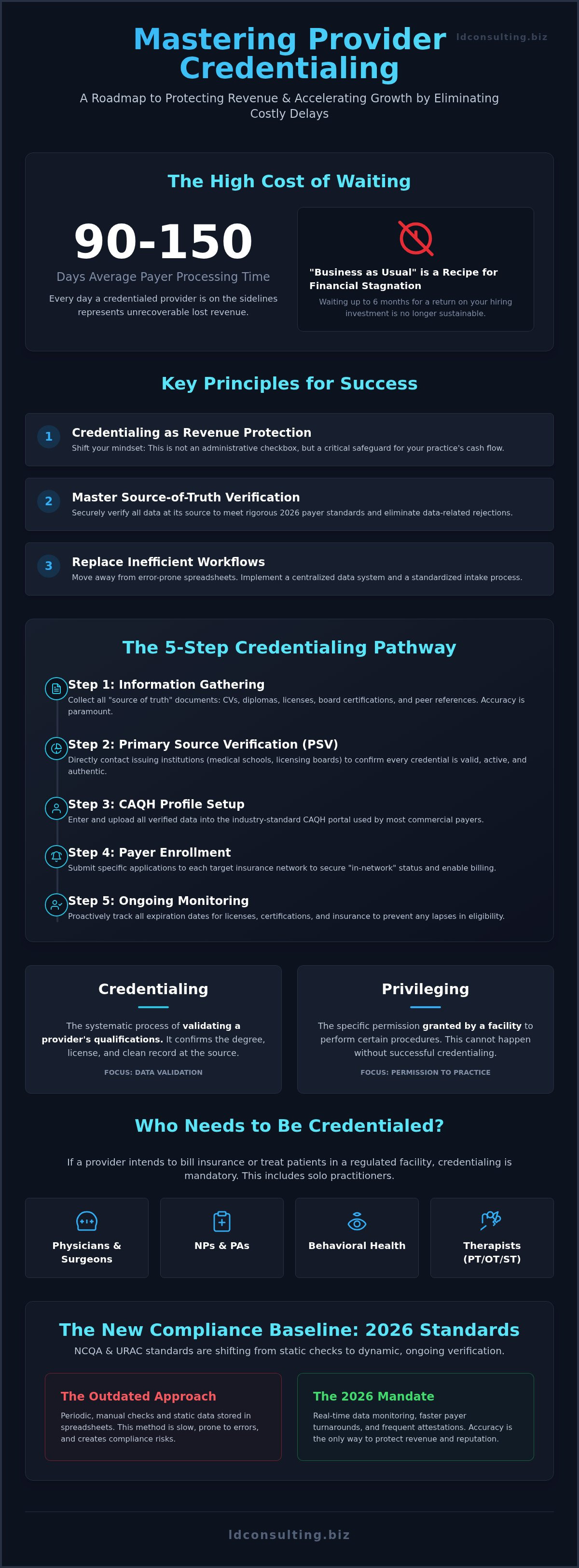
Every day your new physician sits on the sidelines is a day of lost revenue you won't recover. Healthcare provider credentialing isn't just an administrative hurdle; it's the foundational gatekeeper of your practice's revenue cycle. When the average commercial payer takes 90 to 150 days to process an application, "business as usual" is a recipe for financial stagnation. You can't afford to wait six months for a return on your hiring investment.
You've likely felt the frustration of repetitive data entry and the silence of payer portals. It's a complex, manual process that drains resources and delays patient care. This guide changes that. We'll provide a clear roadmap to master the essentials of credentialing, allowing you to protect patient safety and secure your cash flow. You'll learn how to navigate 2026 compliance standards, reduce claim denials, and reach "in-network" status faster. We're cutting through the noise to get your providers billing and your practice growing.
Key Takeaways
- Position healthcare provider credentialing as a revenue protector, not an administrative checkbox.
- Master the two-step verification process to secure source-of-truth data and meet 2026 payer standards.
- Identify the specific friction points causing claim denials and unbillable provider downtime.
- Replace inefficient spreadsheets with centralized data and a standardized intake workflow.
- Utilize per-engagement enrollment services to scale your practice without adding permanent administrative headcount.
What Is Healthcare Provider Credentialing?
Credentialing is the systematic process of verifying a professional's qualifications. It is the gatekeeper of clinical excellence. In the context of Healthcare Credentialing, this means a deep dive into a provider's history to ensure they are exactly who they claim to be. Accuracy isn't optional. It's a requirement for patient safety, legal compliance, and insurance reimbursement. Without it, your practice effectively operates in a vacuum, unable to bill or treat patients legally.
There is a sharp distinction between credentialing and privileging. Credentialing validates the data; it confirms the degree, the license, and the clean record. Privileging is the specific permission granted by a facility to perform certain procedures. You cannot have the latter without the former. The core components of healthcare provider credentialing include education, residency training, board certifications, and clinical experience. Every detail must be verified at the source. This isn't just about checking a box. It's about mitigating risk before a provider ever sees a patient.
Who Needs to Be Credentialed?
The requirement extends across the clinical spectrum. If you intend to bill insurance or treat patients in a regulated facility, the process is mandatory. Payers won't reimburse unverified providers. Facilities won't risk the liability of an unvetted clinician. The list of professionals requiring verification includes:
- Physicians (MD/DO) and Surgeons
- Nurse Practitioners (NP) and Physician Assistants (PA)
- Behavioral Health Clinicians and Counselors
- Physical, Occupational, and Speech Therapists
Even solo practitioners cannot skip this step. Operating as a single provider doesn't exempt you from federal or state mandates. It's a universal standard for anyone delivering clinical care. If you are licensed to provide care, you are subject to the scrutiny of credentialing.
The Standards: NCQA and URAC
Two primary bodies set the benchmarks: the National Committee for Quality Assurance (NCQA) and URAC. These organizations define the rigorous standards that payers and hospitals must follow. The 2026 standards prioritize data accuracy and real-time monitoring over static, periodic checks. Static data is a risk. Real-time updates are the new compliance baseline. Payers now expect faster turnarounds and more frequent attestation to ensure provider networks remain current and safe.
The National Practitioner Data Bank (NPDB) plays a critical role here. It acts as a central repository for reports on medical malpractice payments and adverse actions. A clean NPDB report is a non-negotiable requirement for successful enrollment. Missing a single entry or failing to monitor these standards leads to immediate delays. In the 2026 landscape, manual tracking is no longer sufficient. You need a process that anticipates these checks. Accuracy is the only way to protect your revenue and your reputation.
The Step-by-Step Provider Credentialing Process
Efficient healthcare provider credentialing follows a rigid, linear path. You can't skip steps. A single missing document or a typo on an application can stall your revenue for months. Success requires a structured approach that moves from internal data collection to external verification and final payer acceptance. This sequence turns a chaotic administrative burden into a repeatable business process. If you find the manual tracking overwhelming, our provider enrollment services can manage the entire lifecycle for you.
- Step 1: Information Gathering. Collect all "source of truth" documents. This includes CVs, diplomas, licenses, and peer references.
- Step 2: Primary Source Verification (PSV). Contact the issuing institutions directly to confirm the provider's history is accurate.
- Step 3: CAQH Profile Setup. Enter and upload data into the industry-standard portal used by commercial payers.
- Step 4: Payer Enrollment. Submit applications to specific insurance networks to secure in-network status.
- Step 5: Ongoing Monitoring. Track expiration dates for licenses and certifications to prevent lapses.
Primary Source Verification Explained
Verification is not a suggestion. It is a mandate. You cannot simply take a provider's word for their qualifications. Primary Source Verification (PSV) involves contacting medical schools, licensing boards, and the DEA directly. This ensures that every credential is valid and active. It protects your practice from fraud and significantly reduces your liability risk. Most malpractice insurance carriers require documented PSV before they will extend coverage. Without this verification, you are exposed to legal and financial risks that can sink a practice.
Managing Your CAQH Profile
The CAQH Provider Data Portal is the central hub for most commercial insurance companies. A messy profile is the fastest way to trigger a rejection. Best practices for 2026 require high-resolution document scans and meticulous data entry that matches your primary source documents exactly. Pay attention to the re-attestation cycle. Most providers must re-verify their information every 120 days. Failure to do so results in an inactive status, which leads to immediate claim denials. A clean, active CAQH profile acts as an express lane for the healthcare provider credentialing process. It allows payers to pull your data instantly rather than waiting for manual document exchanges. Accuracy here is your best defense against administrative delays.
Why Credentialing Delays Are Your Practice's Biggest Revenue Killer
A provider on your payroll who cannot bill insurance is a liability. It's that simple. While you wait for healthcare provider credentialing to finalize, you are paying a full salary plus benefits with zero offsetting revenue. This isn't just an administrative lag; it's a direct drain on your cash flow. Many practices attempt to bill before enrollment is complete, assuming they can fix it later. This is a mistake. Billing before a provider is "in-network" triggers immediate claim denials that are notoriously difficult to overturn.
Don't count on retroactive effective dates. Payers are increasingly restrictive with backdating, often setting the effective date as the day the application was finally approved, not the day it was submitted. Services rendered during that gap become uncollectible. Beyond the immediate financial loss, consider patient churn. Patients expect their insurance to work. If they discover you are out-of-network at the front desk, they leave. They won't wait for your paperwork to catch up; they will find a practice that is already compliant.
Common Credentialing Errors That Lead to Denials
Small mistakes cause massive delays. Inconsistent addresses across your CAQH profile, NPI registry, and payer applications are a primary trigger for rejection. Payers look for reasons to pend an application. Expired certifications or missing life-support cards hidden in a provider's file are easy targets. Even gaps in work history longer than 30 days can be flagged as "red flags," requiring detailed explanations that reset your 90-day waiting period. Precision is your only defense against these avoidable setbacks.
The Financial Reality of the 90-120 Day Window
The math is unforgiving. If a provider generates $3,000 in daily billings, a 120-day delay costs your practice $360,000 in gross revenue. In 2026, simply "starting early" isn't a strategy. Payer backlogs are systemic, and the volume of applications has reached an all-time high. The compounding effect of these delays across multiple providers can cripple a growing practice. You aren't just losing today's revenue; you're pushing back your entire growth timeline. We treat healthcare provider credentialing as a revenue protector because that is exactly what it is. Speed is the only metric that matters when your bottom line is at stake.
Best Practices for Streamlining Provider Enrollment
Software doesn't solve bad data. Efficiency in healthcare provider credentialing is the product of a disciplined workflow, not just a digital portal. You must move away from fragmented spreadsheets and paper files. Centralizing your provider data into a single, verified source of truth is the first step toward reducing administrative friction. If your data is scattered, your enrollment will be delayed. It's that simple. We move fast because we don't waste time looking for missing documents.
Standardize your intake process for every new hire. Don't wait for a provider to start their first day to begin collecting documents. Create a mandatory checklist that includes every license, certification, and peer reference required by your most stringent payer. Audit these files internally before they reach a payer's desk. Finding a missing signature now saves you 30 days of "pending" status later. Proactive management is the only way to shorten the gap between hiring and billing. If your current process feels like guesswork, a practice assessment can pinpoint exactly where your revenue is leaking.
Integrating Credentialing and Billing
Silos kill revenue. Your billing team needs real-time access to every provider's credentialing status. Billing a claim before a provider is fully enrolled leads to a permanent denial that no amount of follow-up can fix. Set up "hold" queues for claims involving uncredentialed providers. This allows you to submit the claims the moment the "in-network" notification arrives. When billing and enrollment move in sync, your cash flow remains predictable. Communication between these departments must be structured and frequent to prevent uncollectible write-offs.
The Power of Professional Follow-Up
A submitted application is not a finished task. It's the start of a negotiation. Payer portals are often out of date, and applications frequently stall in "pending" piles without notice. You need a structured follow-up schedule. Contact payers every 10 to 14 days to verify receipt and check for missing information. Don't just ask for status; ask for the specific representative reviewing the file. If an application exceeds standard turnaround times, use escalation tactics. Speak to provider relations managers. Document every call, every name, and every date. This audit trail is your leverage when a payer claims they never received your data. Professional persistence separates a 90-day approval from a six-month disaster. If you don't have the internal bandwidth for this level of scrutiny, our healthcare provider credentialing experts provide the aggressive follow-up required to get your providers in-network and billing.
Scaling with Professional Credentialing Services
Managing enrollment in-house is a scalability bottleneck. Your administrative staff should focus on patient experience and clinical flow, not chasing paper. When you rely on internal teams, healthcare provider credentialing often becomes a secondary task that gets pushed to the bottom of the pile. This leads to missed deadlines and lapsed certifications. A per-engagement model eliminates this risk. You pay for completed enrollments, not for hours spent on hold with payers. This approach provides a clear ROI and allows your practice to grow without adding permanent overhead.
Outsourcing isn't just about offloading work. It's about accessing specialized expertise. Seasoned specialists understand the nuances of every payer portal and the specific documentation that triggers an approval. They speak the language of enrollment managers. This fluency allows for a fast-tracked process that internal staff simply cannot replicate. By leveraging professional services, you ensure that your providers reach in-network status in the shortest time frame possible. Speed is the only metric that matters for your bottom line.
The LD Consulting Advantage
We are results-driven specialists. We don't just fill out forms; we manage the entire lifecycle of healthcare provider credentialing from start to finish. Our process is designed for speed and accuracy. We handle the initial information gathering, the primary source verification, and the relentless follow-up required to move an application through the payer's system. We act as your practice's revenue protector, ensuring that every clinician on your payroll is authorized to bill as quickly as possible.
Our services extend beyond simple paperwork. We conduct comprehensive practice audits to identify existing revenue gaps. Often, practices lose thousands of dollars due to uncredentialed providers or lapsed payer contracts they didn't know existed. We find that money and fix the underlying process. Our national expertise allows us to scale with your practice, whether you are a solo clinic or a multi-state organization. We provide the streamlined, compliant solutions you need to remain focused on care. Get your providers in-network faster with LD Consulting.
Secure Your Practice's Financial Future
Waiting for payer approval is a choice. You can let administrative friction drain your cash flow, or you can treat healthcare provider credentialing as the revenue protector it is. Successful practices in 2026 don't just "start early." They standardize their data, eliminate silos between billing and enrollment, and maintain aggressive follow-up schedules. Manual tracking and fragmented spreadsheets are no longer sufficient to meet modern compliance standards. Precision is the only way to avoid uncollectible denials.
LD Consulting offers a no-nonsense, results-driven path to network participation. Our expert practice assessments identify hidden revenue gaps; our fast-tracked enrollment services ensure your providers are billing in record time. With national reach and a commitment to accuracy, we handle the complex paperwork so you can stay focused on clinical excellence. Stop letting uncredentialed providers sit on the sidelines. Streamline your provider enrollment today with LD Consulting. Your practice is ready to grow. Let's get to work.
Frequently Asked Questions
How long does the provider credentialing process typically take in 2026?
Approval takes 60 to 180 days on average. Commercial payers usually sit in the 90 to 150-day range, while Medicare moves faster at 60 to 90 days. These timelines assume your data is perfect from the start. Any manual error triggers a reset of the clock. Speed depends on your internal organization and the payer's current backlog.
What is the difference between provider credentialing and provider enrollment?
Credentialing verifies your qualifications; enrollment connects you to the payer's network. Think of credentialing as the background check and enrollment as the final contract. You need both to get paid. Payer enrollment is the specific process that allows you to bill for services rendered. In 2026, these are often combined into a single 90 to 120-day workflow.
Can a provider see patients before their credentialing is fully complete?
Seeing patients before enrollment is finalized leads to uncollectible claims. While you can technically provide care, you cannot bill insurance as an in-network provider. Most payers won't backdate effective dates to cover services rendered during the application window. This results in significant revenue loss and potential patient churn when they discover you're out-of-network at the front desk.
What are the most common reasons for credentialing application rejections?
Most rejections stem from inconsistent data and manual entry errors. Inaccurate addresses, expired certifications, and gaps in work history are primary triggers. Payers look for any reason to pend an application and clear their backlog. Meticulous data entry and internal audits are your only defense against these costly administrative delays. Precision is a non-negotiable requirement for success.
How often do providers need to be re-credentialed?
Re-credentialing typically occurs every two to three years depending on the payer. However, CAQH profiles require re-attestation every 120 days to remain active. Missing a single re-attestation deadline can result in immediate suspension from a payer network and a complete halt in reimbursements. Constant monitoring is a foundational requirement for practice compliance and long-term revenue protection.
What documents are required for a primary source verification check?
Primary source verification requires education diplomas, residency certificates, and active state licenses. You also need current DEA registrations and board certifications. These must be verified directly with the issuing institution, not through copies provided by the clinician. This process ensures the "source of truth" is accurate and protects your practice from significant legal liability and insurance fraud.
How does CAQH help speed up the insurance credentialing process?
CAQH acts as a centralized data hub for over 2.5 million providers across the country. It speeds up healthcare provider credentialing by allowing commercial payers to pull your verified data instantly. This eliminates the need for repetitive manual document submissions. A clean, up-to-date profile is your express lane to faster in-network status and predictable practice revenue.
Is it better to handle credentialing in-house or outsource it to a consultant?
Outsourcing to a per-engagement specialist is more efficient than adding internal headcount or permanent administrative overhead. Professional consultants have established payer relationships and refined follow-up workflows that internal staff cannot replicate. This model reduces your financial risk and gets your providers in-network faster. It is the most effective strategy for healthcare practices focused on rapid growth.


