

Every day your new provider sits on the sidelines is a day of lost revenue you'll never recover. It's an expensive reality. You've likely spent weeks chasing payer representatives who don't return calls or resubmitting the same stack of documents for the third time. It's inefficient. It's draining. Most importantly, it's preventable. If you are searching for how to speed up credentialing process, you already understand that administrative friction is your biggest barrier to growth.
We agree that the current enrollment system is built to be slow. Payer black holes shouldn't dictate your practice's financial health. This guide promises to show you the exact administrative levers you can pull to eliminate delays and get your providers in-network faster. We'll provide a clear roadmap to reduce turnaround time and ensure fewer application rejections. You'll gain a strategic checklist for 2026 that converts chaotic paperwork into predictable cash flow for every new provider on your team.
Key Takeaways
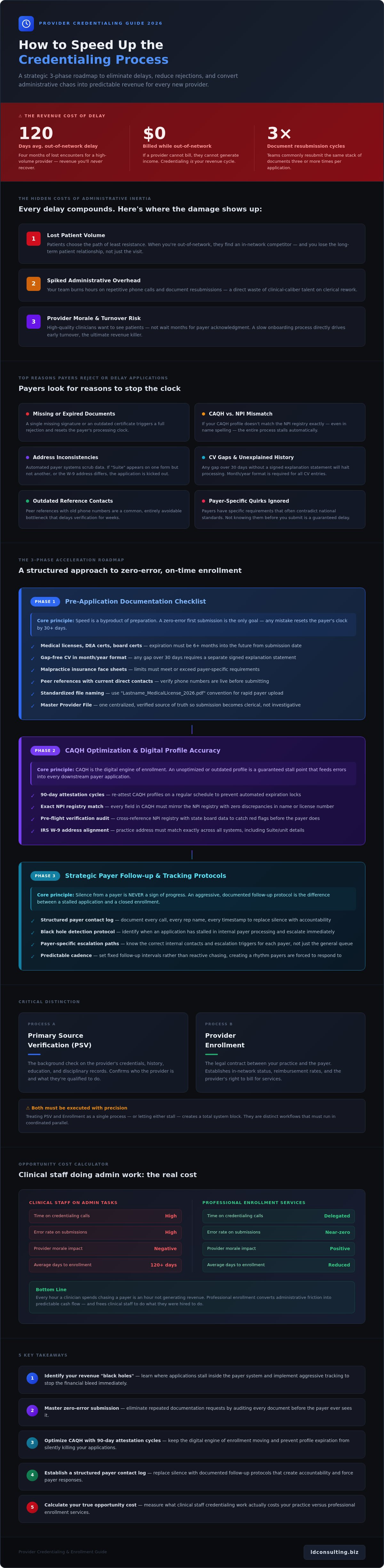
- Identify revenue "black holes" where applications stall and learn how to stop the financial bleed immediately.
- Master a zero-error submission strategy to learn how to speed up credentialing process and eliminate repeated documentation requests.
- Optimize your CAQH profile and 90-day attestation cycles to keep the digital engine of your enrollment moving.
- Establish a structured payer contact log to replace silence with aggressive, documented follow-up protocols.
- Calculate the true opportunity cost of using clinical staff for administrative tasks versus professional provider enrollment.
Understanding the Credentialing Bottleneck and Revenue Impact
Credentialing is the gatekeeper of your practice revenue cycle. If a provider cannot bill, they cannot generate income. It's that simple. Many administrators view this as a back-office chore. It's actually a front-end financial strategy. When you look for how to speed up credentialing process, you're looking for a way to stop the financial bleeding. Applications often fall into a "Black Hole." This happens when a payer receives a file but stops processing it due to a minor internal error. Without an aggressive tracking protocol, your application sits idle for weeks. Silence from a payer is never a sign of progress.
Consider the impact of a 120-day delay. For a high-volume provider, four months of out-of-network status means hundreds of lost encounters. You aren't just losing the immediate revenue. You're losing the long-term patient relationship. Patients choose the path of least resistance. If you aren't in-network, they'll find someone who is. It's also vital to distinguish between provider enrollment and primary source verification (PSV). PSV is the background check on the provider's history. Enrollment is the legal contract with the payer. Both must be executed with precision to avoid a total system stall.
The Hidden Costs of Administrative Inertia
Inertia is expensive. When providers remain out-of-network, your administrative overhead spikes. Your team spends hours on repetitive phone calls and document resubmissions. This is a waste of talent. This friction also damages provider morale. High-quality clinicians want to see patients. They don't want to sit in an office waiting for a payer to acknowledge their existence. A slow onboarding process can lead to early turnover, which is the ultimate revenue killer. Common hidden costs include:
- Lost patient volume as patients seek in-network competitors.
- Spiked administrative overhead from hours of wasted follow-up calls.
- Damaged provider morale and increased turnover risk for new hires.
Why Payers Reject or Delay Applications
Payers look for reasons to stop the clock. A single missing signature or an outdated certificate triggers a full rejection. Inconsistent data is another major culprit. If your CAQH profile doesn't match your NPI registry exactly, the process stalls. Payers also have specific requirements that often contradict national standards. Mastering how to speed up credentialing process requires knowing these specific payer quirks before you hit submit. A thorough practice assessment often reveals that these small, avoidable errors are what’s actually keeping your providers out-of-network.
Phase 1: The Pre-Application Documentation Checklist
Speed is a byproduct of preparation. If you want to know how to speed up credentialing process, start by looking at your data before the payer does. The goal is a zero-error submission on the first attempt. Any mistake, no matter how small, resets the payer's clock. You cannot afford to lose 30 days because of a typo or an expired certificate. Audit your documents now. Ensure every license, DEA registration, and board certification has an expiration date at least six months in the future. If a document expires during the processing window, the payer will likely reject the entire application.
Standardize your digital environment for rapid upload. Use clear, descriptive file naming conventions like "Lastname_MedicalLicense_2026.pdf" to avoid confusion. Centralize everything into a "Master Provider File." This is your single source of truth. When every piece of data is verified and ready, the actual submission becomes a clerical formality rather than a research project. This level of organization is the foundation of efficient provider enrollment.
The Essential Document Repository
A complete repository prevents the back-and-forth that kills momentum. You need current copies of medical licenses, DEA certificates, and board certifications ready for immediate dispatch. Your provider's CV must be gap-free. Payers require a month/year format for all entries. If there's a gap of more than 30 days, explain it in a separate signed statement. Include malpractice insurance face sheets with limits that meet or exceed payer requirements. Finally, secure peer references with current, direct contact information. Outdated phone numbers for references are a common, avoidable bottleneck.
The Verification Audit
Don't trust; verify. Perform a "pre-flight" audit by cross-referencing the NPI registry with state board data. Any discrepancy in name spelling or license numbers will trigger a red flag. Ensure the practice address matches the IRS Form W-9 exactly. Payers use automated systems to scrub this data. If the "Suite" number is missing on one form but present on another, the system may kick the application out. If this sounds tedious, a professional practice assessment can identify these friction points before they cost you revenue. Verify that work history on the CV matches the application exactly. Discrepancies here suggest a lack of attention to detail, which prompts payers to scrutinize the rest of your file even harder.
Phase 2: Optimizing CAQH and Digital Profile Accuracy
CAQH is the engine of modern credentialing. If it stalls, your revenue cycle breaks. Most payers pull data directly from this platform to verify your providers. If your profile is incomplete, outdated, or unverified, the payer stops processing immediately. They won't always call to tell you why. If you want to master how to speed up credentialing process, you must treat CAQH as a high-performance engine that requires constant tuning. Precision here is the prerequisite for speed.
The 90-day re-attestation cycle is the most common point of failure. Missing this deadline is the fastest way to get dropped from a panel or have your application archived. Beyond attestation, you must link your CAQH profile to every specific practice location where you see patients. If a location is missing, claims will deny even if you are technically "credentialed." Granting "Global Authorization" is another critical lever. Proactively allowing all payers to view your data eliminates the need for manual access requests. This simple setting can shave weeks off your timeline.
Step-by-Step CAQH Optimization
Don't ignore the "optional" fields. In the world of provider enrollment, nothing is truly optional. A payer in one state might require a data point that CAQH labels as voluntary. Fill out every field. Upload all supporting documents in high-resolution PDF format. Grainy scans lead to manual reviews and inevitable rejections. Review your "Global Authorizations" settings quarterly to ensure new payers can access your file without your intervention. Finally, set calendar alerts for re-attestation 10 days before the actual deadline. Waiting until day 90 is an unnecessary risk that leads to preventable delays.
PECOS and NPPES Alignment
Your digital identity must be a mirror image across all platforms. Synchronize your NPI Type 1 and Type 2 data within the NPPES registry. Discrepancies between your NPI profile and your CAQH file are a primary cause of application rejection. Update your Medicare enrollment via PECOS before you approach private payers. Many commercial plans use Medicare's data as their baseline for verification. If Medicare is current, the rest of the process moves faster. Every character in your NPI registry must match your CAQH profile exactly to prevent automated system flags from stalling your enrollment.
Phase 3: Strategic Payer Follow-up and Tracking Protocols
Silence from a payer is rarely good news. If you haven't heard back, assume the application is stuck in an administrative queue. Most practices wait for the payer to reach out. This is a mistake. Aggressive, structured follow-up is the only way to ensure your file moves from "received" to "approved." Establishing a "Payer Contact Log" is mandatory. This log serves as your internal record of every touchpoint, providing the necessary evidence if you need to escalate a stalled application. Without documented proof of your attempts to communicate, you have no leverage when a process exceeds its standard turnaround time.
Understanding how to speed up credentialing process requires a shift in mindset. You aren't just checking in. You're auditing the payer's progress. Every interaction must yield a specific data point: a tracking number, a status update, or a request for missing information. If a representative cannot provide a reference number, your application likely hasn't been entered into their system yet. You must stay persistent until you have a verifiable trail of the application's journey through the payer's department.
The Follow-up Cadence
Consistency beats intensity. Follow a strict 7-14-30 day cadence to keep your file at the top of the pile. This structured approach ensures that no application sits idle for more than a week without a status check. Use the following milestones:
- Day 7: Call to confirm receipt. Obtain a tracking or reference number immediately. If they haven't received it, resubmit while you are still on the phone.
- Day 14: Verify that the application has moved to the "In Review" stage. Ask if a specific coordinator has been assigned to the file.
- Day 30: Check for any "Requests for Information" (RFIs). Payers often send these via standard mail or internal portals without notifying you, which stops the processing clock indefinitely.
Managing Payer Relations
Efficiency depends on access. Don't settle for the general customer service line if you can avoid it. Ask for the direct email or extension of the specific credentialing coordinator handling your file. Keep detailed notes of the date, time, and the full name of every representative you speak with. This level of detail prevents "he said, she said" delays and holds the payer accountable. Additionally, reference the payer's specific "Effective Date" policy. Knowing whether they backdate to the application submission date or the contract signature date helps you manage cash flow expectations. If your team lacks the bandwidth for this level of persistence, our provider enrollment services act as your force multiplier.
Scaling Efficiency: Professional Provider Enrollment Services
In-house credentialing is a structural bottleneck. It lacks the scale and payer intelligence required for rapid approval. Most practices assign these tasks to office managers or clinical staff as a secondary duty. This is a strategic error. When you research how to speed up credentialing process, you're actually looking for a way to reclaim your team's time. Clinical staff should focus on patients. Administrative staff should focus on operations. Forcing them to manage payer portals creates a massive opportunity cost that isn't always visible on a balance sheet. Every hour spent on a payer hold line is an hour stolen from practice growth.
Professional consultants bypass the common roadblocks that stall in-house efforts. Issues like "closed panels" or "network adequacy" rejections often require specific appeal strategies that generalists don't possess. We know the language payers use to gatekeep their networks. LD Consulting provides specialized expertise for national provider enrollment. We understand the nuances of different state markets and payer requirements for 2026. We move fast because we've already solved the problems you're currently facing. This isn't just about filing forms. It's about managing a complex contractual landscape with precision.
The Case for Outsourcing Credentialing
Outsourcing isn't just about offloading work. It's about acquiring specialized leverage. Professional consultants possess direct contact lines to payer coordinators that aren't available to the public. They bypass the automated phone trees and general help desks. This direct access is a primary driver of speed. Our per-engagement fee structure provides total budget predictability. You aren't paying for hours of hold music; you're paying for a completed enrollment. High-volume experience also reduces the risk of re-work. A specialist identifies a missing data point in seconds. An in-house generalist might not find it until the payer issues a rejection notice 45 days later. We provide several key advantages:
- Direct Payer Access: We use established relationships to move applications past general intake queues.
- Predictable Costs: Fixed-cost engagements eliminate the uncertainty of hourly administrative labor.
- Accuracy Standards: Specialized focus ensures error rates remain near zero, preventing repeated submissions.
Integrating Credentialing with Revenue Cycle Management
Credentialing is the foundation of your revenue cycle. It isn't a separate administrative island. Accurate enrollment prevents the front-end claim denials that cripple cash flow. When your provider data is accurate across all platforms, your medical billing becomes predictable. This is where a comprehensive practice assessment becomes invaluable. It reveals exactly how enrollment errors are impacting your bottom line. LD Consulting provides the national expertise required to manage these complexities across multiple states and payers. We act as your administrative force multiplier. We handle the friction so you can focus on growth. The next step is simple. Schedule a consultation with LD Consulting to eliminate your credentialing backlog and secure your practice's financial future.
Take Control of Your Provider Onboarding
Stop treating credentialing as an afterthought. It's the foundation of your revenue cycle. You've seen the roadmap: audit your documents six months ahead, optimize your CAQH profile with precision, and maintain a relentless follow-up cadence. Mastering how to speed up credentialing process is a matter of administrative discipline, not luck. If your data is clean and your tracking is aggressive, the payer black hole disappears. Precision on the front end prevents denials on the back end.
Many practices eventually realize that the internal cost of enrollment delays far exceeds the price of professional intervention. LD Consulting offers nationwide provider enrollment expertise with a per-engagement pricing model for total transparency. We perform comprehensive practice assessments to identify revenue leaks and fix them at the source. We handle the friction so your clinicians can focus on care. Don't let administrative inertia dictate your growth or compromise your cash flow. Streamline your provider enrollment with LD Consulting today and get your providers in-network faster. You've built a great practice; let's make sure you get paid for it.
Frequently Asked Questions
How long does the average credentialing process take in 2026?
The average timeline typically spans 90 to 120 days. Some commercial payers move faster, but three to four months is the standard expectation for most networks. Medicare often processes within 45 to 60 days if the PECOS application is error-free. You should always plan for the maximum window to avoid revenue gaps during provider onboarding. Efficiency depends entirely on the accuracy of your initial submission.
Can I speed up the credentialing process once the application is submitted?
Yes, you can accelerate the timeline through structured, persistent follow-up. You shouldn't just wait for a response. Call the payer on day seven to confirm receipt and secure a reference number. Regular status checks every 14 days ensure your file doesn't sit idle in an administrative queue. Active management is the only way to learn how to speed up credentialing process effectively.
What are the most common errors that delay provider enrollment?
Missing signatures and outdated documents are the primary culprits. Discrepancies between your CAQH profile and your NPI registry also trigger immediate rejections. Ensure your CV has no gaps and uses the mandatory month/year format. Even a minor typo in a practice address can cause an automated system to kick your application out for manual review. Precision is the prerequisite for speed.
Is it possible to see patients before the credentialing process is complete?
You can see patients, but you likely won't get paid for those services. Most payers won't backdate your effective date to before the contract was signed. Seeing patients out-of-network results in significant revenue loss and unhappy patients facing unexpected bills. It's better to wait for the official approval notice before opening the provider's schedule to commercial insurance patients. Avoid the financial risk.
What is the difference between credentialing and provider enrollment?
Credentialing is the verification of a provider's qualifications and history. Enrollment is the legal process of contracting that provider with a specific payer network. Think of credentialing as the background check and enrollment as the final contract. You must complete both stages before a provider can bill for services under their own NPI. One verifies the person; the other authorizes the payment.
How often do I need to update my CAQH profile?
You must re-attest every 90 days at a minimum. However, you should update the profile immediately whenever a license, DEA, or insurance policy expires. Proactive updates prevent the system from flagging your account as non-compliant. Set calendar alerts for 10 days before your attestation deadline to ensure you never miss a window. A stalled profile means a stalled revenue cycle.
Do I need a separate credentialing process for every insurance company?
Yes, every payer maintains its own internal panel and contracting requirements. While CAQH streamlines the data collection, you still have to submit individual applications to each insurance company. Some payers have unique supplemental forms that aren't included in the standard CAQH data set. You must manage each relationship as a distinct project to avoid delays. Don't assume one submission covers all networks.
Can a credentialing consultant guarantee a specific start date?
No, because the final approval rests entirely with the payer's internal committee. A consultant manages the variables within your control, such as document accuracy and follow-up frequency. We eliminate the errors that cause delays. While we can't force a payer's hand, we ensure your application is the cleanest file on their desk, which is how to speed up credentialing process for any practice. Focus on compliance.


