

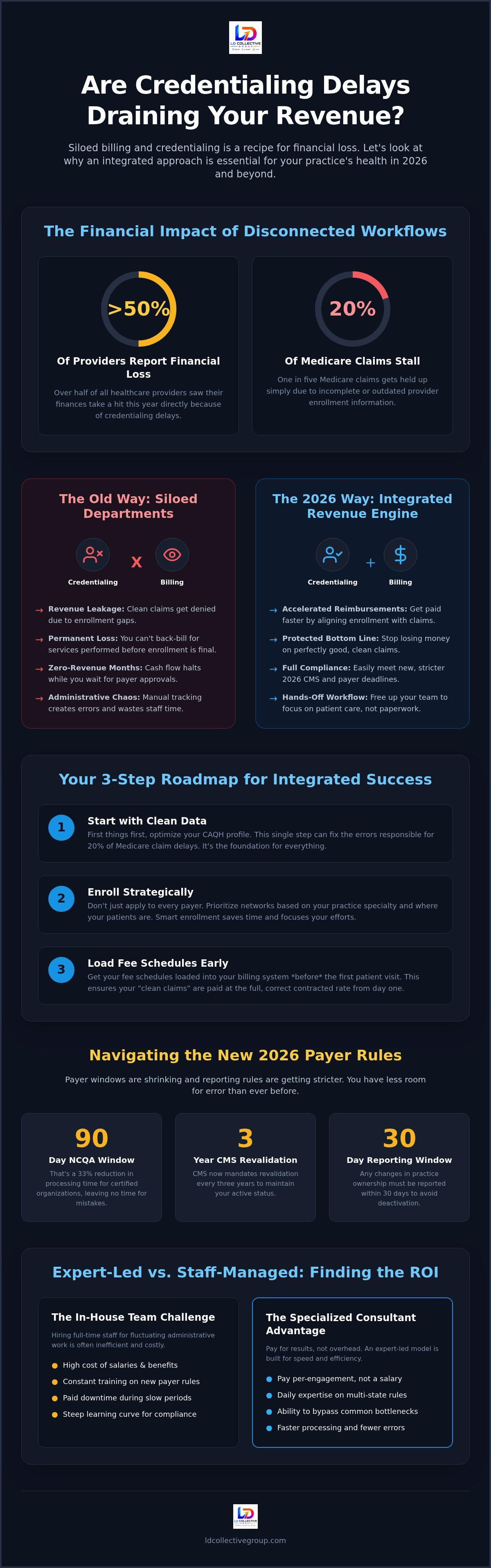
Over 50% of healthcare providers reported financial losses this year because of credentialing delays. It's a staggering number. You might even be part of the group seeing 20% of Medicare claims stall simply due to incomplete enrollment data. In 2026, treating these departments as separate silos is a recipe for revenue leakage. You need integrated medical billing and credentialing to protect your bottom line. It's the only way to stop the zero-revenue months that happen while you wait for payer approval.
We know the administrative burden is overwhelming. The new 90-day NCQA windows don't leave room for mistakes. This guide shows you how to bridge the gap between enrollment and claims to accelerate your reimbursements. You'll learn how to build a streamlined, hands-off workflow that meets 2026 payer standards. It's time to stop the paperwork chase and start scaling your practice.
Key Takeaways
- Stop losing money on clean claims by using integrated medical billing and credentialing to close the gap between enrollment and payment.
- Learn how to optimize your CAQH profile and pick the right payers to grow your practice volume.
- See why hiring a specialist on a per-engagement basis is cheaper and faster than using your own staff for paperwork.
- Get a clear roadmap for a hands-off workflow that keeps you compliant with 2026 payer rules.
Why Your Billing and Credentialing Shouldn’t Live in Silos
Most practices treat billing and credentialing as separate departments. They shouldn't. When these functions don't talk to each other, you lose money. We define integrated medical billing and credentialing as a single, unified revenue engine. It's the technical handshake between getting a provider into a payer network and getting paid for their work. Without this connection, you experience "Revenue Leakage." These are clean claims that are technically perfect but get denied because the provider's enrollment isn't active or updated.
A functional back office relies on three pillars:
- Accurate: Data matches across all payer platforms perfectly.
- Compliant: Meeting strict 2026 CMS reporting windows without fail.
- Fast: Moving from provider intake to reimbursement without friction.
In 2026, manual, siloed tracking is a liability. Payers are phasing out paper and mandating digital submissions. If your billing team doesn't know your credentialing status in real-time, you're just guessing at your cash flow.
The High Cost of Disconnected Administrative Workflows
Credentialing errors do more than delay payments; they often turn potential revenue into uncollectible debt. If a provider treats patients before their enrollment is finalized, you usually can't backbill for those services. A 30-day credentialing delay can result in thousands of dollars in permanent revenue loss that your practice will never recover. In-house teams often miss this because they focus on claim scrubbing while ignoring the enrollment gaps that cause the denial. You need a system where enrollment status dictates billing logic from day one.
The 2026 Roadmap for Integrated Enrollment and Claims
Success in 2026 requires a front-loaded strategy. You can't wait for a denial to fix an enrollment error. A true integrated medical billing and credentialing workflow starts months before the first claim. It's about aligning your provider data with your billing logic to ensure every visit is reimbursable from day one.
- Step 1: Clean data. Optimize your CAQH profile. Incomplete information causes 20% of Medicare claim delays. Fix it now.
- Step 2: Strategic enrollment. Don't apply everywhere. Prioritize payers based on your specific practice specialty and expected patient volume.
- Step 3: Fee schedules. Load these into your billing system before the first patient visit. This ensures your "clean claims" actually pay at the full contracted rate.
If you aren't sure where the leaks are, a healthcare practice audit can pinpoint exactly where your revenue stalls. We find the friction points so you can focus on patient care.
Navigating New 2026 Payer and CMS Requirements
NCQA has shortened credentialing windows to 120 days for accredited organizations and 90 days for certified ones. That's a 33% reduction in processing time. You have less room for error. CMS now mandates revalidation every three years and requires reporting ownership changes within 30 days. Stay ahead with our 2026 Strategic Guide to avoid deactivation and ensure full compliance with new prior authorization rules.
Beyond the Paperwork: Building a Profitable Practice
Administrative work shouldn't be a permanent drain on your resources. Many practices make the mistake of hiring full-time staff to manage a workload that fluctuates. It's inefficient. We advocate for an "expert-led" model over a "staff-managed" one. This is where the ROI of integrated medical billing and credentialing truly shows up. By using a per-engagement fee structure, you eliminate the high cost of benefits, training, and downtime associated with full-time salaries. You pay for the enrollment, not the overhead.
A profitable practice requires more than just getting into a network. You need accurate coding and aggressive denial management to maximize every reimbursement. When billing and enrollment are handled together, your team knows exactly why a claim failed. They can fix the underlying credentialing issue immediately rather than resubmitting a doomed claim. Adopting integrated medical billing and credentialing is a 2026 necessity for financial health. It makes healthcare provider credentialing a strategic asset rather than a recurring headache.
Choosing Between In-House and Specialized Consulting
In-house teams often struggle with the steep learning curve of 2026 payer updates. Specialized consultants don't. They handle these requirements daily across multiple states. They move faster. They know which payers are currently backlogged and how to bypass common bottlenecks. A practice assessment is the best place to start. It provides a clear view of your current revenue leaks and administrative gaps. You can't build a streamlined, profitable system on top of a broken foundation. Move away from administrative chaos and toward a model that prioritizes speed and compliance. It's the only way to ensure your practice grows without being held back by paperwork.
Secure Your 2026 Revenue Engine
The days of managing enrollment and claims in separate silos are over. In 2026, success depends on integrated medical billing and credentialing to catch revenue leaks before they happen. You've seen the roadmap; now it's time to execute. Moving to a per-engagement model ensures you only pay for specific results rather than high staff salaries. It's the fastest way to bridge the gap between provider intake and your first reimbursement. With our national expertise and focus on fast turnaround times, we help you stay compliant while you focus on your patients. Don't let administrative friction hold your practice back.
Your practice deserves a streamlined system that actually works. We've solved these problems for providers nationwide and we're ready to help.
Frequently Asked Questions
What is the difference between provider enrollment and credentialing?
Credentialing is the verification of your professional qualifications, including your education, training, and licenses. Enrollment is the administrative process of joining a specific payer's network so you can receive payment. Think of it this way: credentialing proves you're a qualified doctor; enrollment allows you to actually get paid for the care you provide. You need both to avoid revenue gaps.
How long does the integrated medical billing and credentialing process take in 2026?
Current 2026 standards aim for 90 to 120 days depending on the organization's certification level. While digital submissions are now mandatory, integrated medical billing and credentialing still requires aggressive follow-up to meet these tighter windows. Factors like payer backlogs or missing CAQH data can easily extend this timeline if the process isn't managed by a specialist who understands the current regulatory landscape.
Can I bill for services while my credentialing application is still pending?
You usually cannot bill for services until your enrollment is active. Most payers won't reimburse for care provided during the pending phase. While some commercial plans might allow for limited retroactive billing, Medicare is strictly date-driven. Seeing patients before your official start date is a fast way to generate uncollectible debt that your practice will never be able to recover.
What are the most common credentialing errors that lead to claim denials?
The most frequent errors include outdated CAQH profiles, mismatched NPI records, and expired state licenses. Approximately 20% of Medicare claim delays stem from these simple data gaps. Even a minor discrepancy in your practice location address can cause a payer to reject a clean claim. This is exactly why specialized practice assessments are vital for catching these errors before they impact your cash flow.

Disclaimer
The information provided in this article is for general educational and informational purposes only and reflects the author’s professional experience, research, and interpretation of provider credentialing, payer enrollment, and healthcare operations practices.
Credentialing and enrollment requirements vary by payer, health plan, government program, provider type, state, contract, and organizational structure and are subject to change. Nothing in this article should be interpreted as legal, regulatory, compliance, tax, or other professional advice, nor as an official interpretation or guidance from CMS, a state Medicaid agency, Medicare Administrative Contractor (MAC), commercial payer, accrediting organization, or other regulatory entity.
Organizations and providers should independently verify current requirements with the applicable payer, government agency, regulatory authority, accreditation organization, contract, provider manual, or other authoritative source before making credentialing, enrollment, contracting, billing, or compliance decisions.
Any opinions expressed are those of the author and do not necessarily represent the views, policies, or positions of any current or former employer, client, payer, or affiliated organization.


