

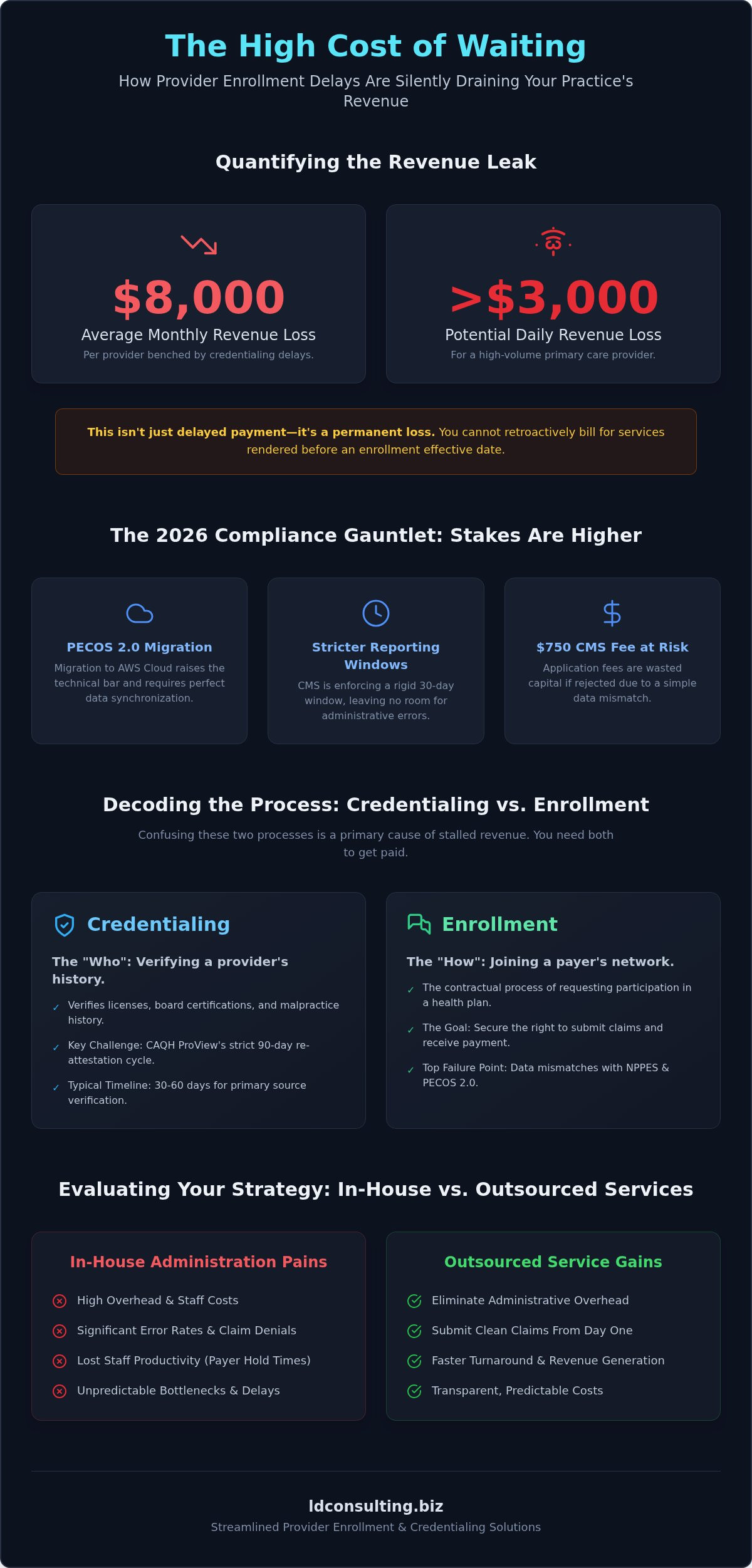
Your practice loses an average of $8,000 every month that a new provider sits on the sidelines. That isn't just an administrative delay. It's a direct leak in your bottom line. In 2026, the stakes are higher than ever. With PECOS 2.0 migrating to the AWS Cloud and CMS enforcing stricter 30-day reporting windows, professional provider enrollment and credentialing services are no longer optional. They're the difference between a predictable cash flow and a mountain of denied claims.
You're likely tired of the endless CAQH re-attestations and the silence from insurance payers. It's frustrating to watch paperwork stall your growth while billing errors pile up. Administrative friction is a choice you don't have to make. This guide provides a no-nonsense roadmap to streamline your operations and stop the revenue bleed. We'll show you how to achieve faster turnaround times, submit clean claims from day one, and finally reduce the administrative burden on your staff.
Key Takeaways
- Stop treating paperwork as a checkbox. Every day spent out-of-network is unrecoverable revenue that directly impacts your bottom line.
- Master the distinction between credentialing and enrollment to navigate the payer maze without avoidable application bottlenecks.
- Outsource to specialized provider enrollment and credentialing services to eliminate the high overhead and error rates of in-house administration.
- Prioritize your payer strategy by identifying high-value networks and centralizing essential data like NPI and CAQH records.
- Transition to a per-engagement model for transparent, predictable costs and a faster path to clean claim submissions.
The High Cost of Delays: Why Credentialing is a Revenue Strategy
Administrative friction is a financial choice. Every day a provider remains out-of-network, your practice loses revenue. You cannot recover those days. Most administrators treat paperwork as a simple checkbox. This is a mistake. Credentialing is the actual foundation of your revenue cycle. If the foundation is cracked, the billing process fails. Without proper enrollment, your billing team is just practicing data entry for claims that will never be paid.
The 2026 environment has made manual processes a liability. With the migration of PECOS to the AWS Cloud on May 4, 2026, and the launch of new Medicaid systems in various states, the technical barrier is higher. CMS has also expanded its retroactive revocation authority. One error in your application can now lead to a demand for repayment of years of Medicare revenue. Professional provider enrollment and credentialing services exist to eliminate these specific risks. They turn a defensive administrative task into an offensive growth strategy.
Quantifying the Revenue Leak
The numbers are stark. Industry data shows practices lose between $6,000 and $8,000 per month for every provider caught in a credentialing bottleneck. In high-volume markets, a primary care provider seeing 25 patients a day stands to lose over $3,000 daily. These aren't just delayed payments. They are often permanent losses. You cannot bill for services rendered before an effective date.
- Immediate Denials: Claims submitted during a credentialing gap are rejected. Many payers refuse to process these retroactively.
- Staff Opportunity Cost: Your internal team spends hours on payer hold music or chasing missing attestation links. That is time stolen from patient care and active collections.
- Application Fees: The 2026 CMS enrollment fee is $750. Paying this fee for an application that gets rejected due to a data mismatch is a pure waste of capital.
The Speed-to-Market Advantage
Efficiency is your most powerful scaling tool. Fast-tracking enrollment allows you to onboard new hires and see insured patients immediately. Strategic provider enrollment and credentialing services don't just blast out applications. They prioritize payers based on your specific patient volume and reimbursement rates. This targeted approach ensures your most profitable channels open first. Credentialing ROI is measured by the time saved between a provider's start date and their first deposited payment. If you aren't measuring that gap, you're losing money. We close that gap by moving faster than the payers expect.
Decoding the Process: Provider Enrollment vs. Healthcare Credentialing
Many administrators use these terms interchangeably. They shouldn't. Confusing credentialing with enrollment is a primary cause of rejected claims and stalled revenue. Credentialing is the verification of a provider's history. Enrollment is the contractual process of joining a payer's network. You need both to get paid. One verifies your competence; the other secures your right to reimbursement. Without a clean bridge between the two, your billing cycle will fail.
In the 2026 compliance environment, these processes are more rigid than ever. Data mismatches between the National Plan and Provider Enumeration System (NPPES) and PECOS 2.0 now trigger immediate application rejections. Professional provider enrollment and credentialing services ensure these systems are synchronized before the first document is submitted. Precision at this stage prevents months of back-and-forth with payer representatives who are looking for any reason to delay your file.
Credentialing: The Verification Phase
Credentialing is the "who." It involves primary source verification of licenses, board certifications, and malpractice history. Payers don't take your word for it. They verify every date and document with the issuing body. In 2026, CAQH ProView has become more aggressive. They now strictly enforce a 90-day re-attestation cycle. If your profile status hits "Expired," your applications stop moving. It's that simple. Maintaining an accurate CAQH profile is no longer a quarterly task; it's a weekly necessity for active practices. Verification timelines typically range from 30 to 60 days, depending on the complexity of the provider's history.
This phase is about risk mitigation. Payers want to ensure you're qualified and compliant before they offer a contract. If you need to audit your current status, a professional practice assessment can identify gaps in your verification history before they become denials.
Enrollment: The Contracting Phase
Enrollment is the "how." This is the process of requesting participation in a health insurance network. It begins only after the initial verification is complete. You submit the application to the payer's network management department. This is where you encounter the "closed panel" hurdle. In competitive markets like Florida, major payers frequently claim their networks are full. Navigating this requires a strategic appeal, not just a standard form. Once accepted, you finalize the provider contract and receive a dedicated provider ID. Successful provider enrollment and credentialing services manage this transition seamlessly, ensuring no gap between the verification of the doctor and the activation of the contract.
Outsourcing vs. In-House: Evaluating Your Enrollment Strategy
Managing enrollment in-house is often a hidden drain on practice resources. Most administrators view it as a clerical task for the front office. It isn't. It is a specialized financial function. When you rely on general staff, you pay for their learning curve, their benefits, and their mistakes. Professional provider enrollment and credentialing services replace these variable risks with a fixed, results-based model. You stop paying for hours worked and start paying for providers enrolled.
The 2026 landscape is too complex for part-time attention. Payer requirements change weekly. Systems like PECOS 2.0 and CAQH ProView now require constant monitoring to avoid deactivation. If your internal team misses a single 30-day reporting window, the financial recovery can take months. Outsourcing shifts this liability to specialists who navigate these systems daily. It transforms a chaotic administrative burden into a predictable line item.
The In-House Bottleneck
Staff turnover is the greatest threat to an in-house strategy. When your only credentialing expert leaves, they take years of institutional knowledge and payer contacts with them. Your revenue pipeline effectively freezes until a replacement is hired and trained. This "single point of failure" is a risk most growing practices cannot afford. Furthermore, the distraction factor is real. Every hour your team spends on payer hold music is an hour stolen from patient care or active collections. Inconsistency in follow-ups leads to expired applications, forcing your practice to restart the 90 to 120-day waiting period from scratch.
- Turnover Risk: Loss of expertise leads to immediate revenue gaps.
- Manual Errors: Data mismatches between systems trigger automatic rejections.
- Follow-up Gaps: Inconsistent contact with payers extends the enrollment timeline indefinitely.
The Professional Service Advantage
Specialized provider enrollment and credentialing services offer immediate scalability. You can add new providers or expand into new states without hiring additional administrative staff. We use established payer relationships and specialized workflows to bypass common friction points. This isn't just about filling out forms. It's about knowing which department to call when an application stalls. The cost of a single credentialing engagement is often less than the revenue lost in just one week of unbillable provider time. By choosing a per-engagement model, you gain transparent pricing that aligns perfectly with your practice goals. You get a seasoned partner who is incentivized to get your providers in-network as quickly as possible.
Navigating the Payer Maze: A Roadmap to Becoming In-Network
Payer enrollment is a war of attrition. You don't win by being loud. You win by being accurate and relentless. A standardized roadmap turns a chaotic process into a predictable timeline. Most practices fail because they treat applications as "fire and forget" tasks. They aren't. They require active management from submission to the first paid claim. Professional provider enrollment and credentialing services provide the structure needed to navigate this complexity without losing revenue to simple data errors.
The path to participation follows five non-negotiable steps. Skip one, and the entire cycle breaks.
- Step 1: Data Gathering. Centralize your NPI, CAQH, and clinical documentation. A mismatch between NPPES and PECOS 2.0 triggers an immediate rejection.
- Step 2: Payer Prioritization. Target the networks that drive your patient volume. Don't waste energy on low-reimbursement panels if your primary demographic uses Florida Blue or UnitedHealthcare.
- Step 3: Application Submission. Accuracy is your only defense against the 2026 enforcement surge. One missing signature can add 30 days to the process.
- Step 4: The Follow-Up Cycle. Persistence is mandatory. Documented communication keeps your file at the top of the pile.
- Step 5: Contract Activation. Verify your effective date before you see the first patient. Seeing a patient even one day early means you are working for free.
Mastering the CAQH and PECOS Portals
PECOS 2.0 migrated to the AWS Cloud on May 4, 2026. This technical shift changed how applications are tracked and processed. You must ensure your data is synchronized across all platforms. Keep your CAQH profile "attestation-ready" at all times. Failure to re-attest every 90 days pauses your applications across all commercial payers. We monitor these portals daily to prevent an "Expired" status from halting your cash flow. To secure your revenue and eliminate the guesswork, view our Shop Packages for professional enrollment support.
The Art of the Payer Follow-Up
Silence from a payer is not progress. It's a delay. Establish a strict 14-day cadence for checking application status. When you call, document the representative's name, the date, and the specific reference number for the interaction. This paper trail is your leverage. If an application stalls past the standard 90-day window, use your logs to escalate the file to a supervisor. You cannot rely on the payer's internal system to move your file forward. You have to push it.
LD Consulting: Streamlined Solutions for Healthcare Providers
Administrative friction is a choice. LD Consulting is the seasoned specialist you call when you need that friction eliminated. We provide national provider enrollment and credentialing services built on speed, accuracy, and professional assurance. There is no hand-holding here. There is only execution. We understand the 2026 regulatory environment because we navigate its complexities every day. We move fast. So should you.
Our per-engagement model is a transparent alternative to the high costs of in-house staff or hourly consultants. You get predictable expenses. You get a partner incentivized to deliver outcomes, not just log hours. Most services hide behind vague timelines. We stand behind our results. Our practice assessments identify the exact revenue leaks in your current cycle. We find the unbilled time and the missed effective dates that cost your practice thousands every month. We stop the bleed immediately.
Comprehensive Provider Enrollment Services
We manage the enrollment process from the first piece of data to the final signed contract. This is full-cycle management. We handle all communication with insurance payers. Your staff stays focused on patient care. Your billing team stays focused on collections. We provide tailored solutions for:
- New Practices: Establishing a clean foundation for immediate cash flow.
- Solo Practitioners: Eliminating the administrative burden of growth.
- Large Groups: Scalable enrollment that keeps pace with high-volume hiring.
Expert Healthcare Credentialing and Compliance
Credentialing is the bedrock of your reputation. We perform rigorous verification and compliance checks to protect your practice from audit risks. The 2026 landscape requires constant vigilance. We provide ongoing support to ensure your re-credentialing deadlines and CAQH attestations are never missed. Precision is our standard. Accuracy is our promise. If you are ready to integrate your enrollment strategy with a high-performing revenue cycle, learn more about our medical billing services. The LD Consulting difference is simple. Zero fluff. Maximum accuracy. Faster results.
Secure Your Revenue for 2026
Administrative delays are a choice. You've seen the data. Every day a provider sits idle is a day of lost, unrecoverable revenue. Credentialing is the actual foundation of your practice's cash flow. In the 2026 landscape, manual oversight and staff turnover are risks you don't need to take. Precision in your CAQH and PECOS data is the only way to bypass the payer bottlenecks that stall your growth. You need a partner who moves as fast as the market demands.
LD Consulting provides professional provider enrollment and credentialing services with a focus on speed and absolute accuracy. We eliminate the guesswork with a transparent per-engagement fee model and comprehensive national service coverage. Our practice assessment and audit expertise identify exactly where your revenue cycle is leaking today. Stop fighting the payer maze alone. It's time to reclaim your time and your revenue. Get your practice in-network faster with LD Consulting. Your bottom line will show the difference immediately.
Frequently Asked Questions
How long does insurance credentialing take in 2026?
Expect the process to take 60 to 120 days per payer. Medicare through PECOS 2.0 currently averages 45 to 90 days, while state Medicaid enrollment often takes longer. In Florida, timelines are more extended, frequently reaching 90 to 150 days. These windows are non-negotiable. Professional provider enrollment and credentialing services track these dates to ensure your application doesn't sit idle in a payer's queue.
What is the difference between provider enrollment and credentialing?
Credentialing is the verification of your professional history. Enrollment is the contractual process of joining a health insurance network. You cannot have one without the other. Credentialing proves you're qualified to practice; enrollment gives you the legal right to get paid for it. If you skip the enrollment phase, your credentials won't matter to the billing department.
Can a provider see patients while their credentialing is still pending?
You can see patients, but you likely won't get paid at in-network rates. Most payers will deny any claim submitted before your official effective date. Some commercial payers offer limited retroactivity, but it's rare and unreliable. Seeing patients while pending is a high-risk financial move that often leads to unrecoverable revenue leaks.
How much do professional provider enrollment services cost?
Industry averages for outsourcing typically range from $150 to $600 per enrollment. Costs vary based on the complexity of the payer and the provider's history. While some firms charge hourly, a per-engagement model provides more predictable costs for your practice. This investment is minimal compared to the $8,000 in monthly revenue lost when a provider remains out-of-network.
What documents are required for the provider credentialing process?
You must have your NPI, current state license, DEA registration, and board certifications ready. Payers also require an updated CV, malpractice insurance face sheets, and a complete CAQH ProView profile. Any mismatch in this data will trigger an immediate rejection. We centralize these documents to ensure every application is 100% accurate before submission.
Do I need to re-credential if I move to a different state?
Yes. Credentialing is state-specific because it relies on state-issued licenses and local payer contracts. You'll need a new license, a new Medicaid ID, and fresh applications for commercial panels in your new location. Moving across state lines effectively resets your enrollment clock. Plan for a 90 to 120-day transition period to avoid a total halt in revenue.
How does credentialing impact my medical billing and claim denials?
Credentialing is the foundation of your revenue cycle. If a provider's effective date isn't active in the payer's system, every claim submitted will be denied immediately. These denials are often final. Gaps in provider enrollment and credentialing services lead to billing errors that your team can't fix after the fact. Clean billing starts with clean enrollment.
What is CAQH and why is it mandatory for provider enrollment?
CAQH ProView is the industry-standard database for provider information. Most commercial payers use it as their primary source for verification. It's mandatory because it centralizes your data, but it requires constant maintenance. In 2026, failing to re-attest your profile every 90 days will result in an "Expired" status. This pauses all active applications and stops your enrollment progress.


