

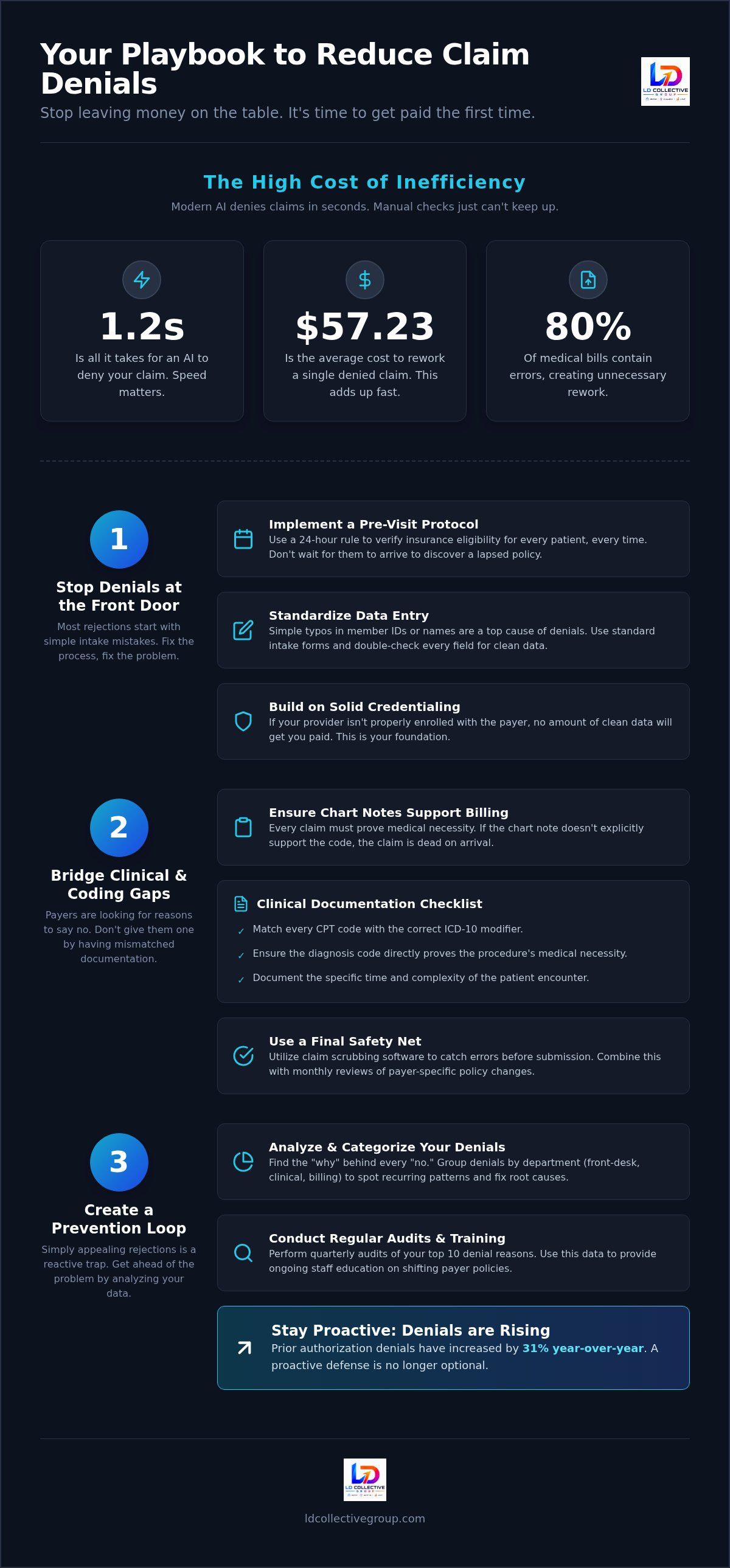
The average insurance payer takes exactly 1.2 seconds to process and deny your claim. That's the speed of modern AI. If you want to reduce claim denials medical billing, you can't rely on manual checks anymore. Revenue lost. Time wasted. Every rework costs your practice $57.23, and you know the frustration of watching cash flow stall while administrative burnout climbs. You deserve a system that works as hard as you do.
This 2026 playbook provides a proactive strategy to eliminate errors before they leave your office. We'll look at why credentialing is your first line of defense, how to audit your internal processes, and the exact steps to build a streamlined revenue cycle. Stop leaving money on the table. It's time to get paid the first time.
Key Takeaways
- Verify insurance eligibility before the patient walks in. This simple front-desk check is the most direct way to reduce claim denials medical billing.
- Standardize your data entry. Simple typos in member IDs or names create unnecessary rework that stalls your revenue cycle.
- Bridge the gap between clinical notes and coding. Ensure every chart note explicitly supports medical necessity to leave payers with no room for dispute.
- Build a denial recovery loop. Categorize your rejections by department to identify and fix the root causes of recurring errors.
Stop Denials at the Front Door: Eligibility and Data Entry
Inaccurate data isn't an accident; it's a choice. Clean data is your primary strategy to reduce claim denials medical billing. Most denials happen before the provider ever enters the room. A comprehensive practice assessment acts as your diagnostic tool, identifying exactly where your intake process is failing. You need to identify Coordination of Benefits (COB) issues during the initial intake. Billing the wrong payer first guarantees a rejection. It's a waste of your team's time and your practice's money.
Data entry errors are the low-hanging fruit of the medical billing process. Industry data from March 2026 confirms 80% of medical bills contain errors. A single typo in a member ID or a misspelled name turns a clean claim into a costly rework. Standardize your intake forms. Double-check every field. Remember that Healthcare Credentialing is the foundation here. If your provider isn't properly enrolled with the payer, no amount of clean data will secure your reimbursement. Start with a solid infrastructure.
The Pre-Visit Verification Protocol
Efficiency requires a strict routine. Implement a 24-hour pre-appointment verification rule for all patients. Don't wait for the patient to arrive to find out their policy lapsed. Scan insurance cards at every visit. Policies change, and assumptions lead to burnout. Use real-time eligibility tools to catch expired coverage immediately. It's faster than a phone call and more accurate than a guess. Clean claims start at the front desk.
Bridge the Gap Between Clinical Documentation and Coding
Payers are not your partners. They're looking for any reason to say no. Don't give them one. To effectively reduce claim denials medical billing, you must align your clinical narrative with your coding. If the chart note doesn't explicitly support medical necessity, the claim is dead on arrival. You need to prove why the service was required, not just that it happened.
Many practices treat billing and Provider Enrollment as separate problems. They aren't. Often, a coding error is actually a hidden credentialing failure. If a provider isn't correctly enrolled for a specific location or plan, the payer will trigger a generic denial code. Fix your enrollment before you spend hours fighting a bill that was never going to be paid. It's about building a foundation that supports your revenue, not one that leaks it.
Accuracy requires precision. A robust program for clinical documentation improvement ensures that your charts support the level of service billed. You should verify that your team follows these steps:
- Match every CPT code with the appropriate ICD-10 modifier.
- Ensure the diagnosis code directly supports the procedure's medical necessity.
- Document the specific time or complexity spent on the patient encounter.
The Role of Claim Scrubbing and Compliance
Don't send claims blindly. Catching mismatched codes before submission is non-negotiable. Utilize claim scrubbing software to act as your final safety net. This technology flags errors that human eyes often miss during a busy shift. But software isn't a cure-all. You must review payer-specific policies monthly to stay ahead of guideline changes. Payers shift the goalposts constantly. For a deeper look at this synergy, read our guide on Integrated Medical Billing and Credentialing: The 2026 Revenue Strategy. If you're struggling with persistent rejections, an expert Practice Assessment can find the root cause.
Implement a Denial Recovery and Prevention Loop
Appealing every rejection is a reactive trap. To truly reduce claim denials medical billing, you must build a loop that stops the leak at the source. Stop guessing. Analyze your denial codes to find the "why" behind every "no." When you categorize denials by department, you see the patterns. Front-desk errors look like eligibility issues. Clinical errors look like medical necessity disputes. Billing errors look like coding mismatches. You can't fix what you haven't measured. Categorization turns a pile of rejections into an actionable to-do list that protects your bottom line.
Practice audits are your revenue insurance. They shouldn't be optional. Training your staff once is a nice gesture, but it isn't a strategy. Ongoing education is the only way to keep up with shifting payer policies. If your team doesn't know that UnitedHealthcare reduced its peer-to-peer review window to 14 days in 2025, you've already lost. Knowledge is profit. Keep your team sharp and your revenue cycle will follow. It's about building a culture of accuracy that payers can't ignore. With prior authorization denials increasing by 31% year-over-year, your team needs a proactive defense.
Leveraging Practice Assessments to Plug Revenue Leaks
Data tells a story. Conduct a quarterly audit of your top 10 denial reasons to identify systemic failures. Often, these rejections are directly linked to provider enrollment delays or credentialing gaps. A professional Practice Assessment is the fastest path to achieving a 95% or higher clean claim rate. It identifies the friction points you're too close to see. Secure your revenue. Plug the leaks. Move fast. Your cash flow depends on a foundation of clean data and compliant provider files.
Secure Your Revenue Cycle Today
Clean claims aren't a matter of luck. They're the result of rigid protocols, precise documentation, and continuous feedback. If you aren't auditing your top denial codes quarterly, you're choosing to lose money. A proactive strategy is the only way to reduce claim denials medical billing in an environment where payers use AI to audit every claim. Stop the revenue leak. Use our national expertise in credentialing and billing. Our fast, reliable practice audits identify exactly where your system is failing.
You've built a practice to care for patients. Let's make sure the billing side is just as healthy. Your revenue cycle should be a source of strength, not a constant fire to put out. You have the tools to win. Now, it's time to use them.
Frequently Asked Questions
What are the most common reasons for medical claim denials?
Eligibility errors, missing prior authorizations, and coding mismatches top the list. Prior authorization denials increased by 31% in 2026, making them a primary target for those looking to reduce claim denials medical billing. Other frequent culprits include duplicate billing and services not covered under the patient's specific plan. Clean claims require verifying these details before the provider encounter begins.
How can I differentiate between a claim denial and a claim rejection?
Rejections occur at the clearinghouse or payer's front-end system due to formatting or simple data errors. These never reach the processing stage. Denials happen after a payer has processed the claim and found a reason to refuse payment. While rejections are often fixed and resubmitted quickly, denials require a formal appeal or clinical documentation correction to secure your revenue.
What is the best way to track denial trends in a small practice?
Pull your Remittance Advice files and categorize every denial by its Remark Code. Focus on the top five codes that appear most frequently. You don't need complex software; a simple spreadsheet tracking the date, payer, and reason will reveal systemic patterns. Identifying whether rejections originate at the front desk or in clinical coding is the first step toward a permanent fix.
Can outsourcing medical billing actually reduce my denial rate?
Specialized medical billing services often lower denial rates by providing dedicated expertise that internal teams lack. These specialists stay updated on monthly payer policy changes and utilize advanced claim scrubbing tools. However, outsourcing only works if your foundation is solid. A practice assessment can determine if your internal enrollment and documentation are ready to support a high clean-claim rate.

Disclaimer
The information provided in this article is for general educational and informational purposes only and reflects the author’s professional experience, research, and interpretation of provider credentialing, payer enrollment, and healthcare operations practices.
Credentialing and enrollment requirements vary by payer, health plan, government program, provider type, state, contract, and organizational structure and are subject to change. Nothing in this article should be interpreted as legal, regulatory, compliance, tax, or other professional advice, nor as an official interpretation or guidance from CMS, a state Medicaid agency, Medicare Administrative Contractor (MAC), commercial payer, accrediting organization, or other regulatory entity.
Organizations and providers should independently verify current requirements with the applicable payer, government agency, regulatory authority, accreditation organization, contract, provider manual, or other authoritative source before making credentialing, enrollment, contracting, billing, or compliance decisions.
Any opinions expressed are those of the author and do not necessarily represent the views, policies, or positions of any current or former employer, client, payer, or affiliated organization.


