

Why does securing a simple Medicaid ID feel like a full-time job? If you're trying to figure out how to enroll with Medicaid as a provider, you've likely already hit a wall of state-specific portal confusion and endless forms. It's frustrating. You want to treat patients and keep your revenue flowing, but the system feels designed to slow you down. One minor error shouldn't stall your practice for months. We know the friction points because we solve them every day.
This guide is your no-nonsense roadmap to mastering the Medicaid maze. We're providing a clear path to your active provider ID without the usual delays or application rejections. You'll learn the 2026 fee updates, the vital distinction between enrollment and credentialing, and the exact steps to navigate risk-based screening. It's time to stop guessing and start billing.
Key Takeaways
- Clean up your data first. An updated CAQH profile and active NPI are the non-negotiable foundations of a rejection-free application.
- Master the exact steps for how to enroll with Medicaid as a provider by identifying your state-specific portal and selecting the correct application type.
- Anticipate 2026 regulatory shifts, including the $750 institutional fee and heightened scrutiny on risk-based screenings.
- Don't stop at the provider ID. Link your enrollment to MCO panels and set up EFT to ensure your revenue flows without interruption.
The Medicaid Pre-Flight Checklist: What You Need First
Knowing how to enroll with Medicaid as a provider starts with your NPI. It's the universal key for all healthcare transactions. This 10-digit number from NPPES is the non-negotiable first step for all providers. Without it, you aren't a provider in the eyes of the government. Understanding the Medicaid program overview basics helps you see why the paperwork is so rigid. It's a massive federal-state partnership. If your data doesn't match across every database, the system flags it as a risk.
Getting Your Paperwork in Order
Think of CAQH as the backbone of your enrollment strategy. Most state agencies pull data directly from your CAQH ProView profile. If your profile isn't current or hasn't been attested recently, your application will stall before a human even looks at it. Precision matters. Standardize your practice address across NPPES, CAQH, and your state license. A missing suite number or a mismatched ZIP code is a common reason for denial. Don't let a typo stop your revenue.
Gather these items before you log in to any portal:
- Active state professional license with no pending disciplinary actions.
- Current W-9 form that matches your IRS legal name.
- Updated proof of malpractice insurance coverage.
- Board certifications and relevant clinical credentials.
If you're unsure how to enroll with Medicaid as a provider without hitting these roadblocks, start by auditing your existing profiles. We often see providers lose weeks because of simple data discrepancies like mismatched legal names. You can also explore our provider enrollment packages to skip the headache entirely. Get it right the first time. Secure your revenue flow.
The 5-Step Medicaid Enrollment Process
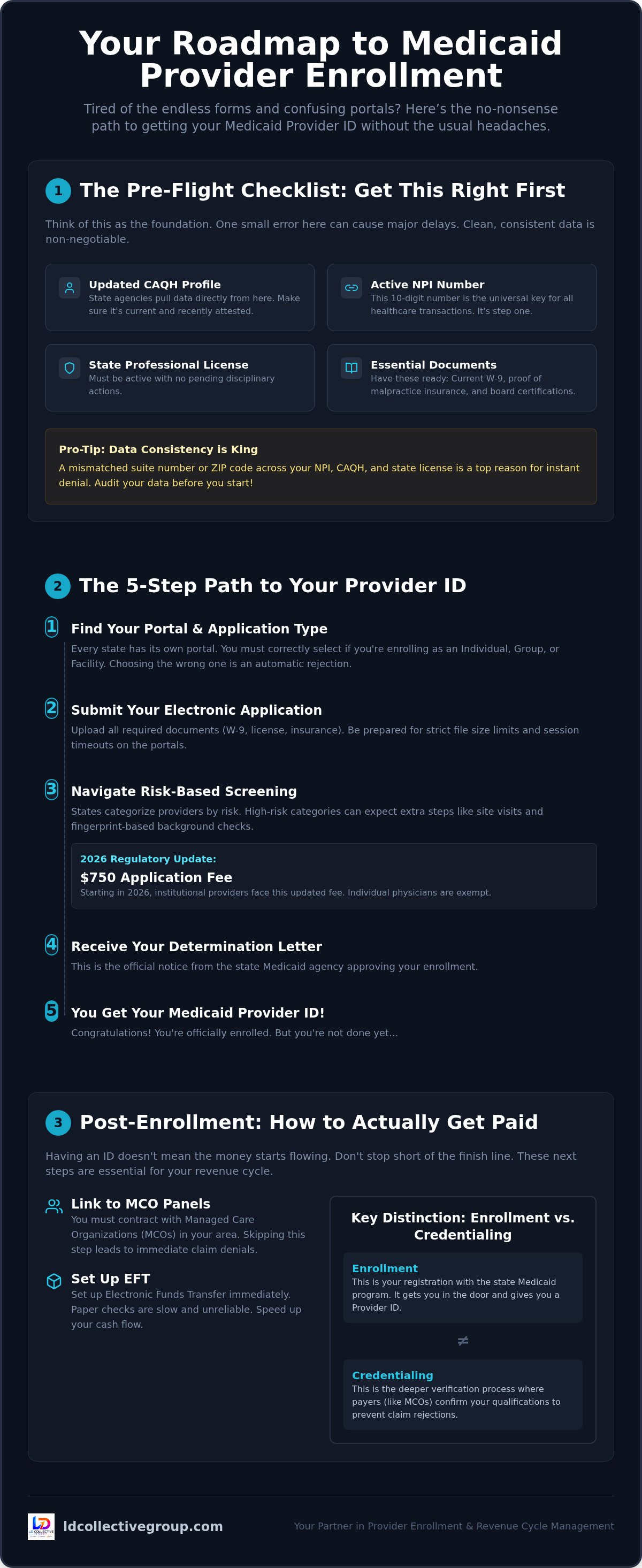
Mastering how to enroll with Medicaid as a provider requires a linear, disciplined approach. Every state manages its own portal. Start by identifying yours. You must select the correct application type: Individual, Group, or Facility. Selecting the wrong category causes instant rejections. Once identified, submit your electronic application with all required attachments. This includes your W-9, license, and proof of insurance.
For 2026, institutional providers face a $750 application fee. This 2.7% increase from 2025 follows CPI-U adjustments. Individual physicians remain exempt from this fee. After submission, prepare for risk-based screening. High-risk categories often require site visits and fingerprint-based background checks. The process concludes when you receive your official determination letter and Medicaid Provider ID. Understanding the federal framework of Medicaid enrollment and credentialing helps you anticipate these state-level rigors.
Navigating State-Specific Portals
Each state has unique digital hurdles. Use this Opening a Medical Practice Checklist to ensure your practice details are consistent before you start. Common pitfalls include aggressive portal session timeouts and strict file size limits for uploads. Have your documents compressed and ready. If the portal feels like a maze, our provider enrollment team can handle the submission for you. We move fast so you can start billing sooner.
Post-Enrollment: Protecting Your Revenue Cycle
You have your Medicaid Provider ID. That doesn't mean the checks are in the mail. Many providers learn how to enroll with Medicaid as a provider but stop before crossing the finish line. Enrollment is just the registration. To actually get paid, you must transition from the state's Fee-for-Service model to Managed Care Organization (MCO) panels. If you aren't contracted with the specific MCOs in your area, you'll face immediate claim denials. It's a common oversight that stalls revenue for months.
Speed up your cash flow by setting up Electronic Funds Transfer (EFT) immediately. Paper checks are a liability and a delay you don't need. Beyond the tech, remember that enrollment and credentialing are distinct processes. Enrollment gets you into the state system. Credentialing is the deeper dive where payers verify your qualifications. Both must be perfect. Accurate credentialing is the only way to prevent future claim rejections. Errors here are expensive and avoidable.
Successful Reimbursement Strategies
Accuracy is the foundation of your billing success. If your enrollment data doesn't match your claims, the system rejects them automatically. Many practices also need to manage dual-enrollment needs. Use our Medicare enrollment guide to understand those specific requirements. The administrative burden is heavy. Partnering with LD Collective Group allows you to outsource the entire headache. We handle the payers and the paperwork while you focus on patient care. Don't let the maze of how to enroll with Medicaid as a provider drain your practice resources.
Secure Your Practice Revenue Today
You've got the roadmap to get your Medicaid ID without the usual headaches. Success depends on total data accuracy across NPPES and CAQH before you ever open a portal. You also need to stay ahead of the 2026 fee adjustments and the heightened scrutiny on risk-based screenings. Don't let the transition to MCO panels or EFT setup become a bottleneck for your practice's cash flow. Mastering how to enroll with Medicaid as a provider is about precision and timing.
We're here to make sure you get paid for the care you provide. Our team brings national expertise and a no-nonsense approach to ensure fast, reliable enrollment. Let's get your provider ID active and your revenue flowing through streamlined paperwork management.
Frequently Asked Questions
How long does it take to get a Medicaid provider number?
Approval typically takes 60 to 90 days from the date of submission. This timeline depends on your state's current backlog and your provider risk level. High-risk providers requiring site visits often face longer waits. Ensure your application is error-free to avoid unnecessary stalls. A single typo can reset your clock and delay your ability to collect revenue.
Do I need a separate Medicaid ID for every state I practice in?
Yes, you need a separate ID for every state where you treat patients. Medicaid is a state-level program with its own unique administration. Even if you're already in-network elsewhere, you must learn how to enroll with Medicaid as a provider in each new jurisdiction. Each state requires its own application, portal registration, and verification of local professional licensing.
What is the difference between Medicaid enrollment and credentialing?
Enrollment is the administrative act of registering your practice with the state agency. Credentialing is the deeper clinical verification of your professional qualifications and work history. You cannot bill without both. Enrollment puts you in the system, but credentialing proves you're qualified to be there. Both processes require distinct documentation and follow different timelines for final approval.
Can I bill Medicaid retroactively once my enrollment is approved?
Most states allow you to bill retroactively for a limited period, usually between 30 and 90 days. This window is tied to the "effective date" listed on your approval letter. When you're figuring out how to enroll with Medicaid as a provider, check your state's specific look-back policy. Don't assume all prior services will be covered without a confirmed effective date.

Disclaimer
The information provided in this article is for general educational and informational purposes only and reflects the author’s professional experience, research, and interpretation of provider credentialing, payer enrollment, and healthcare operations practices.
Credentialing and enrollment requirements vary by payer, health plan, government program, provider type, state, contract, and organizational structure and are subject to change. Nothing in this article should be interpreted as legal, regulatory, compliance, tax, or other professional advice, nor as an official interpretation or guidance from CMS, a state Medicaid agency, Medicare Administrative Contractor (MAC), commercial payer, accrediting organization, or other regulatory entity.
Organizations and providers should independently verify current requirements with the applicable payer, government agency, regulatory authority, accreditation organization, contract, provider manual, or other authoritative source before making credentialing, enrollment, contracting, billing, or compliance decisions.
Any opinions expressed are those of the author and do not necessarily represent the views, policies, or positions of any current or former employer, client, payer, or affiliated organization.


