
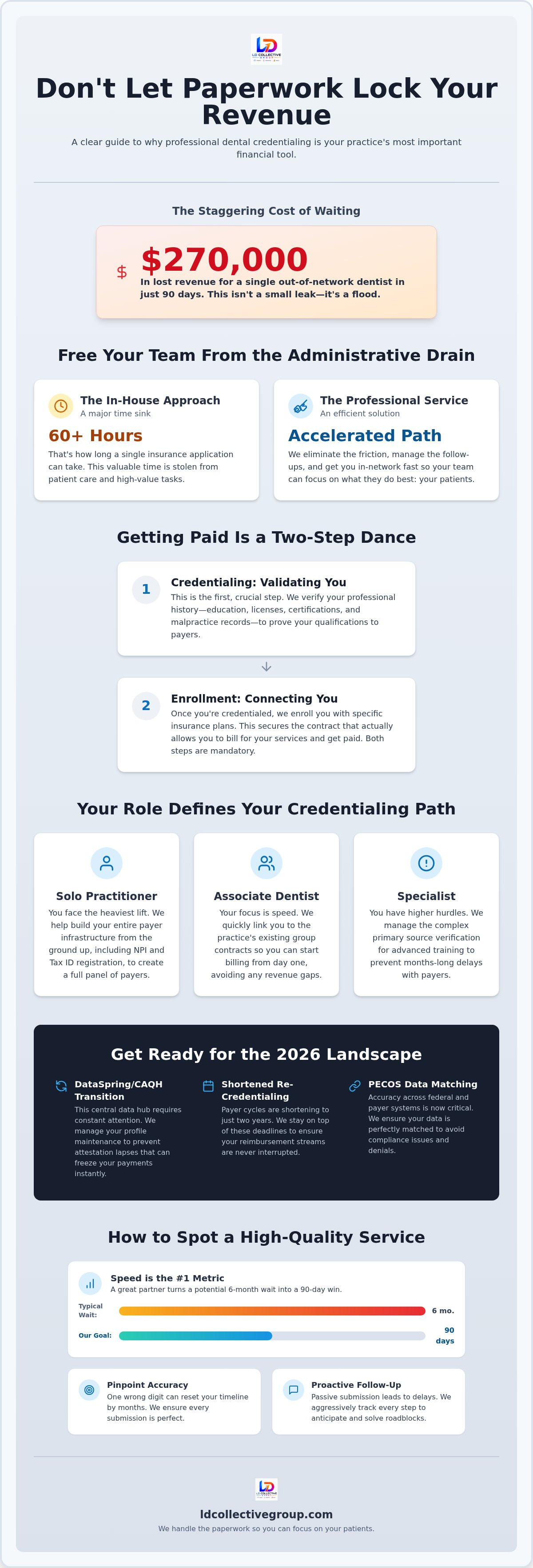
A single dentist operating out-of-network for just 90 days can cost your practice up to $270,000 in lost revenue. That isn't a rounding error. It's a crisis. You already know that insurance paperwork is a massive bottleneck. Spending 60 hours on one application isn't just a headache; it's a drain on your chair time. Professional dental credentialing services eliminate this friction, especially as the 2026 DataSpring/CAQH rebrand and shortened two-year re-credentialing cycles complicate the landscape.
These services stop the bleeding. They accelerate your path to in-network status and protect your bottom line from administrative errors. This guide provides a comprehensive breakdown of how to secure your revenue from PPO and Medicaid plans, maintain a clean CAQH profile, and navigate the latest 2026 payer requirements like PECOS data matching. We move fast so you can get back to your patients. Let's get to work.
Key Takeaways
- Credentialing is the non-negotiable first step for billing insurance; without it, your practice revenue stays locked behind a wall of paperwork.
- Tailor your strategy based on your role, whether you're a solo practitioner building a full payer panel or an associate dentist joining an established group contract.
- High-quality dental credentialing services focus on speed and proactive payer follow-up to eliminate the revenue leakage caused by out-of-network status.
- Learn how to navigate 2026 regulatory shifts, including the CAQH rebrand and shortened re-credentialing cycles, to keep your reimbursement streams uninterrupted.
Understanding Dental Credentialing Services: The Foundation of Practice Revenue
Dental credentialing services are the non-negotiable foundation of your practice’s financial health. Think of this process as the gatekeeper for your revenue cycle. It verifies your professional history, including education, board certifications, and malpractice records. Without it, you aren't just out of the loop; you're out of the money. Insurance payers won't even look at your claims until they've vetted your qualifications through the various agencies overseeing the practice of dentistry.
If you skip or botch this step, you face immediate claim denials. That’s a direct hit to your cash flow. Effective dental credentialing services ensure your background is verified correctly the first time. This prevents the "out-of-network" label that scares away patients and kills revenue. We don't just fill out forms; we secure your right to get paid.
Credentialing vs. Enrollment: Two Sides of the Same Coin
Many providers confuse these two terms, but they serve distinct, vital purposes. Credentialing validates the individual provider’s identity and skill set. Enrollment secures the specific payer contract that allows you to collect. You can't successfully bill insurance without completing both phases accurately. If you're credentialed but not enrolled at the specific location, your claims will still bounce. It's a precise, two-step process. For a deeper look at how these elements work together, read our Provider Enrollment and Credentialing Services: The 2026 Strategic Guide. We handle the heavy lifting so you can focus on the chair. Don't let administrative friction stall your growth. We move fast because your revenue depends on it.
Credentialing Requirements Across Different Dental Roles
Solo practitioners face the heaviest administrative lift. You need a complete infrastructure setup, including NPI and Tax ID registration, before you can even look at payer paneling. It's a comprehensive build from the ground up. Associate dentists have a different path. Their credentialing focuses on linking the provider to your existing group contract quickly. We move fast to ensure they can start billing on day one without the typical 40-hour administrative drain.
Specialists like oral surgeons and endodontists have even higher hurdles. Payers demand primary source verification for advanced training and residency programs. Missing one specific document can stall the entire process for months. Our dental credentialing services manage these nuances so your specialists don't sit idle while revenue leaks. We handle the aggressive follow-ups that in-house teams often miss.
Managing the DataSpring (CAQH) Transition in 2026
DataSpring, powered by CAQH, remains the industry standard for dental data. It's the central hub for your information, but it isn't a tool you can ignore. Frequent profile maintenance is mandatory to avoid attestation lapses. If you miss a window, your payments freeze immediately. We manage these cycles to keep your reimbursement consistent. For more on staying current, see our guide on Healthcare Provider Credentialing: The 2026 Guide to Compliance and Revenue. Clean data leads to faster approvals and fewer denials. It's about protecting your cash flow through precision.
Selecting a Credentialing Partner to Accelerate Network Entry
Speed is the only metric that matters. Every day your provider remains out-of-network is a day of uncaptured revenue. You aren't just paying for data entry; you're buying market access. Professional dental credentialing services remove the 40-hour administrative weight from your front desk staff. This shift allows your team to focus on patient experience and high-value scheduling rather than fighting with insurance portals. We don't just fire off applications and hope for the best. We manage the process with aggressive, proactive follow-ups to ensure you get in-network as fast as the system allows.
Passive submission is a recipe for delay. If a partner doesn't track every touchpoint with the payer, they aren't helping you. You need a team that anticipates roadblocks before they happen. This proactive stance turns a six-month wait into a 90-day win. We prioritize reliability because your cash flow is on the line.
Performance Metrics: How to Spot a High-Quality Service
Accuracy is the silent killer of practice growth. One transposed digit on a Tax ID or a missing signature can reset your approval timeline by months. Look for partners who demonstrate high submission accuracy rates and provide regular, transparent status updates. A nationwide reach is also critical. You need expertise that spans across state lines to navigate varying PPO and Medicaid regulations effectively. Avoid "set it and forget it" software platforms. While automation has its place, it cannot replace human-led consultative support. You need a specialist who knows exactly which payer representative to call when a file gets stuck in the queue. We provide that direct, seasoned intervention to keep your practice moving forward.
Secure Your Practice Revenue for 2026 and Beyond
Success in modern dentistry requires more than clinical skill; it demands administrative precision. You've seen how credentialing acts as the mandatory gatekeeper for your revenue cycle. Whether you're managing the CAQH transition or onboarding a new associate, delays are expensive. Professional dental credentialing services take the administrative burden off your front desk and replace it with reliable, results-driven enrollment. We provide the nationwide consulting expertise needed to navigate complex payer rules and prevent out-of-network revenue leakage. Don't let paperwork stall your growth. It's time to prioritize speed and accuracy to keep your practice profitable.
Your chair time is too valuable for administrative trial and error. Let's get your providers in-network and your claims paid without the headache.
Common Questions About Dental Credentialing
How long does the dental credentialing process typically take in 2026?
The standard timeline for a clean application is 90 to 120 days. If errors are present, this can extend to 180 days or more. Start the process at least four months before a new provider's start date to avoid revenue gaps. Payer backlogs and the 2026 focus on PECOS data matching mean there are no shortcuts.
Can I see patients while my dental credentialing is still pending?
You can see patients, but you cannot bill them as an in-network provider until approval is final. Seeing patients out-of-network leads to lower reimbursement or total claim denials. While the ADA pushes for provisional credentialing, most payers require full approval first. Operating without status risks losing between $1,500 and $3,000 in potential daily revenue per provider.
What are the most common errors that cause dental credentialing delays?
Incomplete CAQH profiles and mismatched NPI data are the most frequent causes of delay. Other common errors include expired state licenses, work history gaps over 30 days, and inaccurate Tax ID details. Using expert dental credentialing services eliminates these friction points. We perform a comprehensive audit before submission to ensure every document is compliant and every data point is accurate.
Is it more cost-effective to handle credentialing in-house or outsource it?
Outsourcing is more cost-effective when you factor in the 40 to 60 hours of administrative time required for in-house efforts. Your team should focus on patients, not paperwork. When considering the $150,000 to $270,000 in revenue lost during a 90-day out-of-network period, professional dental credentialing services provide a clear return on investment. We secure your revenue faster.

Disclaimer
The information provided in this article is for general educational and informational purposes only and reflects the author’s professional experience, research, and interpretation of provider credentialing, payer enrollment, and healthcare operations practices.
Credentialing and enrollment requirements vary by payer, health plan, government program, provider type, state, contract, and organizational structure and are subject to change. Nothing in this article should be interpreted as legal, regulatory, compliance, tax, or other professional advice, nor as an official interpretation or guidance from CMS, a state Medicaid agency, Medicare Administrative Contractor (MAC), commercial payer, accrediting organization, or other regulatory entity.
Organizations and providers should independently verify current requirements with the applicable payer, government agency, regulatory authority, accreditation organization, contract, provider manual, or other authoritative source before making credentialing, enrollment, contracting, billing, or compliance decisions.
Any opinions expressed are those of the author and do not necessarily represent the views, policies, or positions of any current or former employer, client, payer, or affiliated organization.


