

Every day a provider sits on the sidelines is a day of lost revenue your practice can't recover. It's that simple. You've likely dealt with the headache of stalled applications and the vague, conflicting requirements that different insurance payers demand. Navigating the provider enrollment process steps shouldn't feel like a guessing game where the prize is a mountain of claim denials. It's time to stop treating enrollment as a passive administrative task. It's a critical financial operation that requires precision.
We know the frustration of seeing claims rejected because of a single manual entry error or a missed deadline. You need a system that works. This guide provides a clear roadmap to master the enrollment cycle and eliminate the administrative friction that keeps your providers out-of-network. We'll walk through the essential documentation, the precise submission order, and the aggressive follow-up strategies needed to reduce turnaround times. You'll learn how to take control of your revenue cycle and secure the reimbursement your practice deserves.
Key Takeaways
- Connect enrollment speed directly to your Days Sales Outstanding (DSO) and practice cash flow.
- Master the provider enrollment process steps by securing the "Big Five" documents and maintaining data integrity in CAQH.
- Navigate closed panels by identifying the optimal payer mix and submitting aggressive Letters of Intent.
- Eliminate application stalls with a disciplined 14-day follow-up cycle and meticulous documentation of all payer interactions.
- Protect your revenue by weighing the efficiency of professional enrollment against the high cost of in-house administrative errors.
Beyond the Paperwork: Why the Provider Enrollment Process Dictates Your Cash Flow
Provider enrollment is the gateway to insurance reimbursement. It is not a suggestion. It is a requirement for survival. Many practices treat this as a back-office chore to be handled when time permits. That is a mistake. This process is the primary valve controlling your cash flow. If the valve is closed, the revenue stops. It's that simple.
There is a direct, measurable link between enrollment speed and your Days Sales Outstanding (DSO). When you fail to execute the provider enrollment process steps with precision, your DSO spikes. Claims sit in limbo. Payments stall. Meanwhile, your overhead remains constant. You're essentially providing free care while waiting for a payer to acknowledge your existence. This is not how you run a professional practice.
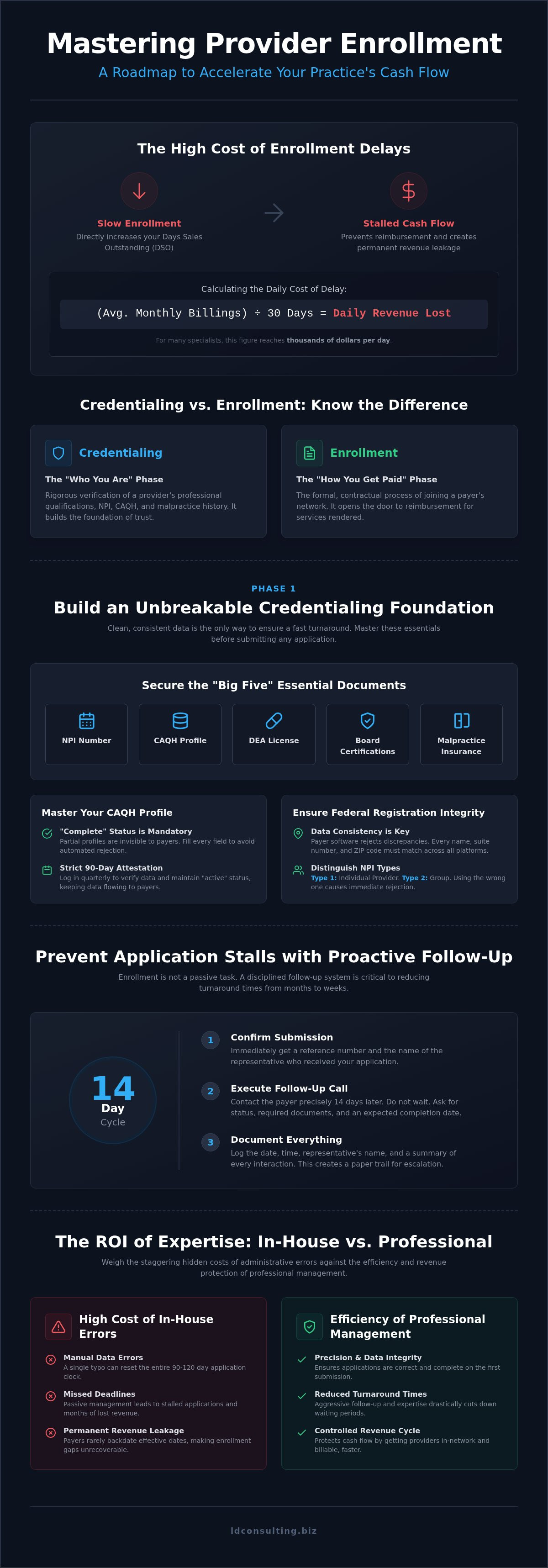
The hidden costs of a "DIY" approach are staggering. A single manual data entry error can trigger an immediate application rejection. You won't find out for weeks. By then, the clock has reset. You've missed filing deadlines. You've lost months of potential revenue. Professional enrollment management isn't a luxury; it is a defensive strategy against administrative incompetence.
The Financial Impact of Enrollment Delays
Calculating the cost of delay is simple math. Take a provider's average monthly billings and divide by thirty. That is the daily cost of being un-enrolled. For many specialists, this figure reaches thousands of dollars per day. When applications stall, you aren't just delaying payment; you are often creating permanent revenue leakage. Payers rarely backdate effective dates to accommodate your administrative errors. The enrollment gap is the distance between provider start dates and their first collectible claim; it is a direct threat to your practice's viability.
Credentialing vs. Enrollment: Knowing the Difference
Credentialing and enrollment are related but distinct. You must understand both to navigate the system. Credentialing is the rigorous verification of professional qualifications. It involves checking NPIs, CAQH profiles, and malpractice history. It is the "who you are" phase of the process. Enrollment is the "how you get paid" phase. It is the formal contractual process of joining a payer network. You can be the most qualified surgeon in the country, but without successful enrollment, you are out-of-network. You cannot have one without the other. Credentialing builds the foundation; enrollment opens the door to reimbursement.
Phase 1: Establishing the Credentialing Foundation and Data Integrity
Enrollment doesn't start with a payer application. It starts with data. If your foundation is cracked, your application will fail before a human even looks at it. Most practices rush the submission and wonder why they face 90-day delays. You must master the provider enrollment process steps by prioritizing documentation first. Clean data is the only way to ensure a fast turnaround. It's that simple.
You need the "Big Five" ready before you open a single portal. These include your NPI, CAQH profile, DEA license, Board Certifications, and Malpractice insurance. These documents are the pillars of your professional identity. Missing even one document stops the entire process. We see it constantly: a provider forgets to update an expired DEA or a new malpractice face sheet, and the whole revenue cycle grinds to a halt. Don't be that practice. Organize your files before you begin.
Standardizing this data prevents "kick-backs." Payers use automated scrubbing software to identify discrepancies. If your address is listed differently in two databases, the system rejects the file. Consistency is your greatest asset. Every suite number, zip code, and middle initial must match across every platform. If you want to find where your data might be failing you, a practice assessment is the most efficient way to audit your standing and protect your revenue.
The CAQH Setup: Your Enrollment Hub
CAQH is the heart of modern enrollment. A "Complete" status is the only acceptable status. Partial profiles are effectively invisible to payers. You must upload every required document and fill every field, even the optional ones. Common errors include gaps in work history or outdated hospital affiliations. These mistakes stall the process for months. Establish a strict attestation schedule. You should log in every 90 days to verify your data, even if nothing has changed. This maintains your "active" status and keeps the data flowing to payers.
NPI and PECOS: Federal Registration Essentials
Verify your NPI records immediately. You must distinguish between Type 1 (Individual) and Type 2 (Group) NPIs. Using the wrong one on an application is a guaranteed rejection. For Medicare enrollment, the PECOS portal is mandatory. It is notoriously difficult to navigate. Ensure your address in PECOS matches your CAQH profile and your IRS records exactly. Federal databases don't communicate well; you are the bridge that connects them. If the bridge is broken, the money doesn't cross. Accuracy at this stage is the only way to move through the provider enrollment process steps without losing momentum.
Phase 2: Payer Contracting and Network Enrollment Execution
Data is settled. Now we execute. Phase 2 moves the provider enrollment process steps from internal preparation to external negotiation. This is where most practices lose momentum. They submit an application and wait. Waiting is not a strategy. You must manage the payer relationship with the same intensity you bring to patient care. If you don't drive the process, the payer certainly won't.
Identifying the right payer mix is your first priority. Don't apply to every network. Analyze your patient demographic. Research which payers dominate your local market. If you're a specialist, look for network adequacy gaps. Targeting the wrong payers wastes administrative resources. Focus on the contracts that actually drive your revenue. Once you identify your targets, you face the credentialing committee review. This is a black box for many. It's where the payer's medical board reviews your credentials and decides if you meet their standards. If you've followed the foundation steps correctly, this is a formality. If you haven't, it's a dead end.
After approval, you receive the final participation agreement. Do not sign it blindly. This document is a legal contract that dictates your reimbursement for years. You must review the terms, verify the effective dates, and ensure the provider is correctly linked to your practice's group tax ID. Execution requires precision. A single oversight here can lead to months of denied claims.
Strategic Payer Outreach
Closed panels are a common hurdle. Payers often claim their network is "full" for your specialty. Don't take "no" for an answer. You need a professional appeal. This requires a compelling Letter of Intent (LOI). Your LOI shouldn't just ask for a spot; it should prove your value. Highlight your unique services, your location's accessibility, or your ability to handle high-risk patients. You're not just a provider; you're a solution to their network gaps. A well-drafted LOI can force a closed panel to reopen for you.
The Contracting Trap: What to Watch For
The contract phase is where revenue leakage often begins. Watch for these three critical points:
- Effective Dates: Never assume a contract is retroactive. Verify the exact date you can begin billing. Treating patients before this date results in uncollectible claims.
- Fee Schedules: Review the reimbursement rates before signing. If the rates don't support your overhead, the contract is a liability, not an asset.
- Group NPI Linking: Ensure the individual provider is correctly linked to your Group NPI. If this link is broken, the payer will process claims under the wrong tax ID, leading to massive reconciliation headaches.
Executing these provider enrollment process steps requires a high level of scrutiny. The contract you sign today dictates your revenue for years. Get it right the first time.
Managing the Dead Zones: How to Prevent Application Stalls
Submitting an application is only half the battle. The real work happens in the "dead zones," those weeks of silence from payers where applications often vanish. To successfully navigate the provider enrollment process steps, you must be the aggressor. Passive waiting is how revenue dies. If you aren't pushing the payer, your application stays at the bottom of the pile. It's that simple.
You must establish a strict 14-day follow-up cycle for every pending application. Mark your calendar. If you haven't received a status update, call. Don't rely on email alone; it is too easy to ignore. During these calls, document everything. You need the name of the representative, the date and time of the interaction, and a specific reference number. This isn't just for your internal records. It is your leverage. When you call back, you aren't just checking in; you're holding the payer accountable to a documented timeline.
The "Payer Black Hole" is a reality of the industry. Sometimes, despite your best efforts, an application stalls indefinitely. This is when you escalate. Your primary target is the Provider Relations Representative. These individuals are your internal allies within the payer organization. They have the authority to bypass standard call center scripts and identify the actual bottleneck. Building a professional relationship with these reps is one of the most effective ways to secure faster provider enrollment and protect your practice's bottom line.
Tracking Your Enrollment Pipeline
Efficiency requires measurement. You must track two essential metrics: Time to Submit and Time to In-Network. If the gap between these two is widening, your process is failing. Use a centralized tracker to manage every provider and every payer in one place. This prevents missed re-attestations and keeps your data fresh. A dedicated enrollment specialist ensures that follow-ups happen on schedule, preventing administrative oversight from becoming a financial liability.
Escalation Strategies for Stalled Applications
Know when to move from email to phone. If an email hasn't been answered in 48 hours, pick up the phone. Voice-to-voice communication is harder to dismiss. When you get a rep on the line, use the "Clean Claim" argument. Remind them that delayed enrollment creates a backlog of claims that will eventually hit their system all at once, impacting their own internal processing metrics. Identify common "missing info" requests before they happen. Most stalls are caused by predictable requests for updated W9s or current malpractice face sheets. Keep these ready for immediate electronic submission. Anticipating these needs is the only way to move through the provider enrollment process steps without losing momentum.
Scaling Your Practice: Why Professional Enrollment Management Wins
Your practice exists to provide care. It does not exist to manage 20 different payer portals. Managing the provider enrollment process steps in-house often seems like a cost-saving measure. It is usually the opposite. The administrative burden on your staff leads to burnout and, more importantly, expensive errors. Every minute your team spends on a hold line with a payer is a minute they aren't improving patient experience or optimizing internal operations. Professional management is the only way to scale without sacrificing your bottom line. Revenue shouldn't wait. Administrative errors cost money.
LD Consulting eliminates the learning curve. We've navigated the nuances of national payer networks for years. We know which reps to call and which buttons to push. This expertise transforms enrollment from a source of anxiety into a predictable business function. When you outsource, you aren't just offloading paperwork. You are investing in revenue certainty. You are ensuring that when a provider sees a patient, the practice actually gets paid. It's about precision. It's about results.
Protecting physician time is paramount. A doctor's value is in the exam room, not the back office. When physicians are forced to manage their own credentialing or follow up on stalled applications, your practice loses money twice. First, in the lost billable time. Second, in the potential for errors that lead to permanent revenue leakage. Professional enrollment management protects your most valuable assets: your providers' time and your practice's reputation. We handle the friction so you can handle the patients.
The LD Consulting Advantage
We operate on a streamlined per-engagement fee structure. This allows for predictable budgeting. You won't face hidden costs or inflated hourly rates. Our services integrate directly with your medical billing and practice audits. This creates a closed loop where enrollment status and claim submission are perfectly aligned. We handle the complex communications so you don't have to. Whether you are adding one provider or ten, our national coverage ensures consistent results across all markets. We move fast. You should too.
Getting Started: Your Path to In-Network Status
The path forward is clear. It begins with a comprehensive initial assessment of your current credentialing status. We identify the gaps, clean up the data, and take over the communication. From the first LOI to the final participation agreement, we manage every detail. Stop letting administrative delays stall your growth. Protect your revenue with LD Consulting enrollment services and take control of your financial future today. The solution is here. It's time to execute.
Secure Your Revenue Cycle Today
Revenue certainty isn't a matter of luck. It's a matter of execution. You now have the roadmap to move beyond administrative stalls and secure the reimbursement your practice has earned. The foundation of success lies in data integrity and a relentless follow-up strategy. Mastering the provider enrollment process steps is the only way to ensure your providers are in-network and billing correctly from day one. Passive waiting is a luxury your cash flow can't afford.
LD Consulting specializes in eliminating the friction that keeps practices from their revenue. We provide fast-tracked enrollment processes and expert handling of payer follow-ups to keep your applications moving. Our comprehensive practice revenue audits identify exactly where you're losing money and how to stop the leakage. It's time to stop letting payers dictate your financial health. Stop waiting for payers-get in-network with LD Consulting. Take the first step toward a more efficient, profitable practice today.
Frequently Asked Questions
How long does the provider enrollment process typically take?
The process generally takes between 60 to 120 days. This timeline depends on the payer's internal committee schedule and the accuracy of your initial submission. Medicare may process faster, while commercial payers often take the full four months. Any data error or missing document resets this clock immediately. Aggressive follow-up is the only way to keep your application at the front of the line.
What is the difference between provider credentialing and enrollment?
Credentialing is the verification of your professional history and qualifications. It confirms you are who you say you are. Enrollment is the formal process of joining a payer network to receive reimbursement. You must complete credentialing before you can execute the provider enrollment process steps. One validates your clinical standing; the other secures your right to bill the insurance company.
Can a provider see patients while their enrollment is pending?
Providers can see patients during the pending phase, but you cannot bill the insurance company as an in-network provider. Claims submitted before the effective date will likely be denied or processed at out-of-network rates. This creates a significant financial risk for the practice. Most administrators hold these claims until the enrollment is finalized, though this creates a massive backlog that can strain your cash flow.
What are the most common reasons for provider enrollment delays?
Most delays stem from incomplete CAQH profiles or discrepancies in provider data. If your address in PECOS doesn't match your NPI registry, the application stalls. Another major bottleneck is the "dead zone" where payers stop communicating. Without a disciplined 14-day follow-up cycle, your application can sit untouched for weeks. Administrative oversight is the leading cause of preventable revenue leakage in modern healthcare practices.
Do I need a separate enrollment for every insurance company?
Yes, every insurance payer operates its own independent network and application process. There is no universal enrollment that covers all commercial companies. While CAQH acts as a central data hub, you must still submit individual requests to each payer you wish to join. Each company has unique requirements, fee schedules, and participation agreements that require separate review and execution to ensure full network coverage.
How often do providers need to re-enroll or re-validate?
Re-validation cycles typically occur every three to five years depending on the payer. Medicare generally requires re-validation every five years for most providers, while commercial payers may request updated credentials more frequently. You must also attest to your CAQH data every 90 days to remain active. Missing a re-validation deadline is as damaging as a failed initial application; it results in immediate de-activation and stopped payments.
What documents are required for the provider enrollment process?
You must provide the "Big Five": NPI, CAQH, DEA license, Board Certifications, and Malpractice insurance. Additional requirements often include a current CV, medical license, and a signed W9. Some payers also demand proof of hospital admitting privileges or specific specialty training. Having these documents primary-source verified and ready for electronic submission is critical for navigating the provider enrollment process steps without administrative friction.
Can I bill retroactively once my provider enrollment is approved?
Retroactive billing is rarely guaranteed and depends entirely on the payer's policy. Medicare may allow billing back to the date they received a "clean" application, but commercial payers usually set the effective date as the day the contract is fully executed. Never assume you can bill for services rendered before you receive a formal approval letter. Treating patients before the effective date is a high-stakes gamble with your revenue.


