

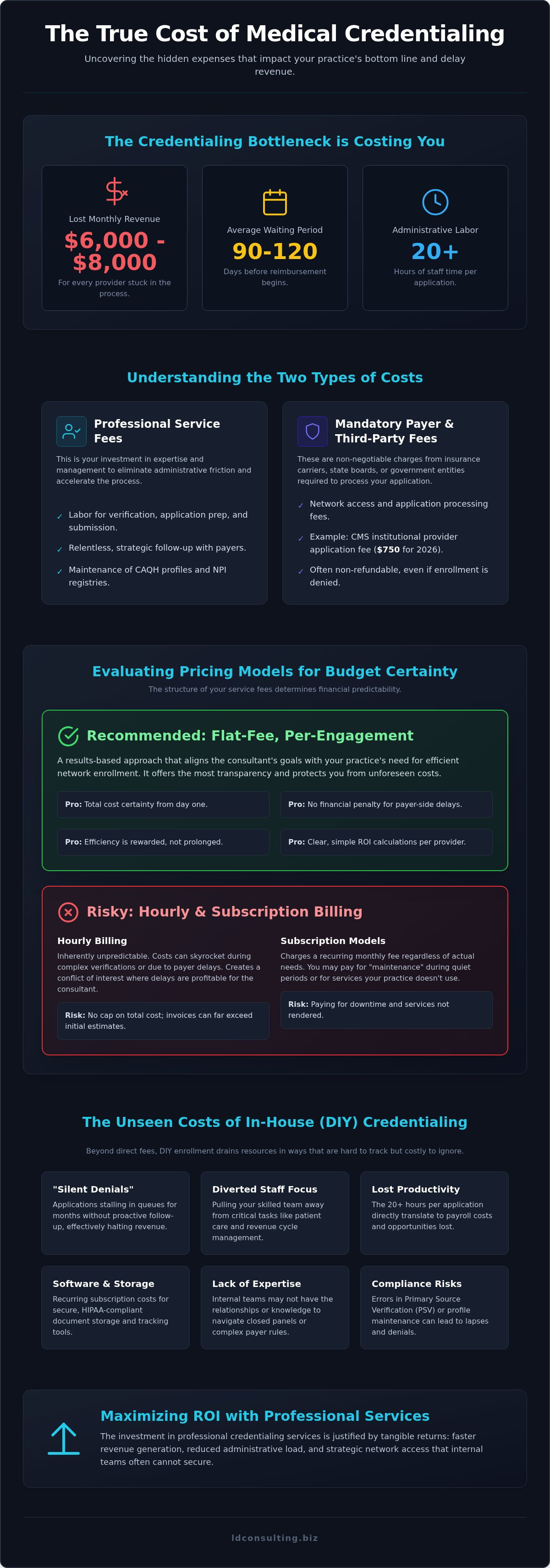
The average medical practice loses between $6,000 and $8,000 in monthly revenue for every provider stuck in the credentialing bottleneck. That is a staggering figure. It dwarfs the actual service fees. You already know the 90 to 120 day waiting period is a liability. What remains unclear is the total investment required to fix it. If you are asking how much does credentialing cost, you are likely tired of vague quotes and the fear of paying for network access that never materializes.
Administrative friction is expensive. Every application requires over 20 hours of staff time. This pulls your team away from patient care and revenue cycle management. This guide provides a direct look at the true costs of healthcare credentialing. You will discover the difference between mandatory application fees and professional service models. We provide the framework to justify the ROI of professional services. You will gain a clear path to faster reimbursement and a more efficient practice.
Key Takeaways
- Distinguish between professional service fees and mandatory external costs like the $750 CMS application fee.
- Evaluate how much does credentialing cost through the lens of flat-fee, per-engagement models to ensure budget certainty.
- Identify the "silent denials" and administrative labor that make DIY enrollment more expensive than professional outsourcing.
- Account for variables like provider type and payer volume that directly influence the total investment required.
- Secure network access in closed panels by leveraging professional expertise that internal teams often lack.
Understanding the Components of Credentialing Costs
A single line item rarely explains the full financial commitment. Determining how much does credentialing cost requires a granular look at two distinct categories: professional service fees and third-party expenses. You aren't just paying for a form to be filled out. You are paying for the elimination of administrative friction. To evaluate the total investment, you must first understand What is Credentialing? and the specific administrative layers involved. Professional service fees cover the labor of verification, application preparation, and the relentless follow-up required to move a file through a payer's system.
Direct Service Fees vs. Payer Application Fees
Professional fees are the investment in management. These cover the hours spent by a consultant or internal employee navigating the enrollment cycle. Payer application fees are different. These are non-negotiable charges from insurance carriers or state boards. For example, the CMS institutional provider application fee is $750 for the 2026 calendar year. Some specialty networks require these non-refundable fees just to review your credentials. A service fee covers the labor of managing your enrollment, while a network access fee is a mandatory charge from a payer to process your application for their panel.
Administrative Labor and Resource Overhead
Time is the most expensive resource. Industry data indicates each credentialing application requires over 20 hours of staff time. This includes primary source verification (PSV), which is a meticulous check of education, training, and history. If your team handles this in-house, you are paying for those hours in payroll and lost productivity. Factor in the maintenance of CAQH profiles and NPI registries. These aren't one-time tasks. They require regular updates to prevent lapses. When calculating how much does credentialing cost for a new practice, you must account for these recurring administrative burdens.
Hidden overhead also includes secure document storage and tracking software. These tools ensure compliance but add to the monthly operational budget. Most providers overlook the cost of follow-ups. A submitted application isn't a finished application. It requires weekly check-ins with payer representatives to ensure it hasn't stalled in a queue. This persistence is what professional services provide. Without it, applications often sit for months. You also need to account for the software used to track these interactions. Secure document transmission and encrypted storage are mandatory for HIPAA compliance. These subscriptions are recurring costs that many practices fail to include in their initial estimates.
Evaluating Pricing Models: Flat Fee vs. Hourly Billing
Professional firms generally operate under three distinct structures: flat fee, hourly, or subscription. Each impacts your practice's bottom line and budget predictability differently. When you ask how much does credentialing cost, you aren't just looking for a base rate. You're looking for a final invoice that matches your initial quote. Flat-fee, per-engagement models offer the most transparency for medical practice budgeting. They remove the guesswork from your financial projections and ensure that the cost is tied directly to results.
The Flat-Fee Per-Engagement Model
In a per-engagement model, fees are typically structured per provider, per insurance panel. This is a results-based approach. It aligns the consultant’s goals with your practice’s primary objective: getting in-network. There is no incentive for a consultant to drag out the process or over-complicate simple filings. Efficiency is rewarded. If a payer is slow to respond or requires multiple follow-ups, your cost remains fixed. This model protects you from the financial impact of payer-side bureaucracy and administrative delays.
Choosing this structure allows for clear ROI calculations. You know exactly what the investment is for each new hire. You can find transparent provider enrollment services that utilize this per-engagement structure to ensure total cost certainty from day one. This approach is particularly effective for growing practices that need to scale without unpredictable administrative spikes.
The Risks of Hourly and Subscription Billing
Hourly billing is inherently unpredictable. It often leads to scope creep. If a payer requests additional documentation or a clarification on a decade-old malpractice claim, the clock keeps running. Your invoice grows while your network access remains stalled. Hourly rates can skyrocket during complex verifications, turning a standard enrollment into a significant financial drain. There is a fundamental conflict of interest when the person managing your delays is paid by the hour.
Subscription models present a different set of risks. These firms charge a monthly fee regardless of your actual needs. You may find yourself paying for "maintenance" during months when no new credentialing is occurring. Many of these services cover tasks that a well-organized practice could handle in-house with minimal effort. Unless you have a high-volume, revolving door of new providers, a subscription often results in paying for idle time. Consider these common pitfalls of non-flat-fee models:
- Uncapped Invoices: Hourly billing provides no maximum price for a single enrollment.
- Idle Fees: Subscriptions charge you even when your provider roster is stable.
- Misaligned Incentives: Slow payer responses increase the consultant's revenue in hourly models.
- Budget Volatility: Unpredictable billing makes it difficult to forecast practice overhead.
Determining how much does credentialing cost involves more than comparing base rates. It requires choosing a model that favors speed and completion over administrative duration. Flat-fee models provide the necessary guardrails to keep your enrollment projects on budget and on schedule.
The Hidden Costs of DIY and Credentialing Delays
Attempting to manage enrollment in-house is often a false economy. While the direct expense of a consultant is visible, the invisible costs of DIY efforts are far more damaging. Most practices suffer from "silent denials." This occurs when an application sits untouched in a payer’s queue for weeks because no one is pushing it forward. In-house staff rarely have the direct, payer-specific contacts required to escalate these stalled files. Without these relationships, your application is just another number in a massive backlog.
Errors are the primary cause of timeline resets. A single discrepancy in a CAQH profile or a minor NPI data mismatch can reset the 90-day processing clock. This effectively doubles the time your provider is out-of-network. When assessing how much does credentialing cost, you must factor in the price of these avoidable delays. A professional specialist ensures the data is accurate the first time. This prevents the recursive cycles of rejection and resubmission that plague DIY attempts.
Calculating Opportunity Cost and Revenue Leakage
Revenue leakage is the most significant financial risk in the credentialing process. Consider the math for a single provider seeing 15 patients a day with an average reimbursement of $100 per visit. That provider generates $1,500 in daily revenue. Every day they remain out-of-network is a $1,500 loss that the practice cannot recover. Multiply that daily revenue by the 120-day industry average for a staggering total loss. A $500 service fee is a negligible investment when compared to a $60,000 revenue delay caused by administrative stalling.
Practices often focus on the upfront fee while ignoring this massive opportunity cost. If a professional service gets your provider in-network just two weeks faster than an internal team, the service has already paid for itself several times over. Speed is the only metric that truly matters when calculating how much does credentialing cost in the long term.
The Administrative Burden of Follow-ups
Credentialing is not a "set it and forget it" task. It requires persistent, manual follow-up every 7 to 10 days to ensure progress. Taking an office manager away from patient care or revenue cycle management to sit on hold with payers is an invisible drain on your resources. Their time has a specific dollar value. When they are chasing applications, they aren't managing the clinic or improving the patient experience. Professional consultants use streamlined tracking systems to handle these touchpoints efficiently. We move fast because we know exactly who to call. Your staff should be focused on the clinic, not the payer’s hold music.
Factors That Influence Your Total Credentialing Investment
Costs are not static. The complexity of the provider's background and the specific market determine the final price. When calculating how much does credentialing cost, you must look beyond the base service fee. The workload varies significantly based on the provider's license type and the specific insurance panels they need to join. Variables like specialty risk and state-level fragmentation dictate the total administrative effort required for a successful enrollment.
Provider Type and Specialty Complexity
High-risk surgical specialties require extensive primary source verification. This includes detailed hospital privilege verification, which involves coordinating with multiple medical staff offices. Each extra layer of verification increases the labor hours required. Nurse Practitioners and Physician Assistants bring a different challenge. They require collaborative agreement documentation. This paperwork must be filed correctly with the state and the payer to ensure compliance. Errors here don't just delay enrollment; they create legal liability.
Mental health providers often encounter closed panels. Payers frequently claim their network is full for specific geographic areas. Overcoming this requires a formal appeal or a network gap justification. This is a specialized skill set. It involves proving that the provider offers a service currently unavailable in the existing network. Professional consultants handle these negotiations regularly. We know how to present the data that payers need to see before they will open a restricted panel.
Medicare and Medicaid Enrollment Nuances
Government payers operate with zero tolerance for errors. Medicare and Medicaid applications are multi-page, high-stakes documents. A single typo in a date of birth or a license number leads to an immediate rejection. This is why Medicare enrollment is often priced as a premium engagement. The risk of a 90-day delay is too high to treat these as standard filings. You aren't just paying for data entry. You are paying for the security of an error-free submission.
Certain provider types also face site visits and mandatory background checks for government enrollment. These logistical requirements add time and coordination costs to the project. You need someone who knows the specific triggers for these audits. If you want to avoid these pitfalls, you can outsource provider enrollment to specialists who manage these nuances daily. We ensure your facility is prepared for inspection before the application is even submitted.
Finally, the volume of payers and state-level fragmentation play a role. Enrolling in 5 panels is a straightforward project. Enrolling in 20 is a massive administrative undertaking. Some states utilize centralized portals effectively, while others remain fragmented with individual paper-based requirements. When you weigh how much does credentialing cost for a multi-state expansion, these regional differences become the primary cost drivers. A localized approach is the only way to maintain budget control across different jurisdictions.
Maximizing ROI with Professional Credentialing Services
Professional oversight transforms credentialing from an administrative burden into a strategic asset. A turnkey solution allows your providers to focus on patient care while specialists manage the payer bureaucracy. The objective is a clean application. Rejections are expensive. They extend the timeline and keep your revenue frozen. When you evaluate how much does credentialing cost, you must prioritize the speed and accuracy that professional consultants provide. Software alone cannot navigate these complexities. Software doesn't pick up the phone to talk to a payer representative. People do.
Consultants offer specialized expertise in navigating "closed panels." Many practices attempt DIY enrollment only to receive a generic rejection letter stating the network is full. We know the specific data points and appeal strategies required to secure spots where internal efforts fail. By bundling credentialing with Medical Billing Services, you create a seamless revenue cycle. This ensures that your billing team is ready to submit claims the moment a provider is active. A unified approach prevents the common disconnect between enrollment status and claim submission.
Streamlining Enrollment for Faster Reimbursement
Experienced specialists understand the unwritten rules for each major insurance carrier. We know which representatives to call and which specific portals are most reliable for different provider types. This insider knowledge significantly reduces the days in accounts receivable (A/R) for new providers. Proactive data management is a core component of the service. We track expiration dates for licenses, DEAs, and board certifications automatically. This ensures that re-credentialing alerts never result in a lapse in payment. A single missed deadline can lead to a total loss of network status. Professional oversight eliminates this risk entirely.
Why LD Consulting’s Per-Engagement Approach Wins
Our model is built for transparency. We utilize a per-engagement fee structure to provide absolute cost certainty. You pay for a result. You don't pay for the time it takes to achieve it. This eliminates the billing surprises common with hourly or subscription models. Our national expertise ensures compliance with all state and federal payer requirements, regardless of your location. We serve providers across the United States with a focus on eliminating paperwork friction. We move fast because your revenue depends on it.
If you are ready to stop the revenue leakage caused by enrollment delays, take the next step. Contact LD Consulting for a clear credentialing quote today. We provide the professional assurance you need to grow your practice without the paperwork friction.
Secure Your Practice Revenue
Credentialing is a financial strategy, not just administrative paperwork. You now understand that asking how much does credentialing cost involves balancing service fees against the massive risk of lost billable hours. The real expense lies in the 90 to 120 day waiting period and the "silent denials" that plague DIY attempts. A per-engagement model provides the cost certainty your budget requires. It aligns your consultant's goals with your practice's financial health. Accuracy at the start prevents expensive resets later.
LD Consulting brings decades of revenue cycle experience and national service coverage to every enrollment file. We eliminate the administrative friction that stalls your growth. Our expert-led process ensures your providers move through the payer system with precision and speed. Stop letting paperwork dictate your provider's start date. You focus on patient care while we handle the payer bureaucracy.
Get a Transparent Credentialing Quote from LD Consulting
Your practice deserves a streamlined path to reimbursement. We are ready to clear the way for your success.
Frequently Asked Questions
How much does it typically cost to credential one doctor?
Industry averages for professional service fees generally range from $100 to $500 per payer for each provider. A full initial setup across a standard set of panels typically sits between $2,500 and $5,000. These figures reflect the labor of verification and application management. When calculating how much does credentialing cost, remember that these fees are separate from mandatory state board or CMS application costs.
Is there a difference in cost between credentialing and provider enrollment?
Yes, though the terms are often used interchangeably. Credentialing is the primary source verification of a provider's background and qualifications. Provider enrollment is the administrative process of getting that provider into a specific insurance network. Enrollment generally carries a higher labor cost. It involves extensive follow-up with payer representatives to ensure the provider is correctly loaded into the billing system for reimbursement.
Can I save money by doing my own credentialing?
You save on direct service fees but lose significantly more in opportunity cost. In-house staff spend over 20 hours per application. If an error resets the clock, your practice loses $6,000 to $8,000 in monthly revenue per provider. Professional services eliminate these "silent denials." The investment in a specialist is recovered through faster reimbursement and reduced administrative burden on your clinic staff.
What are the most common hidden fees in credentialing contracts?
Hourly billing models often hide costs through scope creep and administrative "touch" fees. You might see unexpected charges for follow-up calls or documentation requests. Subscription models are another risk. They often charge monthly fees for maintenance that isn't always active. Look for per-engagement pricing to avoid these surprises. This ensures you only pay for the specific enrollment work being performed for your practice.
How long does the credentialing process take in 2026?
The average timeline for 2026 remains 60 to 90 days. Medicare applications often move faster, sometimes completing in 45 to 60 days. Private payers are less predictable. They frequently hit the 120-day mark without persistent follow-up. This timeline is the primary driver of your total investment. Every day of delay is a day of lost billable revenue. Speed is the most critical factor in your ROI.
Do insurance companies charge providers to join their network?
Some insurance companies and government programs require non-refundable application fees. For the 2026 calendar year, the CMS institutional provider application fee is $750. Many private specialty panels also charge a "network access" fee to review your credentials. These are external costs paid directly to the payer. They are separate from any fees paid to a professional consultant or your internal administrative staff.
Does the cost of credentialing vary by state?
Yes, state-level variables significantly impact the final price tag. Medical board licensing fees range from $750 to $800 depending on the jurisdiction. Some states use centralized portals that streamline the process. Others remain fragmented and require individual, manual submissions for every payer. These regional differences change the labor hours required. You must account for these local regulations when forecasting how much does credentialing cost for a national expansion.
Is credentialing a one-time cost or an ongoing expense?
It is an ongoing operational expense. Most insurance payers require recredentialing every two to three years to maintain network status. This process typically costs 30% to 50% less than the initial enrollment but still requires significant documentation. You also have recurring costs for CAQH profile maintenance and NPI registry updates. Treating credentialing as a one-time task leads to lapses in coverage and interrupted cash flow.


