

Every day a provider sits uncredentialed, your practice loses an average of $7,500 in revenue. That is not just a delay. It's a drain on your sustainability. The question of how long does insurance credentialing take has become more complex in 2026 with the full migration to PECOS 2.0 and tighter NCQA standards. You're likely facing unpredictable revenue gaps and opaque communication from payers. It's frustrating. We know.
You need a predictable start date for billing, not a series of administrative excuses. This article delivers the definitive 2026 timeline and the strategies necessary to prevent the errors that stall your cash flow. We'll examine the new 90 to 120 day NCQA windows, the impact of diverse state-specific mandates, and why CAQH re-attestation is now a high-stakes requirement. Stop guessing when you'll get paid. Start managing the process with precision. We move fast, and your revenue cycle should too.
Key Takeaways
- Commercial payers require 90 to 120 days for processing, while Medicare and Medicaid typically move in 60 to 90 days.
- Knowing how long does insurance credentialing take allows you to forecast revenue accurately and avoid unexpected cash flow gaps.
- Minor administrative errors and slow third-party verifications are the primary causes of 30-day application resets.
- Deploying digital-only submission packets and weekly contact logs effectively eliminates the credentialing black hole.
- Professional enrollment services offer a results-based, per-engagement model that outperforms overwhelmed in-house staff.
The 2026 Credentialing Timeline: What to Expect
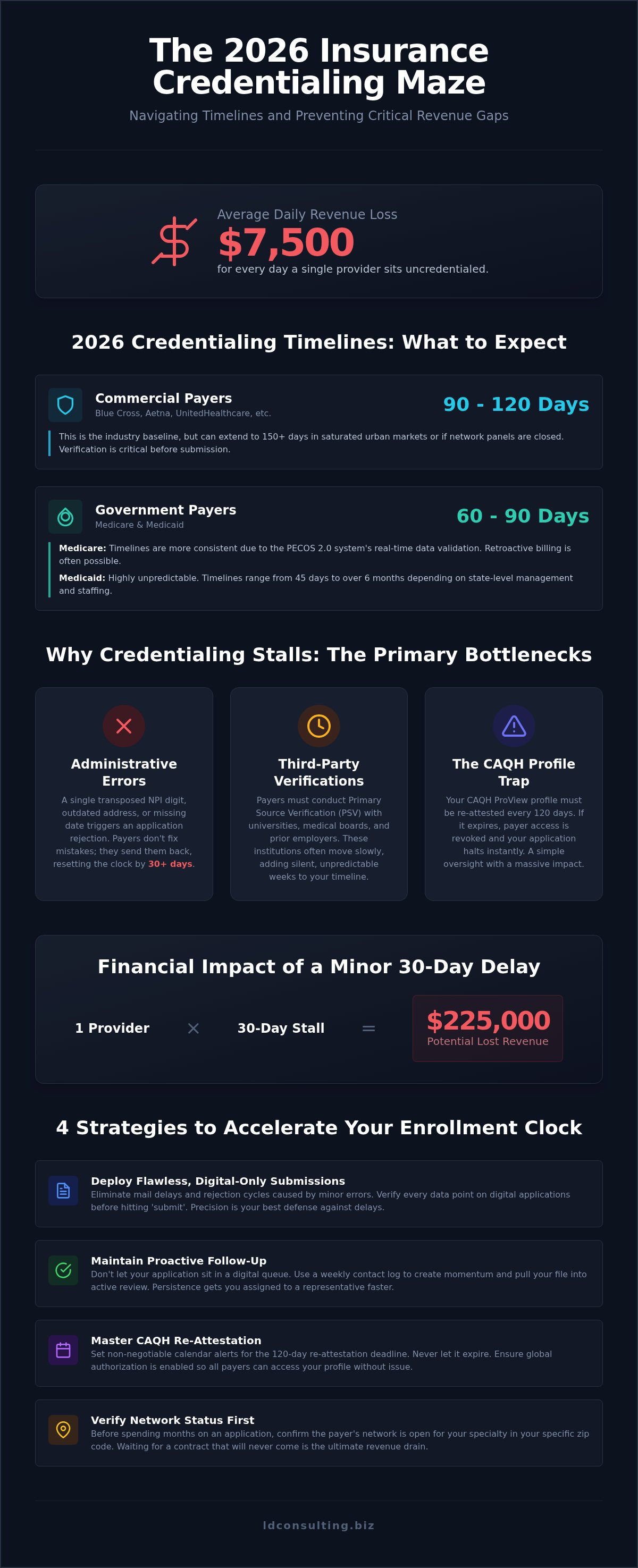
The standard answer for how long does insurance credentialing take is 90 to 120 days. That is the industry baseline. In 2026, this window is under significant pressure. Payer consolidation has merged administrative departments, while provider volume has reached record highs. The result is a persistent backlog. You cannot assume the process will be "standard" for your practice without aggressive management. We move fast. You should too.
The Credentialing process officially begins only when a payer accepts a "clean application." This distinction is critical. If you submit a packet with a single missing date or an expired license, the payer may not notify you for weeks. When they finally do, the 120-day clock resets to zero. Effective enrollment requires getting it right the first time. There is no room for administrative learning curves when your revenue is on the line.
Commercial Payer Timelines
Major commercial payers like Blue Cross Blue Shield, Aetna, and UnitedHealthcare typically operate within the 90 to 120-day range. However, regional variations are common. A national payer may process an application in 60 days in a rural market but take 150 days in a saturated urban center. Network adequacy also plays a role. If a payer determines their network is already sufficient for your specialty in your zip code, they may deprioritize your file or close the panel entirely. You need to know the status of the network before you spend months waiting for a contract that won't come. Don't wait. Verify first.
Government Payer Timelines (Medicare/Medicaid)
Medicare and Medicaid are often faster but far more rigid. With the full migration to PECOS 2.0 in 2026, Medicare timelines generally fall between 60 and 90 days. The new system uses real-time data validation against IRS and NPPES records. If your data doesn't match exactly, the system flags it immediately. When calculating how long does insurance credentialing take for government programs, you must account for state-specific secondary verification steps. Medicaid remains the most unpredictable variable. Because Medicaid is managed at the state level, timelines fluctuate from 45 days to over six months depending on local staffing.
Understanding the difference between your Approval Date and your Effective Date is vital for your cash flow. Medicare often allows for retroactive billing back to the date the application was received. Commercial payers usually don't. If you see patients before the official approval date for a commercial plan, you're likely providing free care. We don't let that happen. We focus on securing the earliest possible effective date to protect your revenue cycle from day one.
Why Credentialing Stalls: The Three Primary Bottlenecks
Credentialing is not a passive waiting game. It is an active management challenge. When providers ask how long does insurance credentialing take, they often ignore the internal friction that adds months to the clock. Stalls aren't bad luck. They're the result of specific, manageable failures. You can't control payer speed, but you can control the quality of your submission. Precision is your only defense against the administrative black hole.
Administrative errors are the most common cause of unnecessary delays. A typo is a 30-day setback. Payers don't fix your mistakes; they reject them. A transposed NPI digit or an outdated office suite number triggers an immediate "Return to Provider" status. Most payers don't notify you of these errors via phone. They send a letter through the mail. By the time you receive it, three weeks have passed. You're back at the starting line. We don't accept that. We verify every data point before it leaves the desk.
The payer queue is another significant hurdle. Applications often sit for weeks without an assigned representative. Without a named contact, your file gathers dust in a digital stack. This is where momentum dies. You need a dedicated follow-up schedule to pull your application out of the pile and into active review. Stalls here are silent but deadly for your revenue cycle.
The CAQH Profile Trap
The CAQH ProView profile is the foundation of commercial enrollment. An incomplete profile is the fastest way to a rejection. Providers must re-attest their profile every 120 days to keep it active. In 2026, many payers use automated systems that check this status daily. If your attestation expires, the payer's access is revoked. The process halts instantly. You must also verify that global authorization is enabled. If a specific payer isn't authorized to view your data, your application won't even reach a reviewer's desk. It's a simple step that many practices miss.
Verification Delays Beyond Your Control
Primary Source Verification (PSV) requires payers to confirm your credentials directly with the source. Universities, medical boards, and previous employers move at their own pace. They often ignore standard requests. This adds weeks to the how long does insurance credentialing take equation. We recommend proactively gathering peer reference letters and verifying the current contact information for your previous department heads. Don't let a slow registrar at a distant university stall your billing. Administrative overwhelm is the enemy of profit. Outsourcing these tasks to a specialist ensures your provider enrollment stays on track while you focus on patient care.
Calculating the Cost of Credentialing Delays
Credentialing is a financial gatekeeper. Every day a provider sits on the sidelines, your practice bleeds cash. When asking how long does insurance credentialing take, most administrators focus on the calendar. They should focus on the ledger. Industry data indicates the average cost of credentialing delays is $7,500 per provider, per day in lost revenue. For a standard 120-day cycle, that is nearly $900,000 at risk. This isn't just an administrative hurdle. It's a revenue crisis.
Revenue loss isn't the only factor. Patient leakage creates long-term damage. When you turn away an out-of-network patient, they don't wait for your approval letter. They find another provider. You've lost the immediate billing and the lifetime value of that patient relationship. Additionally, seeing patients while "pending" is a high-stakes gamble. If the application is denied or the effective date is set later than expected, those claims are dead on arrival. You've provided free care and incurred the overhead to do it.
Staff overhead adds another layer of waste. You're likely paying a salary and benefits to a provider who cannot generate a single dollar of billable revenue. This creates a "double-dip" loss: you're spending money on compensation while losing the income that compensation is supposed to produce. We stop the bleed. We focus on the earliest possible approval to turn your providers into profit centers.
The ROI of Speed
Speed pays for itself. Shaving just 30 days off the credentialing clock can recover over $225,000 in potential billing. Compare that to the cost of a vacant exam room or a stalled hire. Professional healthcare credentialing isn't an expense. It's a revenue recovery strategy. Revenue Cycle Management (RCM) starts the moment you decide to hire, not when you send the first bill. If the front end is slow, the back end is empty.
The Hidden Cost of In-House Efforts
In-house efforts are rarely "free." Your staff likely spends 20 hours per week on payer follow-ups and form corrections. That is time taken away from patient scheduling, billing, and practice management. Learning complex payer forms on the fly leads to errors. Errors lead to resets. Resets lead to another 30 days of $7,500 daily losses. Fixed-price, per-engagement services provide budget predictability. You know the cost upfront. You know the goal. We deliver the result without the administrative drag.
5 Strategies to Accelerate Your Enrollment Clock
Waiting is not a strategy. When you ask how long does insurance credentialing take, you're asking for a benchmark. But benchmarks are for passive observers. If you want to beat the industry average, you must control the variables. Speed is a byproduct of precision and persistence. We don't wait for payers to find our files. We force them to look.
Start by eliminating paper. Submit 100% complete digital packets through payer portals. Paper mail adds 10 to 14 days of transit and manual data entry time. Digital submissions are instantaneous. They also provide a digital trail that payers cannot easily deny. Next, manage your NPI and state licenses with zero margin for error. An expired license in the NPPES database will trigger an automatic rejection in most payer systems before a human even sees your application.
Outsourcing to a specialist is the most effective way to bypass the learning curve. In-house staff often learn by making mistakes on your time and your dime. A specialist has already navigated the specific friction points of each major payer. They know which portals are glitchy and which representatives actually answer the phone. This expertise shaves weeks off the process. It turns a 150-day nightmare into a 90-day success.
Aggressive Follow-Up Protocols
Implement the 15-Day Rule. Make your first inquiry exactly 15 days after submission. Don't call the general provider line. Identify the specific Credentialing Coordinator assigned to your group or region. Document every interaction in a Payer Contact Log. Record the date, the representative's name, and the specific status of your file. This level of documentation holds payers accountable and prevents your application from sitting in a queue without an owner.
Document Readiness Checklist
Payers look for reasons to say no. Don't give them one. Gather your malpractice Certificates of Insurance (COI), diplomas, and board certifications months in advance. Your CV must be standardized to match CAQH requirements exactly. Ensure your work history has no gaps larger than 30 days. If a gap exists, write a brief, professional explanation and include it in the packet. Gaps are red flags that trigger manual reviews. Manual reviews add weeks to the timeline.
Ready to stop the revenue drain? Our healthcare credentialing services are designed to eliminate the administrative drag that stalls your practice growth. We move fast because your revenue depends on it.
Professional Enrollment: Eliminating the Credentialing Black Hole
In-house administrative staff are often spread thin. They manage scheduling, patient issues, and general office duties. Credentialing becomes a side task. This is how applications fall into the black hole. When you ask how long does insurance credentialing take, the answer depends heavily on who is driving the process. Generalists make mistakes. Specialists deliver results. We focus exclusively on enrollment. We don't get distracted by the daily operations of your front desk.
Accountability is built into our model. We use per-engagement pricing. This means our success is tied directly to your approval. Hourly employees get paid regardless of how long an application sits. We don't. We move fast because our business model demands it. This creates a results-based partnership that protects your practice revenue. You get transparency, predictable costs, and a clear path to billing.
Streamlining the bridge to medical billing is our priority. Credentialing is not an isolated event. It is the foundation of your revenue cycle. If the enrollment data doesn't match your billing setup, claims will fail. We ensure the transition from "pending" to "in-network" is seamless. You focus on your patients. We handle the payers. Precision at the start prevents denials at the finish.
The LD Consulting Advantage
We don't just submit forms. We manage relationships. Our team maintains direct lines of communication with payers to bypass standard queues. This access is a product of years spent navigating the credentialing landscape. We also provide comprehensive practice assessments to find hidden inefficiencies in your current workflow. Often, the bottleneck isn't just the payer. It's a fragmented internal process. We identify those gaps and close them immediately.
- Proven processes for getting providers in-network quickly.
- Direct communication with payers to bypass standard queues.
- Comprehensive practice assessments to find hidden inefficiencies.
Next Steps for Your Practice
Don't wait for the backlog to grow. Payer consolidation and new regulations like PECOS 2.0 are making the process more rigid. Every day of delay is a day of lost billing. Transitioning from "pending" to "in-network" requires a proactive approach. Start the process today to secure your revenue for the coming quarter. The question of how long does insurance credentialing take shouldn't be a source of anxiety. It should be a managed timeline. Get Started with LD Consulting Enrollment Services to eliminate the administrative drag and maximize your practice revenue.
Secure Your 2026 Revenue Cycle
Credentialing is not a waiting game. It is a managed administrative process where every error costs thousands in lost daily revenue. You now have the definitive 2026 timeline and the strategies to navigate it. Success requires more than just submitting forms. It demands perfect CAQH profiles, proactive license management, and an aggressive follow-up protocol that holds payers accountable. Knowing how long does insurance credentialing take is only the first step. The next is taking control of the clock.
LD Consulting provides expert healthcare consulting focused on results. We offer an accurate, timely, and compliant service designed to bypass the standard payer queues. Our fast turnaround for provider enrollment ensures your practitioners start billing sooner, not later. Stop the revenue drain and eliminate the administrative black hole today. Streamline Your Provider Enrollment with LD Consulting. Your practice deserves a predictable start date and a maximized bottom line. We move fast. Let's get to work.
Frequently Asked Questions
How long does it take to get credentialed with insurance?
Expect 90 to 120 days for most commercial payers. Medicare typically processes applications in 60 to 90 days through the PECOS 2.0 system. These benchmarks assume a clean application with zero errors. When calculating how long does insurance credentialing take, you must account for the initial 15 to 30 days spent gathering documents and verifying CAQH data before submission.
Can I bill for services while my credentialing is pending?
You cannot bill commercial payers for services rendered while your application is pending. Claims submitted before your official effective date will be denied as out-of-network or unauthorized. Medicare is the exception. It often allows for retroactive billing back to the date your application was received. Never assume a commercial payer will backdate your contract.
Why does insurance credentialing take so long?
Primary Source Verification is the primary cause of delay. Payers must manually contact your medical school, residency programs, and previous employers to verify every credential. This process relies on third-party responsiveness. High application volumes and seasonal backlogs at the payer level further extend these timelines. One missing signature can reset the entire cycle.
What is the difference between credentialing and provider enrollment?
Credentialing is the vetting process where a payer verifies your qualifications and background. Provider enrollment is the subsequent process of contracting with that payer and obtaining a provider ID. You must be credentialed before you can be enrolled. Both steps are mandatory before you can submit claims and receive payment as an in-network provider.
How often do I need to re-credential with insurance companies?
Most payers require re-credentialing every three years to maintain NCQA compliance. This cycle is mandatory. If you miss the deadline, the payer will terminate your contract and halt your payments immediately. Keeping your CAQH profile active with 120-day re-attestations is the most effective way to ensure a smooth re-credentialing process.
What happens if my credentialing application is denied?
You must identify the specific cause of denial, which is usually related to missing data or network adequacy. If the denial is due to an error, you can correct the information and resubmit. If it is due to a closed panel, you may need to file a formal appeal based on patient need. A denial stops your revenue cycle with that payer instantly.
How can I speed up the CAQH credentialing process?
Upload all required documents digitally to bypass manual data entry queues. Re-attest your profile every 120 days to keep the file active for all payers. Granting global access is critical. If a payer cannot see your data because you haven't authorized them, your application will sit in a "missing information" status for weeks.
Is it better to outsource credentialing or do it in-house?
Outsourcing is more efficient for practices that prioritize revenue and speed. In-house staff often lack the specialized payer contacts and technical knowledge required to navigate complex backlogs. Specialists eliminate the learning curve and reduce the question of how long does insurance credentialing take by preventing the administrative errors that cause 30-day resets. We focus on the paperwork while you focus on the patients.


