

A primary care physician can lose an average of $30,000 in revenue while waiting for a typical 3-6 month credentialing window to close. That isn't just an administrative delay; it's a direct hit to your bottom line. When you're weighing the choice between a credentialing consultant vs in-house staff, you aren't just hiring a person. You're choosing a financial strategy. Most practices treat enrollment as a back-office chore. They're wrong. It's the engine of your revenue cycle. If that engine stalls because a staff member leaves or a form is outdated, the money stops.
You likely feel the mounting pressure of rising overhead and the fragility of your current process. It's a common frustration. This article breaks down the real ROI of outsourcing your enrollment versus the hidden liabilities of a full-time salary. You'll learn how to achieve faster "time to revenue" for new providers and significantly reduce the burden on your clinical team. We're analyzing the math on scalability, first-pass approval rates, and the 2026 NCQA standards that make in-house compliance more complex and costly than ever before.
Key Takeaways
- Stop treating enrollment as a side task for administrative staff.
- Evaluate the true ROI of a credentialing consultant vs in-house hiring by accounting for hidden software and benefit costs.
- Prioritize speed to revenue with specialized workflows designed to eliminate onboarding delays.
- Transition to a per-engagement model to remove fixed salary liabilities from your bottom line.
- Use a growth-based decision matrix to determine exactly when to shift from in-house staff to professional outsourcing.
The Credentialing Bottleneck: In-House Staff vs. Specialist Consultants
Practices often default to hiring in-house because it feels safer. They want someone they can see across the hallway. But "control" is a poor substitute for cash flow. When you look at the choice between a credentialing consultant vs in-house staff, you're looking at the difference between a dedicated revenue engine and an administrative bottleneck. Most practices fall into the trap of viewing what is credentialing as a clerical box to check. It isn't. It's a high-stakes negotiation with payers who have every incentive to delay your payments.
The Myth of the Part-Time Internal Resource
Giving enrollment tasks to an office manager or front-desk receptionist is a recipe for financial disaster. These roles are already stretched thin. Credentialing requires relentless, daily follow-up. It doesn't happen in the spare five minutes between patient check-ins. One missing signature or an outdated CAQH profile can stall a 90-day window, effectively pushing your revenue out by half a year. By 2026, NCQA standards have tightened. Primary source verification must now be completed within a narrower 90 to 120 day window for accredited organizations. A part-time internal resource simply cannot keep up with these shifting goalposts without dropping a ball elsewhere.
Consultants as Specialized Revenue Accelerators
A consultant doesn't just fill out forms. They bring a plug-and-play infrastructure that your practice likely lacks. While an in-house generalist might spend hours on hold with a generic provider line, a specialist consultant often has direct lines to payer representatives. This isn't just about knowing the process. It's about knowing the people who move the files. This specialized focus eliminates the learning curve that kills momentum in internal teams.
The choice between a credentialing consultant vs in-house hire comes down to speed. Consider these advantages of a specialized model:
- Performance alignment: Per-engagement fees mean the consultant only wins when you're enrolled.
- Instant scalability: Adding five new providers this month? A consultant scales immediately. Your in-house team just burns out.
- Reduced error rates: Professional services often achieve 95% first-pass approval rates. Internal teams often hover around 60% to 75%.
In-house staff are a fixed liability. Consultants are a performance-driven asset. If you want to maximize revenue and minimize the time a provider spends seeing patients for free, the specialist approach is the only logical path. Don't let administrative comfort cost you tens of thousands in lost billing.
The Hidden Math: What In-House Credentialing Actually Costs
Salary is the starting point, not the total investment. Most practice managers look at the average $48,750 salary for a specialist and assume that's the price tag. They're wrong. When you calculate the true cost of a credentialing consultant vs in-house employee, you must account for the "fully loaded" expense. Between payroll taxes, health benefits, and 401k contributions, that $48k hire actually costs your practice between $75,000 and $100,000 annually. You're paying for the seat, not just the results.
The True Cost of a Credentialing Specialist Hire
The overhead doesn't stop at payroll. In-house teams require infrastructure. Credentialing software implementation can cost up to $30,000 upfront, with annual maintenance fees ranging from $5,000 to $15,000. These are fixed costs you pay regardless of how many providers you actually enroll. Then there's the "turnover tax." With 73% of healthcare leaders citing a shortage of skilled candidates, finding a replacement when your specialist leaves is expensive and slow.
When an employee quits every 18 to 24 months, they take more than their personal belongings. They take institutional knowledge. They take the direct payer contacts, the pending application status notes, and the login credentials for dozens of portals. Your revenue cycle doesn't just slow down; it stops. You spend months re-hiring and re-training while your new providers sit idle, unable to bill. It's a cycle of financial fragility that a professional practice assessment can help you break.
Risk Mitigation: Data Security and Compliance
Managing the credentialing process internally introduces significant liability. In-house staff often rely on spreadsheets or legacy systems that lack redundant backups. If a single hard drive fails or a file is misplaced, you face more than just a delay. You face compliance lapses. 2026 NCQA standards now require monthly monitoring of provider licenses and Medicare exclusions. Missing a single check can lead to massive payer clawbacks and federal fines.
Specialized consultants operate on HIPAA-compliant, enterprise-grade systems designed for high-volume data security. They provide a level of redundancy that a single in-house hire cannot match. By choosing a credentialing consultant vs in-house staff, you're shifting the burden of compliance and data security to experts whose entire business model depends on accuracy. You gain professional assurance without the administrative baggage of a full-time department.
Speed to Revenue: Why Consultants Outperform Internal Teams
Time to reimbursement is the only metric that matters. If your provider is seeing patients but you cannot bill for them, you're running a charity, not a business. When comparing a credentialing consultant vs in-house team, the consultant wins on velocity every time. Their workflows are stripped of administrative fluff. They don't get distracted by patient phone calls or office politics. They focus on the "full loop" of payer enrollment and credentialing to ensure that once a provider starts, the money follows immediately.
Calculating the Cost of a 30-Day Delay
For a primary care physician, a 3 to 6 month credentialing window results in an average revenue loss of $30,000. While an in-house process might seem "free" because you're already paying the salary, it actually costs you tens of thousands in lost collections when timelines slip by just a few weeks. Inefficient processes can cost healthcare organizations an average of $10,122 per day of delay in provider onboarding. This creates a snowball effect. Slow enrollment kills practice cash flow, delays new equipment purchases, and prevents you from hiring additional support staff. You aren't just losing money today; you're stalling your growth for next year.
Payer Relationship Management
Consultants navigate the "black hole" of payer portals with a precision that internal staff cannot replicate. They understand the nuances of the credentialing process and how to submit "clean" applications that move through the system on the first pass. Professional services achieve a 95% first-time approval rate. In contrast, in-house teams often struggle with a 60% to 75% rate. Every rejection adds another 30 to 60 days to the clock.
By leveraging established networks, consultants bypass common enrollment hurdles that would leave an office manager on hold for hours. They know which payers require digital attestations and which still demand paper. This proactive follow-up reduces "days in credentialing" by 30 to 45 days. In the debate of credentialing consultant vs in-house efficiency, the consultant's ability to accelerate the revenue cycle makes the service pay for itself before the first claim is even paid.
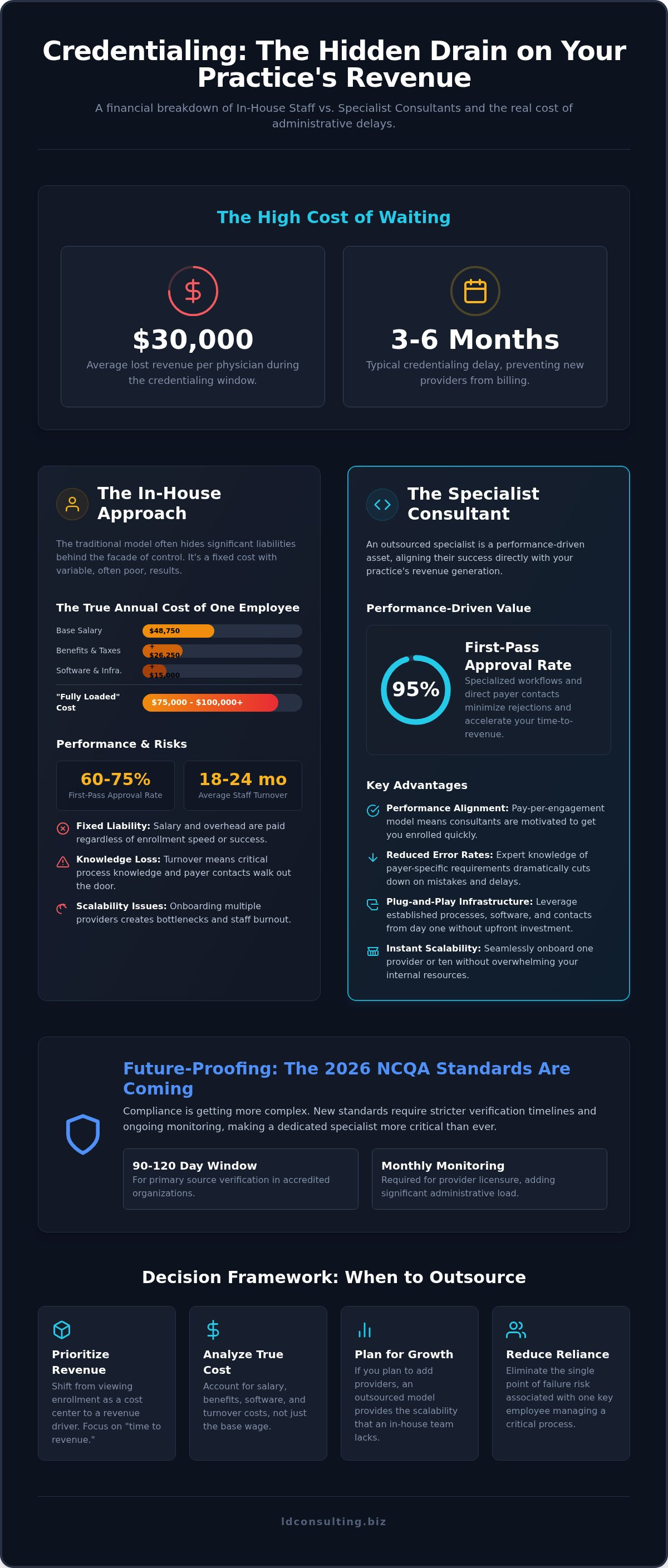
Decision Matrix: When to Hire vs. When to Outsource
Choosing the right path depends on your growth trajectory. If you add one provider every few years, your needs differ from a multi-specialty group scaling monthly. Regardless of size, the choice between a credentialing consultant vs in-house department is a choice between fixed overhead and performance-based results. You must evaluate your budget structure and technical complexity before committing to a permanent hire.
When In-House Might Seem Logical (And Why It Often Isn’t)
Large health systems with 500 or more providers are typically the only organizations where a full-time, in-house team makes financial sense. For everyone else, the desire for "control" is a trap. You might think having a staff member down the hall ensures accountability. It doesn't. Internal accountability is soft. If an employee misses a payer deadline, you still pay their salary and benefits. You bear the cost of their mistakes.
Consultants operate under strict Service Level Agreements (SLAs). They don't get paid for effort; they get paid for completed enrollments. This creates a superior reporting structure. You receive clear, data-driven updates on application status without micromanaging daily tasks. Outsourcing provides better transparency because the consultant's revenue is directly tied to your practice's success. Hire for results, not attendance.
The Case for the Per-Engagement Model
The per-engagement model offers the ultimate flexibility for growing practices. You pay only for the work that needs to be done. This transforms a fixed salary liability into a variable expense that scales with your revenue. If you suddenly add ten new providers, you don't need to post job listings or conduct interviews. You simply scale your engagement. It's a plug-and-play solution for growth.
Technical complexity is another deciding factor. Enrolling with Medicare or Medicaid requires precise adherence to federal guidelines and constant monitoring of exclusion databases. When weighing a credentialing consultant vs in-house specialist, consider that consultants manage these high-stakes requirements as a standard part of their workflow. This allows your clinical staff to focus on patient care rather than wrestling with CAQH profiles. Ready to see where your revenue is leaking? Start with a comprehensive practice assessment to identify the friction points in your current enrollment process.
LD Consulting: Streamlined Credentialing Without the Overhead
LD Consulting eliminates the friction between provider hire and first payment. We don't over-explain. We don't hedge. We provide a clean, linear path to revenue for practices tired of administrative stagnation. When you compare a credentialing consultant vs in-house hire, the difference is measurable performance. We move fast so you get paid. Our commitment to your revenue cycle is absolute. We ensure every application is accurate, compliant, and submitted with precision.
The LD Consulting Per-Engagement Advantage
Our model is built on pay-for-performance. You pay for the enrollment you need, not the annual overhead of a full-time employee. This removes the fixed salary liability from your ledger and replaces it with a scalable, variable cost. We handle enrollment across all US networks. This national expertise allows us to navigate payer-specific requirements that often baffle local staff. You gain a seasoned specialist without the recruitment headache.
Transparent reporting is a standard, not an upgrade. You'll know exactly where every application stands in the process. We eliminate the "black hole" of payer portals by providing clear, data-driven updates. This level of visibility ensures your practice is always positioned for immediate growth. We handle the volume. You handle the patients. It's a streamlined division of labor that maximizes your bottom line.
Ready to Stop Losing Revenue?
Credentialing is only one piece of the revenue puzzle. We look deeper. Our practice assessment service identifies existing revenue leaks and compliance gaps before the first application is even filed. We find the money you've already earned but haven't collected. This proactive approach ensures your practice is optimized for maximum reimbursement from day one.
Don't let administrative bottlenecks stall your expansion. The choice of a credentialing consultant vs in-house staff shouldn't be based on tradition. It should be based on ROI. We provide the infrastructure you need to scale without the administrative fluff. We're ready to move when you are. Contact LD Consulting for a streamlined credentialing solution and start accelerating your time to revenue today.
Choose Performance Over Fixed Overhead
The decision between a credentialing consultant vs in-house hiring isn't about office culture; it's about your bottom line. An in-house specialist carries a fully loaded cost of up to $100,000 and leaves your revenue cycle vulnerable to staff turnover. A consultant removes that liability. You pay for results, not attendance. You gain national payer network expertise and accurate, compliant credentialing services without the administrative burden of a full-time department.
Speed to revenue is the only metric that matters for a growing practice. Every day a provider sits idle is a day of lost collections. We move fast so you get paid. Our per-engagement model ensures our goals are perfectly aligned with your performance. Stop treating enrollment as a clerical task. Treat it as the revenue engine it is. Maximize your practice revenue with LD Consulting today. Your practice is ready to grow. We're ready to help you scale.
Frequently Asked Questions
Is it cheaper to outsource credentialing or hire a full-time employee?
Outsourcing is significantly more cost-effective for the vast majority of practices. You eliminate the fixed overhead of a $75,000 to $100,000 fully loaded salary. You also avoid recurring expenses for software licenses, office space, and specialized training. With a consultant, you pay only for the work performed. It transforms a permanent liability into a variable, performance-based asset.
How long does the credentialing process take with a consultant vs. in-house?
Specialized consultants typically reduce the enrollment timeline by 30 to 45 days. This speed stems from established payer relationships and stripped-down workflows. While internal teams often struggle with a 60% first-pass approval rate, professional services frequently exceed 95%. Faster approvals mean your providers start billing weeks earlier. Velocity is the primary advantage of a specialist.
What are the risks of having an office manager handle credentialing?
The biggest risk is revenue leakage due to divided focus. Credentialing is not a side task; it requires daily follow-up and precision. Office managers are often overwhelmed by clinical operations, leading to missed deadlines or expired attestations. One missing document can stall a 90-day window. This results in thousands of dollars in lost billable revenue that you can never recover.
Can a credentialing consultant help with Medicare and Medicaid enrollment?
Consultants specialize in the high-stakes requirements of federal and state programs. They manage complex PECOS submissions and ensure compliance with 2026 federal monitoring standards. When comparing a credentialing consultant vs in-house generalist, the consultant’s familiarity with exclusion databases provides a critical layer of protection. They ensure your enrollment is accurate and compliant from the first submission.
Does outsourcing credentialing mean I lose control over provider data?
Outsourcing actually improves data transparency through structured, enterprise-grade reporting. You retain full ownership of your data while gaining professional assurance that your provider profiles are accurate. Consultants use HIPAA-compliant systems that offer better security and redundancy than a local office spreadsheet. You get better oversight and regular status updates without the burden of manual data entry.
What happens to my credentialing if my in-house specialist quits?
Your revenue cycle stops immediately. You lose institutional knowledge; direct payer contacts; and pending application status notes. Replacing a skilled specialist in the current labor market is slow and expensive. Outsourcing eliminates this fragility. A consultant provides a permanent, scalable infrastructure that doesn't disappear when a single staff member leaves. It ensures business continuity.
How do per-engagement credentialing fees work compared to a salary?
Per-engagement fees are a pay-for-performance model. You pay for the specific enrollment or re-credentialing task completed. This is the opposite of a salary, which you must pay regardless of provider volume or productivity. Engagement fees scale with your practice growth. If you aren't adding providers, you aren't paying for a specialist to sit idle. It is the ultimate financial flexibility.
Can a practice assessment help determine if I should outsource?
A practice assessment is the most effective way to identify hidden friction points in your current workflow. It reveals where revenue is leaking due to onboarding delays or compliance gaps. This data-driven approach helps you decide between a credentialing consultant vs in-house hire by quantifying the potential ROI. It gives you the facts needed to make a results-driven decision for your practice expansion.


